
In 1924, a university professor in Tokyo wanted an Akita dog.
Not for protection.
Not for prestige.
Simply because he loved dogs and wanted companionship.
The professor’s name was Hidesaburō Ueno. He taught at the Tokyo Imperial University and was known as a calm, methodical, deeply dedicated academic. In November 1923, a litter of Akita puppies was born in the city of Ōdate, in Japan’s Akita Prefecture. A few months later, one of those puppies was shipped by train to Tokyo to join his new owner.
That puppy would become known as Hachikō.
This wasn’t a movie-style instant bond. The puppy was fragile and struggled with health issues early on. Historical accounts suggest Professor Ueno carefully nursed him during those first months, concerned he might not survive. He named him “Hachi,” a name associated with the number eight — considered lucky in Japanese culture.
Hachikō grew up in a quiet residential neighborhood. Professor Ueno was a widower, living with household staff. The dog was not chained in a yard. He wasn’t simply “kept.” He was a companion.
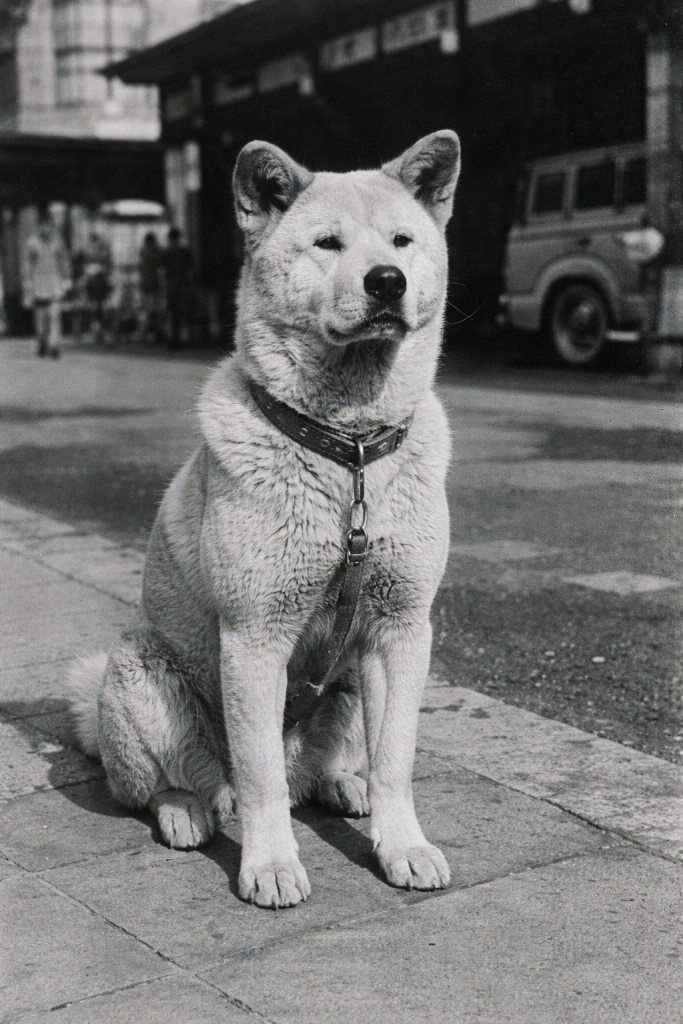
Their Routine
Every morning, Professor Ueno left for work. His home required a train commute, departing from Shibuya Station.
As Hachikō grew, he began accompanying the professor to the station.
Not because he was trained to.
Because he wanted to.
Picture Tokyo in the 1920s. Not the neon, high-tech metropolis of today, but a city rebuilding after the Great Kantō Earthquake of 1923. Steam trains. Crowded platforms. A mix of traditional kimono and Western suits. A country in transition.
Each morning, the professor walked to Shibuya Station with Hachikō at his side. And every afternoon, around the time the train was due to return, the dog would come back to the station to meet him.
It wasn’t a trick.
It was routine.
They repeated this ritual for nearly a year and a half.
The Day the Routine Broke
On May 21, 1925, Professor Ueno left for work like any other day.
While at the university, he suffered a cerebral hemorrhage during a faculty meeting. He died suddenly at age 53. He never returned home.
For his colleagues and family, it was a shocking loss.
For the dog, it was simply absence.
That evening, Hachikō went to the station.
And waited.
The professor never stepped off the train.
The dog went home.
The next day, he returned again.
And the day after that.
Ten Years of Waiting
After the professor’s death, Hachikō did not remain permanently in the same home. He was placed temporarily with relatives of the Ueno family. Accounts suggest he repeatedly escaped and returned to the old neighborhood near Shibuya Station.
Soon, he became a daily presence outside the station — especially around the hour when his owner’s train would once have arrived.
At first, people paid little attention. Just another stray dog.
But in 1932, a former student of Professor Ueno published an article about the dog who continued waiting for his deceased owner. The story appeared in a Japanese newspaper and quickly captured national attention.
Hachikō became known as “the faithful dog.”
Local shopkeepers fed him. Commuters recognized him. Schoolchildren stopped to pet him. In a rapidly modernizing Japan, he became a symbol of unwavering loyalty.
But beneath the symbolism was a simpler reality:
A dog kept returning to the place where his world once made sense.
He did this for nearly ten years.
On March 8, 1935, Hachikō was found dead near Shibuya Station. He was approximately 11 years old. A post-mortem examination revealed he suffered from heartworm disease and other age-related conditions.
He did not die “of heartbreak.”
He died of illness.
But until the end, he continued to return to the station.
What Does It Really Mean?
Hachikō’s story is not a fairy tale about a dog who “didn’t understand death.”
Modern research into canine attachment shows that the bond between a dog and a human activates neurological mechanisms similar to those in parent-child relationships. The human becomes the primary attachment figure — a source of safety, structure, and orientation.
When that figure disappears, the attachment system does not simply switch off.
Dogs may not understand the abstract concept of death in the human sense. But they understand routine. They understand anticipation. They understand the absence of someone who used to be there.
Hachikō was not a romantic film character.
He was an animal repeating a ritual that once defined his world.
And his world had been built around one person.
Why This Story Still Moves Us
Perhaps it unsettles us because unconditional loyalty makes us uncomfortable.
We know how easily we drift away from one another.
How quickly we change routines, priorities, allegiances.
A dog does not renegotiate attachment.
Does not reassess it.
Does not suspend it.
Hachikō never knew he became a national symbol. He never knew that in 1934, a bronze statue was erected in his honor outside Shibuya Station. He never knew that when he died, people gathered to mourn him.
He only knew the routine.
And the absence.
Maybe the most haunting part isn’t that he waited ten years.
It’s that, for him, waiting was not an act of heroism.
It was simply the continuation of a bond that did not know how to end.
That tells us something about dogs.
But it also tells us something about ourselves.
Because beyond the history and the statue, one quiet question remains:
How often do we truly deserve the loyalty we are given?