
When you first hear it, it sounds like one of those emotional internet headlines.
“Elephants cry.”
It feels dramatic. Almost manipulative.
And yet, the truth is more nuanced — and perhaps more powerful — than the myth.
Elephants do have tear ducts. Their eyes can produce visible moisture. Like ours, their tears can serve biological purposes: lubrication, protection from dust, irritation.
That part is simple biology.
But what has drawn real scientific attention isn’t just the presence of tears.
It’s the behavior.
In the wild, when an elephant dies, the rest of the herd doesn’t simply move on. They slow down. They gather. They touch the body with their trunks. Sometimes they remain for hours. Sometimes they return to the same place days later.
There are documented observations of mothers standing beside their deceased calves, attempting to lift them. There are cases in which elephants investigate bones—especially skulls and tusks—gently exploring them with deliberate attention.
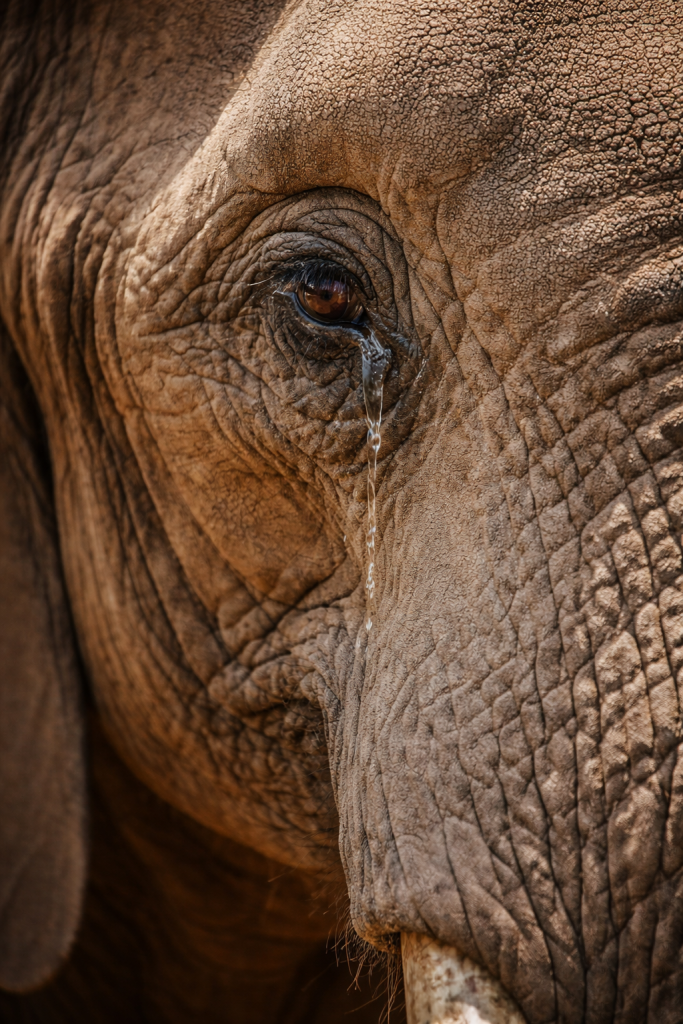
We don’t fully understand what elephants comprehend about death.
But we do know this: they react to it.
The elephant brain is one of the largest and most complex among land animals. The regions associated with memory and emotional processing are highly developed. Elephants remember individuals years after separation. They recognize voices. They maintain long-term social bonds.
And perhaps most importantly — they form relationships.
Real, structured, long-lasting relationships.
When elephants are forcibly separated from their herd or from their calves, behavioral changes are measurable. They vocalize differently. They show signs of agitation. In captivity, caretakers have described instances where elephants appeared to have excessive tearing during periods of extreme stress or loss.
Science remains careful. There is no definitive evidence that elephants shed emotional tears in the same way humans do.
But we can say this with confidence:
Elephants experience attachment.
Elephants show behaviors consistent with grief.
Elephants respond to loss.
Maybe the question isn’t whether the moisture in their eyes is emotional.
Maybe the deeper question is why we feel the need for visible tears before we accept that an animal can suffer.
Because when an elephant stands quietly beside a fallen member of its herd, touching the body slowly, repeatedly, something profound is happening — regardless of whether tears are visible.
What moves us isn’t the tear itself.
It’s the bond.
And perhaps that’s what unsettles us the most — the realization that loyalty, attachment, and mourning are not exclusively human.
Elephants don’t write elegies.
They don’t build monuments.
They don’t name their emotions.
But they stay.
And sometimes, staying says more than tears ever could.