
It was an ordinary morning when I realized that eggs had quietly become a supporting character in my life. Not the hero. Not the miracle cure. Not the internet’s latest “superfood.” Just something small, simple, always within reach.
Something you eat without thinking about it… until you start hearing only two extremes:
“Eggs are the best thing you can eat every day.”
or
“Eggs will wreck your cholesterol and your heart.”
And as it usually goes, when there are two loud extremes, the truth tends to live somewhere in the middle. But the middle rarely goes viral.
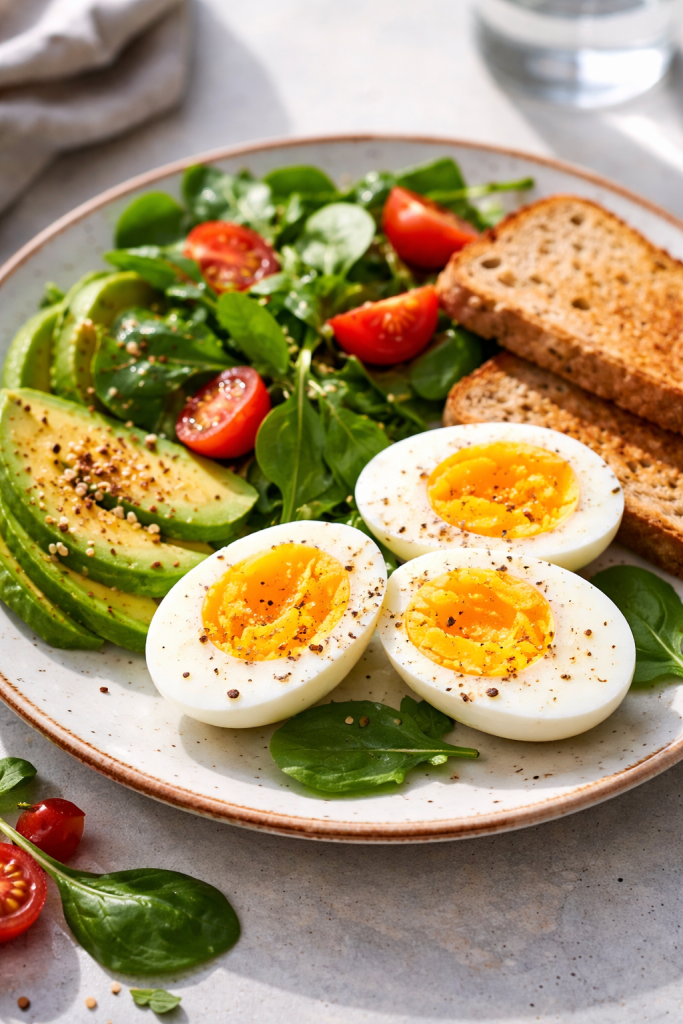
So I asked the question the way people do when they’re just trying to simplify life a little:
If I eat one egg a day, what actually happens in my body?
What’s Actually Inside an Egg?
A medium egg has about 70–80 calories and is considered one of the most complete sources of protein available in the human diet.
It contains:
- Complete protein (all essential amino acids)
- Vitamin B12
- Vitamin D
- Choline
- Selenium
- Lutein and zeaxanthin (antioxidants that support eye health)
- About 180–200 mg of cholesterol in the yolk
It’s not magical. But it is nutrient-dense.
The First Effects: Satiety and Stability
If an egg replaces something ultra-processed or heavy in refined carbs (a pastry, sugary cereal, a bagel on the run), the first thing you notice is fullness.
The combination of protein and natural fats slows digestion and helps stabilize blood sugar. The result isn’t dramatic — but it’s noticeable: “I’m not hungry again already.”
An egg isn’t a diet by itself. It’s more like an anchor. What you eat with it matters.
An egg next to vegetables and fiber is different from an egg next to processed meats and white toast.
Protein: Why It’s the “Gold Standard”
Egg protein is often used as the biological standard for comparing other proteins. That means your body can use it efficiently for:
- Maintaining muscle mass
- Cellular repair
- Enzyme and hormone production
For active people, for adults trying to preserve muscle as they age, or for anyone who wants a more substantial breakfast, this matters.
Choline: The Underrated Nutrient
One of the egg’s most meaningful benefits is its choline content.
Choline is essential for:
- Liver function
- Fat metabolism
- Brain development and neurological function
- Memory and cognition
The National Institutes of Health (NIH) lists eggs as one of the most important dietary sources of choline. Many Americans don’t meet optimal intake levels.
It’s not a nutrient you “feel” immediately. But it’s foundational.
Eye Health and Antioxidants
The yolk contains lutein and zeaxanthin, carotenoids linked to retinal protection and reduced risk of age-related macular degeneration.
Interestingly, these compounds are well absorbed from eggs because the natural fat in the yolk helps your body use them effectively.
Cholesterol — The Part That Creates Panic
This is where things get nuanced.
Eggs contain dietary cholesterol. In the 1980s and 1990s, this was seen as almost directly responsible for raising blood cholesterol.
Research has since shown that, for most people, dietary cholesterol has less impact on blood cholesterol than:
- Saturated fat intake
- Body weight
- Physical activity
- Genetics
The Dietary Guidelines for Americans (2020–2025) recommend keeping dietary cholesterol “as low as possible” within a healthy eating pattern, but they no longer set strict numerical limits like they once did.
For most healthy adults, one egg per day does not significantly raise LDL (“bad” cholesterol) and may slightly increase HDL (“good” cholesterol).
The body has a regulatory mechanism: when dietary cholesterol intake increases, the liver often compensates by producing less.
However, some individuals — called “hyper-responders” — are more sensitive to dietary cholesterol. These are often people with existing lipid disorders or familial hypercholesterolemia.
What Do Studies Say?
There are observational studies that have linked dietary cholesterol and egg consumption with cardiovascular risk.
A study published in JAMA (2019) reported an association between dietary cholesterol and cardiovascular events.
A review published in Circulation (2022) discussed potential links between egg intake, cholesterol, and mortality in certain populations.
Important: association does not equal causation.
Results vary depending on:
- Overall diet quality
- Metabolic status (diabetes, obesity)
- Genetics
- Lifestyle habits
An egg in a balanced diet is not equivalent to an egg in a diet high in ultra-processed foods and saturated fats.
Context matters.
Real Risks (Not the Dramatic Ones)
Food Safety – Salmonella
The real risk appears with raw or undercooked eggs (homemade mayonnaise, raw batter, certain desserts).
The FDA recommends cooking eggs until both the white and yolk are firm, or ensuring recipes reach 160°F (71°C).
Properly cooked eggs carry very low risk.
Diabetes or Higher Metabolic Risk
In some subgroups, such as people with type 2 diabetes, research findings are mixed. Some studies suggest different associations.
In these cases, overall diet and medical context matter more than the egg alone.
Very High LDL / Familial Hypercholesterolemia
Individuals with significantly elevated LDL cholesterol may respond differently to dietary cholesterol. A personalized discussion with a healthcare provider is important.
Allergies
Egg allergy is common in childhood. In adults, it’s less common but still possible.
What an Egg Does Not Do
It does not “clog your arteries” overnight.
It does not “damage your liver.”
It is not a miracle food.
It is simply nutrient-dense.
So… Is One Egg a Day Good?
For most healthy adults, yes — one egg per day can absolutely fit into a balanced diet.
Health problems rarely come from a single food. They develop from:
- Chronic excess
- Poor overall diet quality
- Sedentary lifestyle
- Chronic stress
- Genetic predisposition
An egg in a healthy lifestyle is very different from an egg in a diet dominated by ultra-processed foods.
Maybe the Real Question Isn’t About the Egg
The real question isn’t:
“Are eggs good or bad?”
It’s:
What does the rest of your life look like?
How much do you sleep?
How much do you move?
What does your overall diet look like?
How stressed is your body?
One egg a day does not determine your health.
Your daily habits do.
And maybe, instead of fearing a yolk, it’s more useful to look at the bigger picture.