
Is it okay to take your phone into the bathroom?
There’s a question nobody asks at dinner, over coffee, or in meetings, yet it keeps popping up online in surprisingly heated discussions: is it normal to bring your phone into the bathroom?
If the answers were honest, the world would probably split into two categories. Those who say they never do it — and those who are reading this text right now from the toilet. The joke isn’t new, but it reveals something real about modern life. The phone has become such a constant presence that it follows us into almost every moment. Even the most intimate and mundane ones.
Every time this topic comes up, half the comments sound like this: “It’s funny you ask… I’m literally on the toilet right now.”
The other half: “That’s disgusting. I don’t understand how anyone can do that.”
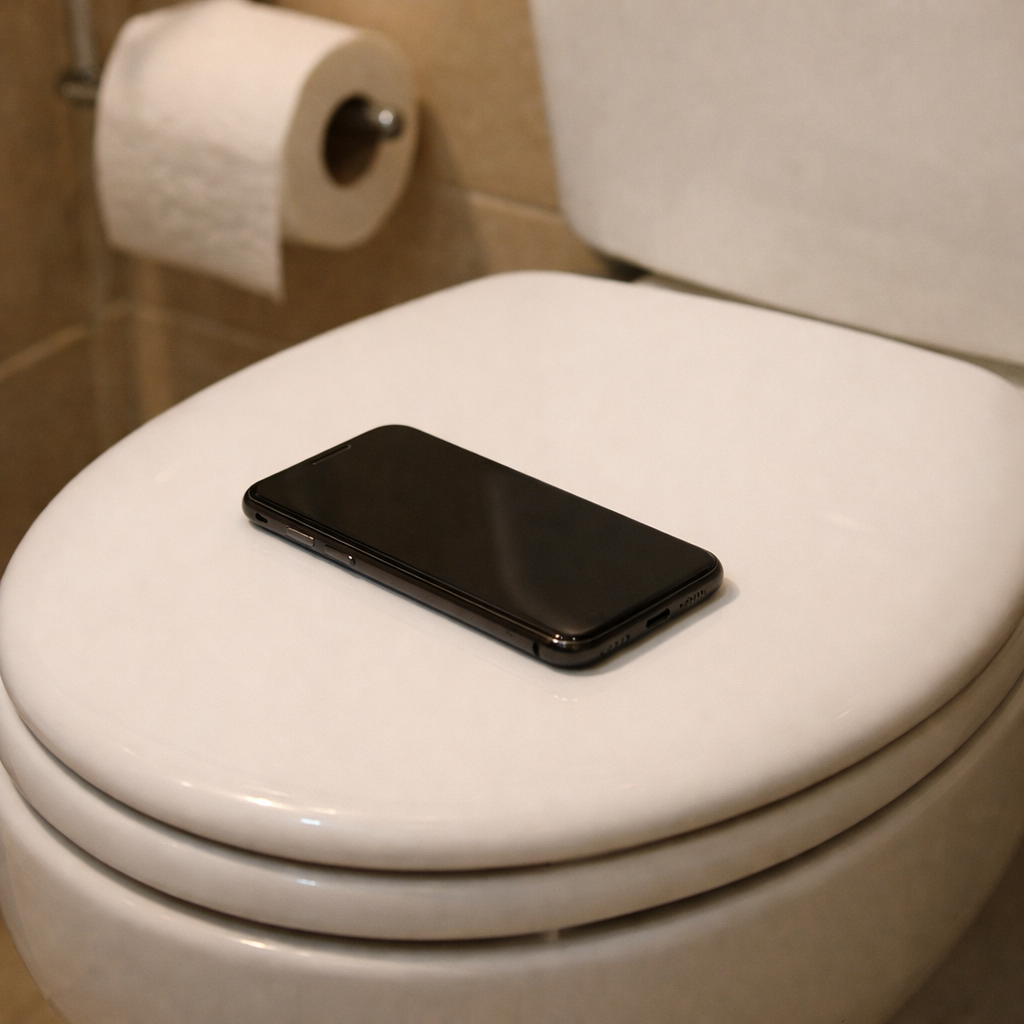
Between these two camps lies a more interesting question than it first appears:
what does it say about us that we can’t go a few minutes without our phones?
Years ago, people brought newspapers or magazines into the bathroom. It was almost a ritual. A pause. A moment to read a couple of pages, to sit in silence. Today, the phone has replaced those magazines and brought something far more powerful: an infinite feed. You don’t have one article anymore — you have hundreds. You don’t have one joke — you have an endless algorithm. And before you realize it, three minutes turn into fifteen.
For some, the phone in the bathroom is simply an extension of daily life. It’s in your pocket, so it goes everywhere. For others, it’s the only place they can sit quietly for a few minutes. The phone becomes a way to keep thoughts at bay.
There’s also the other side. People who find the habit odd or even unpleasant — especially when someone is on a call from a public stall, discussing medical appointments, vacation plans, or personal issues while background sounds no one asked for echo around. For some, it’s not just about hygiene, but privacy. The idea that someone, somewhere, is listening without context feels simply… bizarre.
Another interesting angle is time. Many doctors notice that extended sitting on the toilet — especially when absorbed in your phone — can lead to unnecessary 20–30 minute stays. The phone itself doesn’t directly cause problems like hemorrhoids, but it can prolong the position that contributes to them. The honest question isn’t whether phones are “forbidden,” but whether you’re staying longer than you need to simply because you don’t want to stop scrolling.
In reality, the conversation about phones in the bathroom isn’t about the bathroom. It’s about our relationship with silence. For many people, a few minutes without stimulation have become uncomfortable. Thoughts appear immediately. Mental to-do lists open. Worries demand space. The phone offers a quick way to fill that gap. A small digital refuge. A tiny anesthetic.
If you read people’s comments about this habit, you quickly realize it’s not just about the phone. It’s about the life behind it.
Confessions from… the throne
Andrew, 42:
“It’s the only place where nobody asks me anything. Two young daughters, a wife, a stressful job. The bathroom is quiet. Yeah, scrolling is just the excuse.”
Mara, 29:
“I can’t sit alone with my thoughts. If I don’t take my phone, I start thinking about everything I have to do. My phone calms me down.”
Vlad, 36:
“I once got stuck in the bathroom when the handle broke. Since then, I take my phone everywhere. Just in case.”
Ioana, 33:
“I find it gross. The idea that someone is talking on the phone in the stall next to me and someone in another city can hear everything… no thanks.”
Each justification reveals something different about us. It’s not just boredom. It’s the need for a break. A need for distraction. Avoidance of thoughts. Lack of personal time. Automatic reflex.
What’s actually happening in the body
Going to the bathroom activates the parasympathetic nervous system — the “rest and digest” system. Essentially, the body enters a state of relaxation. It’s one of the few moments in the day when we naturally slow down.
But what do we do?
Open TikTok.
Email.
News.
Tense conversations.
Instead of a micro-moment of reset, we turn it into another stream of digital stimulation.
The brain gets a small dopamine boost. Scrolling is quick reward. The problem isn’t that you do it. The problem is that sometimes you forget how not to do it.
The less glamorous part: hygiene
There’s a not-so-poetic term: toilet plume — the microscopic aerosol that rises when you flush, especially with the lid open. Yes, invisible particles can land on nearby surfaces.
Is this a reason to panic? No.
Is it a reason to be aware? Yes.
Studies show that phones are already among the most contaminated personal objects — often dirtier than a toilet seat. Not because we bring them into the bathroom, but because we constantly touch them and then touch our face, food, and eyes.
If you take your phone to the bathroom and never clean it?
Not a tragedy, but not ideal either.
If you bring it in, set it down before you wipe, wash your hands, and occasionally disinfect it?
Then the issue is more psychological than microbiological.
So… is it okay?
There’s no moral answer.
It’s not a sin.
Not a major medical mistake.
Not proof that you’re “addicted.”
But it can be a small signal.
If you can’t go 3–5 minutes without your phone, maybe it’s not about the bathroom. Maybe it’s about how we relate to silence.
You don’t necessarily need to give up your phone in the bathroom entirely. Sometimes it’s just a natural extension of the day. But every once in a while, it might be worth leaving it on the table. Go in, do what you need to do, and come out. Simple. Quiet. Unaccompanied by an algorithm.
Not because it’s “the right thing to do.”
But because sometimes the body knows how to slow down better than the algorithm does.
And if you’re reading this from the toilet…
I promise I’m not judging.