
You’ve probably experienced this many times: while you’re in the water, you feel relatively comfortable—even if the water isn’t particularly warm. But the moment you step out, you suddenly start shivering and feeling much colder.
Why does this happen?
The answer has to do with how your body regulates its internal temperature and with a few basic physical processes, including heat transfer and the evaporation of water from your skin.
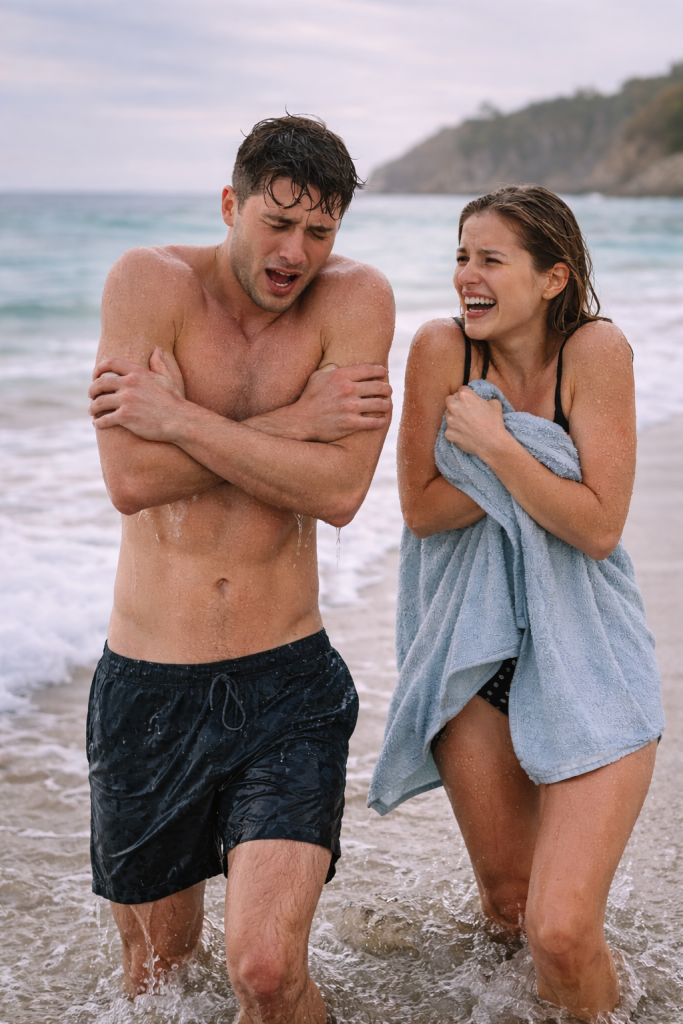
How Your Body Maintains Its Temperature
The human body functions best at an internal temperature of about 98.6°F (37°C).
This temperature is regulated by the hypothalamus, a region of the brain that acts like an internal thermostat. When your body detects that it’s losing heat, the hypothalamus triggers several responses to keep your temperature stable.
These responses may include:
- narrowing blood vessels in the skin
- triggering shivering
- creating the sensation of feeling cold.
Why Water Cools the Body Faster Than Air
Water transfers heat much faster than air.
In fact, water conducts heat about 25 times more efficiently than air. Because of this, your body loses heat much faster when you’re in water—even if the water temperature doesn’t seem very cold.
By the time you step out of the water, your body may have already lost a significant amount of heat.
Evaporation: The Main Reason You Feel Cold
After you leave the water, a thin layer of water remains on your skin.
This water begins to evaporate. Evaporation requires energy in the form of heat.
To turn into vapor, the water on your skin absorbs heat from your body. This causes your skin temperature to drop quickly, which creates the sensation of feeling cold.
This is the same principle that allows sweat to cool the body during exercise.
Why Shivering Happens
When the body detects a drop in temperature, it may trigger shivering.
Shivering consists of rapid, involuntary muscle contractions. These contractions produce heat through muscle activity.
This mechanism helps the body generate warmth and maintain a stable internal temperature.
The Role of Your Skin
Your skin is the first system to detect temperature changes.
The skin contains thermal receptors that send signals to the brain. When these receptors detect cold, the brain can trigger several responses, including:
- constricting blood vessels (vasoconstriction)
- producing the sensation of cold
- initiating shivering.
Why Wind Makes You Feel Even Colder
If it’s windy after you get out of the water, the cold sensation can become even stronger.
Wind speeds up the evaporation of water from your skin. This phenomenon is known as the wind chill effect.
The faster the evaporation occurs, the faster your body loses heat.
Differences by Age
Children
Children tend to lose body heat more quickly because:
- they have a larger body surface area relative to their weight
- their thermoregulation system is still developing.
For this reason, children may start shivering sooner after leaving the water.
Adults
Adults generally have a more stable thermoregulation system, but they can still lose heat quickly if they stay in cold water for extended periods.
Older Adults
In older adults, the body’s ability to regulate temperature may become less efficient. Some older individuals may have greater difficulty maintaining their body temperature.
Differences Between Men and Women
Research suggests that women may feel cold more intensely than men in certain conditions.
Several factors may contribute to this:
- women typically have lower average muscle mass
- differences in peripheral circulation
- hormonal influences on temperature perception.
On the other hand, women often have a slightly higher percentage of subcutaneous body fat, which can provide some thermal insulation.
Why You Sometimes Get Goosebumps
After leaving the water, you may also notice goosebumps on your skin.
This occurs when tiny muscles at the base of hair follicles contract. The reaction is controlled by the autonomic nervous system.
In our evolutionary past, this reflex helped trap warm air in body hair. In humans today, it mainly appears as a response to cold or strong emotions.
Conclusion
The cold sensation you feel after getting out of the water is the result of several processes happening at the same time:
- heat loss while you were in the water
- evaporation of water from your skin
- activation of the body’s thermoregulation mechanisms.
Through these reactions, your body works to maintain its internal temperature and keep your vital systems functioning properly.