
Sleep may seem like something simple. You lie down, close your eyes, and a few hours later you wake up.
But when sleep disappears, the body begins to change surprisingly quickly.
Many people think that lack of sleep only means feeling tired or having dark circles under the eyes. In reality, sleep is one of the most essential biological processes for the brain and the entire body. During the night, the brain consolidates memories, regulates hormones, repairs tissues, and removes metabolic waste.
When we don’t sleep, these processes begin to break down—and the effects appear in a fairly predictable pattern.
After about 16–18 hours without sleep
For most people, this is roughly the limit of a normal waking day.
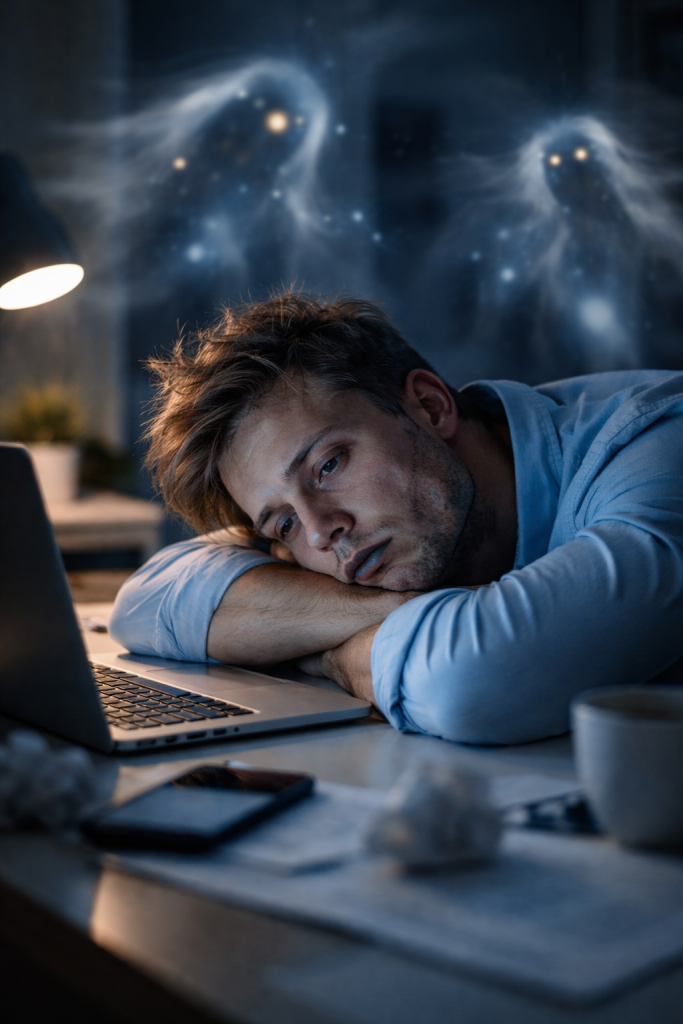
At this point the first signs of fatigue begin to appear:
- reduced concentration
- slower reaction time
- irritability
- difficulty maintaining attention
Research shows that after about 17 hours without sleep, cognitive performance can become comparable to that of someone with a blood alcohol level of about 0.05%.
The brain starts conserving energy and prioritizing only the most essential functions.
After 24 hours without sleep
After a full day without sleep, the effects become much more noticeable.
People may experience:
- difficulty concentrating
- short-term memory problems
- decreased coordination
- trouble organizing thoughts
The prefrontal cortex—the part of the brain responsible for decision-making, planning, and self-control—begins to function less efficiently.
As a result, people often become more impulsive and make more mistakes.
After 36 hours without sleep
At this stage the body begins to enter a state of biological stress.
Levels of cortisol, the stress hormone, increase, and the immune system begins to be affected.
Some people begin to experience episodes of microsleep.
Microsleep is a fascinating phenomenon: the brain briefly shuts down for a few seconds without the person realizing it. The eyes may remain open and the person may appear awake, but the brain momentarily slips into a sleep-like state.
This is why extremely tired people can sometimes fall asleep for a few seconds while sitting, standing, or performing repetitive tasks.
After 48 hours without sleep
After two days without sleep, the brain and body are significantly affected.
Common symptoms may include:
- serious concentration problems
- errors in perception
- confusion
- mood changes
Some people begin to experience mild hallucinations, usually visual ones. The brain starts misinterpreting signals from the environment.
After 72 hours without sleep
After about three days without sleep, mental functioning can become severely impaired.
Possible effects include:
- stronger hallucinations
- disorganized thinking
- paranoia
- severe memory problems
At this point the brain repeatedly tries to force sleep through frequent microsleep episodes.
How long can a human stay awake?
The most widely cited documented record belongs to an American teenager, Randy Gardner, who stayed awake for about 264 hours (around 11 days) in a monitored experiment in 1964.
In the final days of the experiment he experienced:
- hallucinations
- speech difficulties
- memory problems
- coordination issues
After finally sleeping, most of the symptoms disappeared. The experiment demonstrated how dramatically the brain can be affected by extreme sleep deprivation.
Today, such extreme sleep deprivation experiments are no longer approved for ethical reasons.
Children, adults, and older adults
Sleep deprivation affects people differently depending on age.
Children and teenagers are generally more sensitive to lack of sleep, because their brains are still developing rapidly.
In adults, the main effects appear in attention, memory, and decision-making.
In older adults, sleep deprivation may worsen balance problems, attention deficits, and memory difficulties.
Are there differences between men and women?
Some studies suggest that women may be slightly more sensitive to sleep deprivation in terms of attention and working memory.
Men, on the other hand, tend to show more risk-taking behavior when severely sleep deprived.
Overall, however, sleep deprivation affects nearly everyone in similar ways regardless of sex.
Sleep is not optional
Lack of sleep is not just about feeling tired.
Within just a few dozen hours without sleep, the brain begins to function differently. Microsleep episodes appear, perception changes, and in extreme cases hallucinations can occur.
Sleep is not a luxury.
It is one of the body’s most fundamental biological needs.