
Many people believe that Mărțișor is an exclusively Romanian tradition.
In reality, similar customs exist across several Balkan countries. One of the closest examples is in Bulgaria, where the tradition is known as Martenitsa.
The celebration is very similar to the Romanian one, but it also has a few interesting differences.
What is Martenitsa?
In Bulgaria, on March 1st, people exchange small ornaments tied with red and white strings, very similar to Romanian Mărțișor.
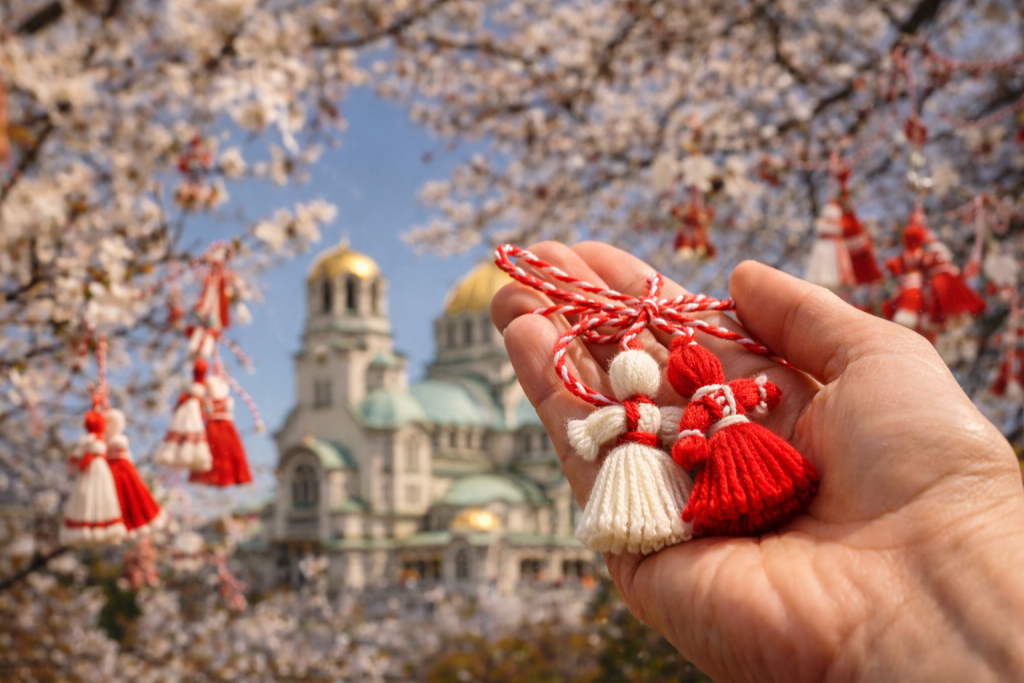
These are called martenitsi.
The colors carry almost the same traditional meaning:
- red – life and energy
- white – purity and light
These small objects are worn as symbols of health, good luck, and the arrival of spring.
An interesting difference: men wear them too
In Romania, Mărțișor is most commonly given to women.
In Bulgaria, the tradition works a bit differently.
Everyone wears a martenitsa — men, women, and children alike.
Rather than being a gift mainly for women, it is seen as a general symbol of good fortune and protection for the coming spring.
When people remove the martenitsa
In Bulgaria there is also a special moment when people take off the martenitsa.
This happens when they see the first sign of spring, usually:
- the first stork returning from migration
- the first tree in bloom
After that, the red-and-white string is often tied to a tree branch or placed under a stone.
The gesture symbolizes the arrival of spring and the renewal of nature.
A shared Balkan tradition
Similar customs can be found in several countries across the Balkans, including:
- North Macedonia
- Greece (where a similar red-and-white bracelet called Martis is worn)
- Albania
- Serbia
In 2017, UNESCO recognized these spring traditions as part of the Intangible Cultural Heritage of Humanity, highlighting their shared cultural roots across the region.
What these traditions have in common is simple:
they celebrate the same moment of the year — the end of winter and the beginning of spring.