
Sloths survive on a diet that provides very little energy. They mostly eat leaves, which are low in calories and difficult to digest. Instead of compensating by becoming more active, their entire biology has adapted in the opposite direction.
Digestion can take anywhere from two to four weeks for a single meal, and their metabolism is so slow that their body temperature can fluctuate with the environment.
They don’t fight their limitations.
They adapt to them.
The Name Says More About Us Than About the Animal
In many languages, the sloth’s name is directly tied to the idea of laziness. In English, the word sloth refers not only to the animal but also to one of the seven deadly sins—associated with idleness and lack of effort.
But that label reflects human perception, not biological reality.
What looks like inactivity is, in fact, a precise and effective survival strategy.
A Living Ecosystem… Right in Its Fur
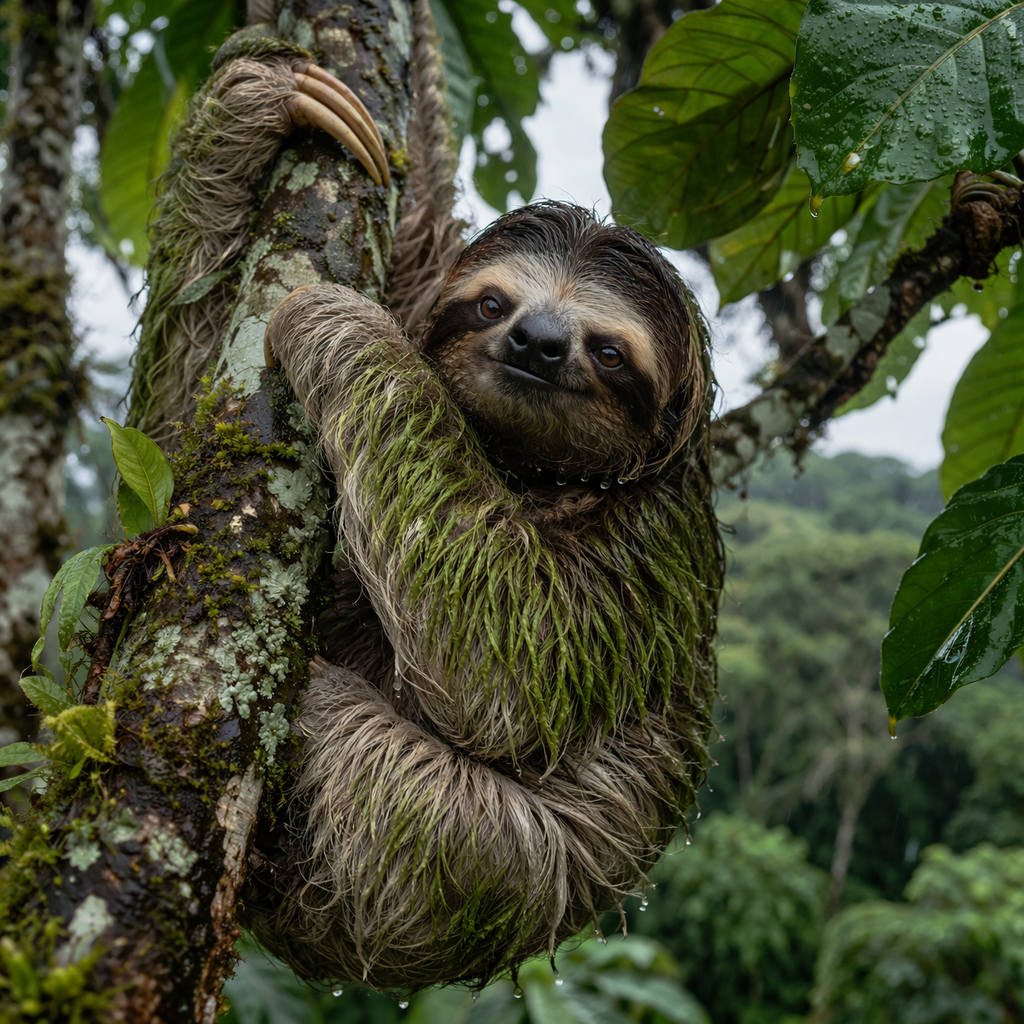
A sloth’s fur is more than just a coat—it’s a habitat.
It hosts algae, fungi, and small insects, forming a tiny ecosystem. The algae often give the fur a greenish tint, helping the sloth blend seamlessly into the forest canopy.
Instead of escaping danger by running, it avoids being noticed at all.
Who Hunts Sloths—and Why
Despite their adaptations, sloths are not without predators. In tropical forests, their main threats include jaguars, ocelots, and large birds of prey such as harpy eagles.
These predators don’t rely only on speed; they rely on opportunity. A sloth, when discovered, becomes a viable source of food precisely because it cannot escape quickly.
And yet, most of the time, sloths go unnoticed.
Their slow movement actually works in their favor, since many predators are triggered by motion. When a sloth remains still, it can be nearly invisible—even from a short distance.
The real danger appears during the rare moments when it must move or leave the safety of the trees. About once a week, a sloth climbs down to the ground, and during that time it becomes extremely vulnerable. On the forest floor, it cannot defend itself effectively or flee.
It is in these moments that many predation events are believed to occur.
Built to Observe Without Moving
Unlike most mammals, which have seven neck vertebrae, some sloths have up to nine. This allows them to rotate their heads up to around 270 degrees without moving their bodies.
For an animal that depends on staying still, this is a crucial advantage.
Better in Water Than You’d Expect
On land, sloths are slow and exposed. In water, however, they are surprisingly capable.
They can swim several times faster than they move on land and are able to hold their breath for extended periods.
It’s another reminder that they’re not limited—they’re specialized.
How They Reproduce and Raise Their Young
Sloths are solitary animals, and interactions between males and females are brief. After mating, they go their separate ways, with no long-term pairing.
Gestation lasts roughly between six and eleven months, depending on the species, and typically results in a single offspring.
Despite their reputation, sloth mothers are attentive and consistent. The baby clings to its mother immediately after birth and remains attached to her for months, learning by observation what it needs to survive.
As it grows, it begins to explore more on its own, but it may stay close to its mother for up to a year. There is no sudden separation—independence develops gradually.
Not Lazy. Just Precisely Adapted
From the outside, a sloth may appear inactive or unmotivated. But every aspect of its life is carefully balanced around one goal: conserving energy while minimizing risk.
It isn’t neglect.
It isn’t lack of effort.
It’s efficiency.
In a world that often rewards speed, the sloth survives by doing the opposite.
Not laziness.
Adaptation.
Survival.