
Have you ever considered that, just beneath your feet, there are entire worlds operating according to remarkably precise rules, without visible leaders, spoken commands, or chaos? And if those worlds were scaled up to our size, the question would no longer sound far-fetched: if ants were bigger… would they dominate us?
Ants are not just insects that occasionally appear in kitchens or along walls. They are among the most sophisticated biological systems in nature, capable of building social structures that, in certain ways, resemble our own societies. While each individual ant is relatively simple, the colony as a whole behaves like a highly efficient, adaptive organism.
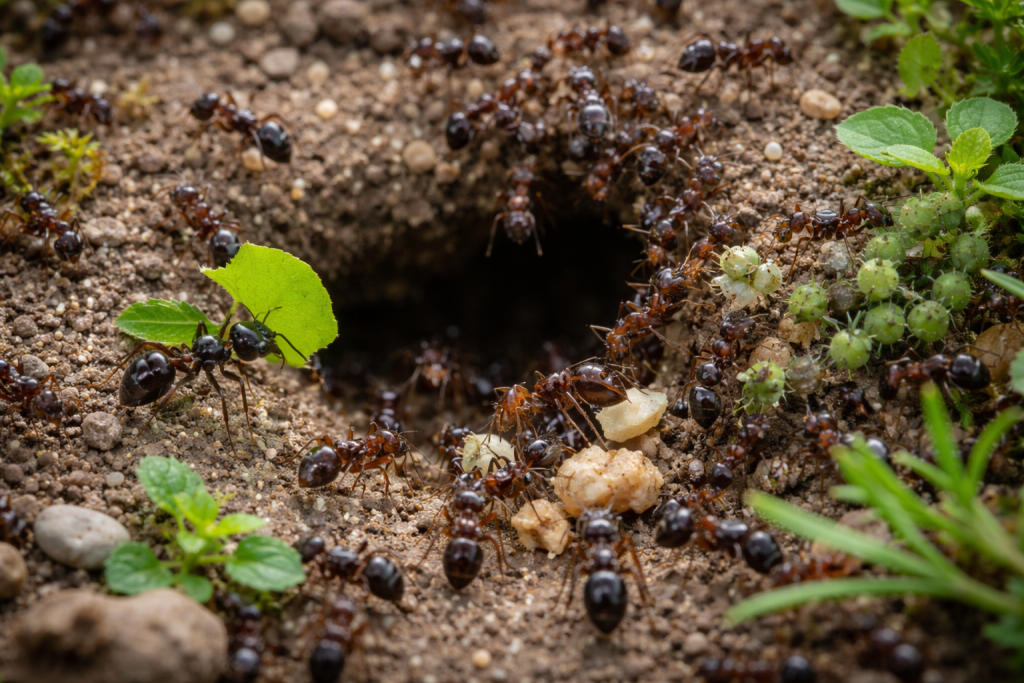
A society without chaos
Inside an ant colony, very little is left to chance. Each individual fulfills a specific role, yet these roles are not assigned through commands but emerge from finely tuned biological and chemical processes. There is the queen, whose primary role is reproduction, worker ants that gather food, care for larvae, and maintain the nest, and in some species, specialized soldier ants responsible for defense.
Communication does not rely on sounds or visible signals, but on pheromones—chemical substances that convey precise information about food sources, danger, or the needs of the colony. When a single ant discovers food, it can lay down a chemical trail that guides hundreds or even thousands of others with remarkable accuracy.
This form of collective intelligence has inspired research in fields such as computer science and robotics, where ant-based algorithms are used to optimize routes and manage complex systems.
Farmers and livestock keepers of the insect world
One of the most surprising behaviors observed in ants is their ability to “farm” other organisms. Certain species protect and care for aphids, small insects that produce a sugary substance known as honeydew. Ants defend them from predators, move them to better feeding spots, and effectively “harvest” this resource.
Other species, such as leafcutter ants, cultivate fungus inside their nests using plant material they collect and process. These agricultural systems have existed for millions of years, long before humans developed farming practices.
Organized conflicts and survival strategies
Despite their small size, some ant species engage in highly organized conflicts with other colonies. These encounters can involve coordinated attacks, territory defense, and even the capture of larvae from rival colonies, which are then integrated as workers.
These behaviors are not random. They are guided by chemical recognition systems and collective responses that allow the colony to adapt quickly to threats. Rather than individual decision-making, it is the colony as a whole that reacts.
Why ants enter our homes
Beyond their scientific fascination, ants often become a practical concern in everyday life. The primary reason they enter homes is simple: access to food.
Even small traces—crumbs, sugary residues, or pet food—can attract ants. Once a reliable food source is found, ants establish stable trails between the nest and that location. These trails can persist as long as the resource remains available.
Environmental factors such as temperature changes or increased humidity can also push ants to seek new habitats, and indoor spaces often provide favorable conditions.
How they reproduce and why they return
Ant colonies revolve around the queen, who can live for years and produce large numbers of offspring. During certain periods, winged ants emerge to reproduce and establish new colonies.
This reproductive cycle explains why ants may return even after they seem to disappear. Removing visible ants does not eliminate the colony, and as long as the queen survives, the population can recover.
How to manage infestations
Managing ants effectively involves more than simply removing those you can see. It requires disrupting their trails and limiting access to food sources.
Keeping surfaces clean, storing food securely, and sealing entry points are essential steps. Some natural solutions, such as vinegar or citrus-based substances, can interfere with pheromone trails and reduce activity.
In more persistent cases, bait systems are often used. These allow ants to carry substances back to the colony, targeting the source rather than just the visible individuals.
A small world that is hard to ignore
Ants are, at the same time, fascinating and inconvenient. They demonstrate how complex a system can become when simple individuals work together, and how efficiency can emerge without centralized control.
They may never dominate us, regardless of size, but one thing is certain: if they were larger, we would not be able to ignore them so easily.
And the next time you see a line of ants crossing your floor, it may be worth remembering that you are not just looking at insects, but at a miniature civilization shaped by millions of years of evolution.