
There is a type of fish that doesn’t seem content staying underwater. Instead of swimming quietly below the surface, it comes out onto land, moves around, explores its surroundings, and behaves in ways that feel surprisingly unfamiliar for something we usually associate with water.
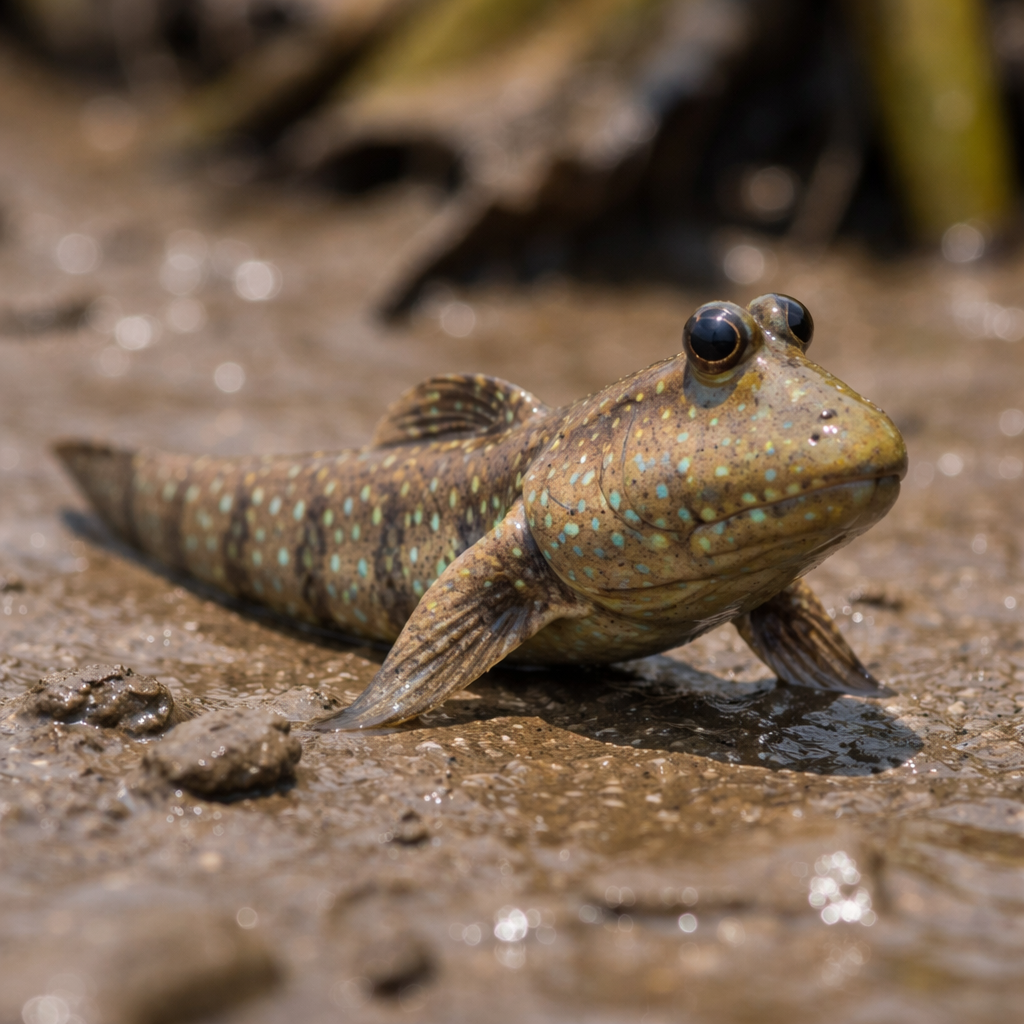
Known as the mudskipper, and sometimes described as a “mud-walking fish,” it is one of the most fascinating examples of how life can adapt to environments that sit between two worlds.
How it survives outside of water
Unlike most fish, the mudskipper does not rely solely on gills to breathe. It is able to absorb oxygen through its skin and through the lining of its mouth and throat, in a way that resembles how some amphibians function.
For this system to work, its body needs to stay moist, which is why mudskippers are typically found in muddy coastal areas, mangroves, and tidal flats where they have constant access to both water and air.
They can also retain water inside their gill chambers, effectively carrying a small reserve with them that allows them to continue breathing even when they are out of the water.
It doesn’t just leave the water… it moves on land
Mudskippers don’t have legs, but their movement on land is surprisingly effective. They use their pectoral fins to support and push their bodies forward, creating a motion that looks more like walking than swimming.
They are also capable of short jumps, climbing over surfaces, and defending territory outside of water, making them one of the few fish with such active behavior on land.
Eyes built for two environments
One of their most distinctive features is their eyes, which are positioned on top of the head and slightly protrude upward. This gives them a wide field of view, allowing them to detect potential threats both in the water and on land.
Mudskippers can even blink, which is extremely rare among fish. They use a specialized membrane to keep their eyes moist while they are out of the water.
More complex behavior than you might expect
Mudskippers are not only highly adapted but also display structured behavior. Males build burrows in the mud where they attract females and protect their territory from rivals.
These burrows are more than simple shelters. They often include air pockets, which are essential for the survival of eggs in environments where oxygen levels can fluctuate.
Interactions with humans
Mudskippers are not dangerous to humans and generally avoid contact. In coastal regions across Asia and Africa, they are often seen as an unusual and interesting part of the local ecosystem rather than a threat.
They are sometimes observed by visitors exploring mangrove areas, offering a rare glimpse into a form of life that operates differently from what most people expect from fish.
However, their habitats are sensitive. The destruction of mangroves and environmental changes can directly impact mudskipper populations, which is why they are often considered indicators of ecosystem health.
A fish… or something more?
The mudskipper is more than just an unusual species. It is a reminder that the boundary between water and land is not as strict as it might seem, and that evolution can produce solutions that challenge how we define entire groups of animals.
The next time you think of a fish, it probably won’t be one that climbs, jumps, and looks back at you from the shore.