
Have you ever noticed that you can have two scars on the same body… and they look nothing alike?
One fades so much you barely see it anymore. The other stays visible, raised, sometimes even more noticeable than the original injury.
And the surprising part is that we’re not talking about two different people.
We’re talking about the same body, responding in different ways.
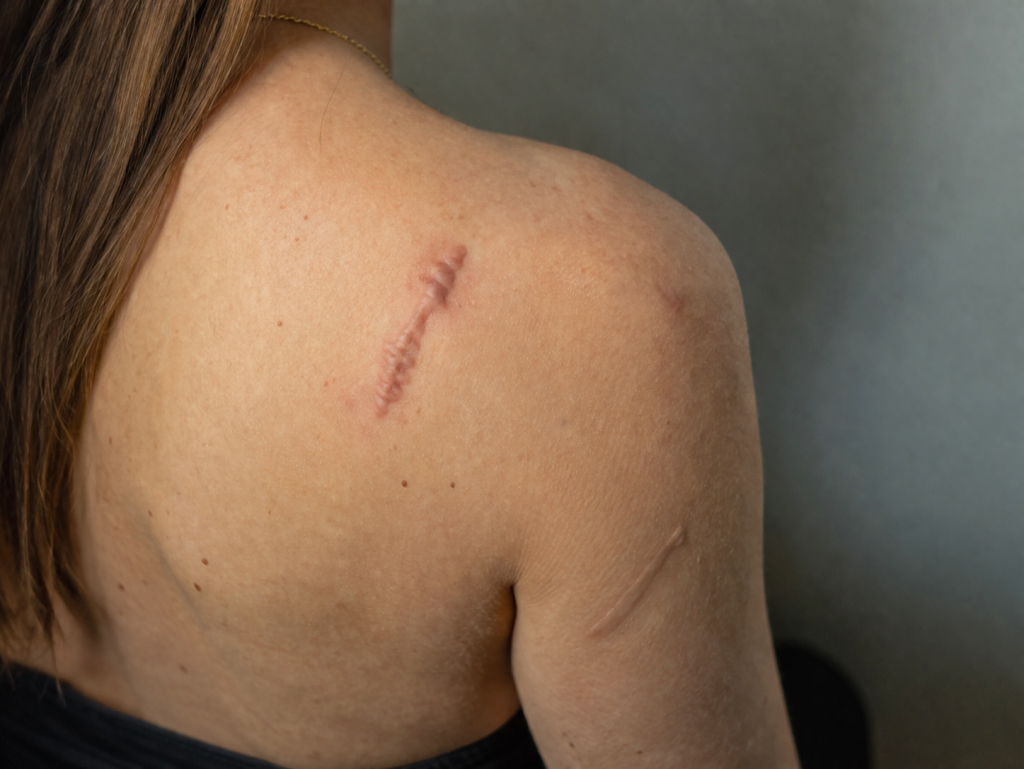
When your skin is injured, your body doesn’t just “close” the wound. It starts a complex repair process that rebuilds the tissue almost from scratch.
First comes inflammation — a normal response that helps clean the area and prepare it for healing. Then specialized cells begin producing collagen, the protein that gives your skin structure and strength.
This is where everything is decided.
Because healing isn’t just about closing the wound. It’s about how much collagen your body produces and how it organizes it.
If the process stays balanced, the result is a thin scar that gradually becomes less visible over time.
If your body produces more collagen than needed, the result can be a thicker, raised scar — sometimes called a keloid. This isn’t just a “more visible” scar, but a healing response that continues beyond what’s necessary.
So why doesn’t your skin heal the same way everywhere?
Because not all areas of your body behave the same.
Certain regions are more prone to visible or raised scars, including the chest, shoulders, upper back, earlobes, and neck. In these areas, the skin is under more tension, and movement can influence how the tissue heals.
That’s why two similar injuries in different locations can leave very different marks.
But it’s not just about where the injury happens.
It’s also about you.
Some people are more prone to developing thicker scars due to genetic factors. If you’ve developed a raised scar before, you may be more likely to develop one again.
In a way, your body has its own “healing pattern.”
Age also plays a role.
In children, the skin heals quickly, but raised scars are less common before puberty. In young adults, especially between the ages of 20 and 30, the likelihood of more pronounced scars is higher.
As we age, healing tends to slow down, but scars are often finer and less noticeable.
In simple terms, the more active the skin’s repair process is, the stronger the response can be.
What about differences between women and men?
Biologically, the risk is relatively similar. However, in real life, raised scars are reported more often in women, partly because of more frequent skin-related procedures such as piercings or cosmetic treatments.
Can diet make a difference?
There is no specific diet that can prevent scars. However, your body needs proper nutrients to heal effectively. Protein, vitamin C, and zinc all support tissue repair.
Even so, nutrition alone cannot fully determine how a scar will form.
Do creams actually help?
Some do, some don’t.
Silicone-based gels and sheets have been shown to help improve the appearance of scars over time. In more pronounced cases, medical treatments such as injections or laser therapy may be used.
Even then, some scars can return.
Because you’re not just treating the mark on the skin.
You’re working with how your body responds to healing.
And maybe that’s the most important thing to understand:
A scar doesn’t just show what happened to you.
It shows how your body responded.
That’s why no two scars are exactly the same — not even on the same person.
And sometimes, the difference isn’t in the injury itself.
It’s in the way each of us heals.