
There are moments that feel almost unreal when you first see them.
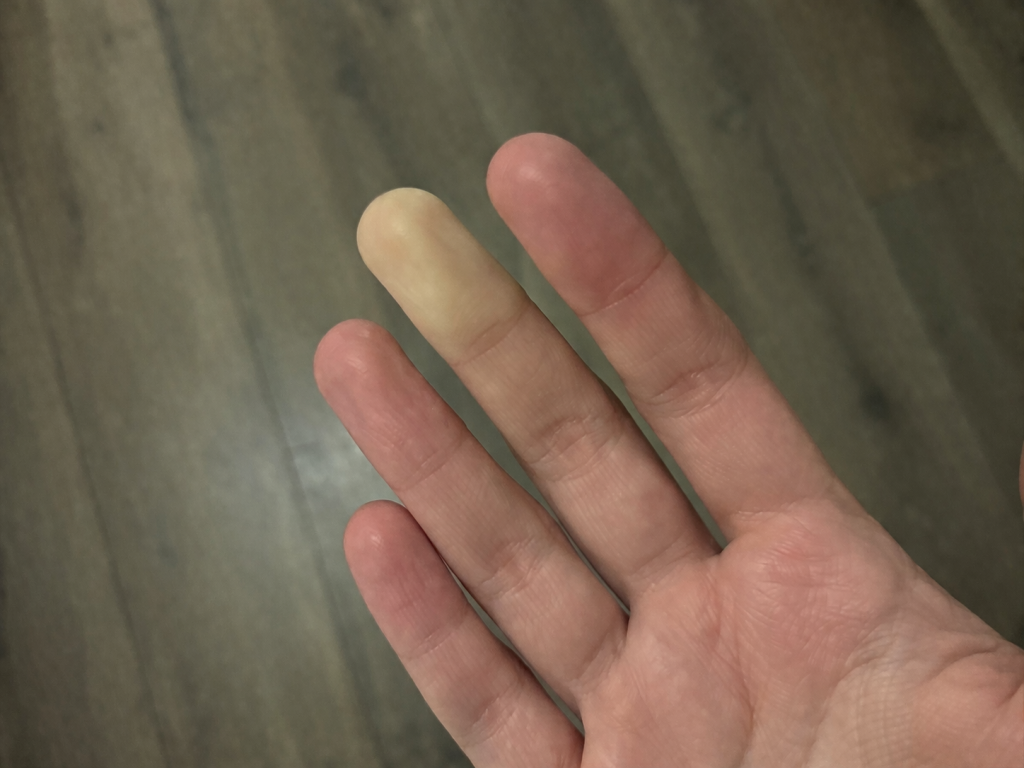
You look at your hand and notice that one of your fingers has turned completely white — not pale, not lighter than usual, but almost wax-like, as if the blood has simply disappeared.
The first reaction is immediate:
“How is that even possible?”
It looks alarming. Unnatural. Rare.
But it isn’t.
This is a real, well-documented reaction of the body known as Raynaud’s phenomenon — and it happens far more often than most people realize.
What’s Actually Happening Inside That Finger
Under normal conditions, blood flows continuously through tiny vessels all the way to your fingertips, keeping them warm and pink.
But in certain situations, those small blood vessels suddenly constrict.
They narrow so much that blood flow drops sharply — sometimes almost completely.
For a short period, that area isn’t being properly supplied with blood.
That’s why the finger turns white.
It’s not an illusion.
It’s a temporary interruption of circulation.
Why the Body “Shuts Down” Blood Flow Like This
At first, it seems counterintuitive.
Why would your body do this on purpose?
In most cases, this reaction is triggered by cold temperatures or emotional stress.
It’s actually an exaggerated version of a normal protective response.
Your body is trying to preserve heat and protect vital organs by reducing blood flow to the extremities.
The problem is not the mechanism itself — it’s how strongly it reacts.
The Color Changes That Tell the Whole Story
The white color is usually just the beginning.
Many people experience a sequence that follows a recognizable pattern:
– white — reduced blood flow
– blue — lack of oxygen in the tissue
– red — blood rushing back into the area
This shift isn’t random. It reflects what’s happening beneath the surface in real time.
What It Feels Like, Not Just What It Looks Like
This isn’t only something you see.
It’s something you feel.
The affected area may become:
– numb
– cold
– tingling
– sometimes painful when circulation returns
For someone experiencing it for the first time, it can be unsettling.
For those who have it repeatedly, the sensation becomes very familiar.
How Common Is It, Really?
Despite how dramatic it looks, this isn’t a rare condition.
Around 4–5% of the population experiences Raynaud’s phenomenon, and in some groups, the number may be even higher.
That means:
it’s not unusual
it’s often underrecognized
many people have experienced it without knowing what it was
Is It Dangerous?
In most cases, it isn’t.
There are two main forms:
Primary Raynaud’s — the most common type
It occurs on its own, without an underlying disease
It doesn’t cause permanent damage
Episodes typically last from minutes to a few hours
Secondary Raynaud’s — less common
It is associated with underlying conditions, often autoimmune or vascular
In more severe cases, it can lead to complications affecting the tissue
Most people fall into the first category.
But if episodes are frequent, severe, or worsening, medical evaluation is important.
Why It’s More Common in Women
One important detail that often goes unnoticed:
Raynaud’s is more common in women than in men.
In many studies, women represent the majority of cases.
Possible explanations include:
– differences in vascular sensitivity
– hormonal influences
– genetic predisposition
It’s not exclusive, but the pattern is clear.
Age Matters More Than You Think
When it appears can be just as important as how it appears.
Primary Raynaud’s most often begins between the ages of 15 and 30, especially in younger women.
Secondary Raynaud’s tends to develop later in life, often after 40, and may be linked to other conditions.
This distinction helps put the symptoms into context.
Does It Happen Just Once — Or Keep Coming Back?
One of the defining features of this phenomenon is that it often repeats.
It’s not usually a one-time event.
Episodes can be triggered by:
– cold exposure
– emotional stress
– sudden temperature changes
Some people experience it occasionally.
Others notice a recurring pattern that can last for years.
It’s essentially a specific way the blood vessels respond — repeatedly.
What You Don’t See Beneath the Surface
At the moment your finger turns white, several processes are happening at once:
– small blood vessels constrict
– blood flow decreases sharply
– oxygen levels in the tissue drop
– the nervous system becomes involved
– circulation eventually returns, sometimes rapidly
All of this unfolds within minutes.
And in most cases, without lasting harm.
Not Random — But Not a Reason to Panic
It may look dramatic.
And in a way, it is.
But in most situations, it’s not dangerous.
It’s your body reacting — a bit too strongly — to something it’s designed to handle.
What Your Body Is Really Showing You
Your body doesn’t shut down circulation randomly.
It responds to triggers.
It adapts.
Sometimes, it overreacts.
And that pale, almost unreal-looking finger is simply a visible reminder of how quickly and powerfully your body can respond — even in the smallest details.