
There is a detail about Europe that most people today no longer realize, even though it was true for centuries, even millennia: a fish born in the Black Sea could swim freely up the Danube River and reach deep into what is now Germany.
This is not a poetic exaggeration. It is a documented biological and historical reality, supported by fishing records, trade accounts, and modern research on migratory species.
That fish still exists today.
It’s called the sturgeon.
A Fish That Was Never Meant to Still Exist
Up close, a sturgeon doesn’t look like something that belongs in our time. Its body is not covered in scales but in rows of bony plates, known as scutes, forming a kind of natural armor. Its skeleton is largely made of cartilage, a feature more commonly associated with much more primitive aquatic life.
From an evolutionary perspective, sturgeons are survivors from a distant past. Fossil evidence shows that their ancestors were already swimming in ancient waters over 200 million years ago. The fact that their structure has remained so unchanged suggests something remarkable: they were already perfectly adapted long before most modern species even appeared.
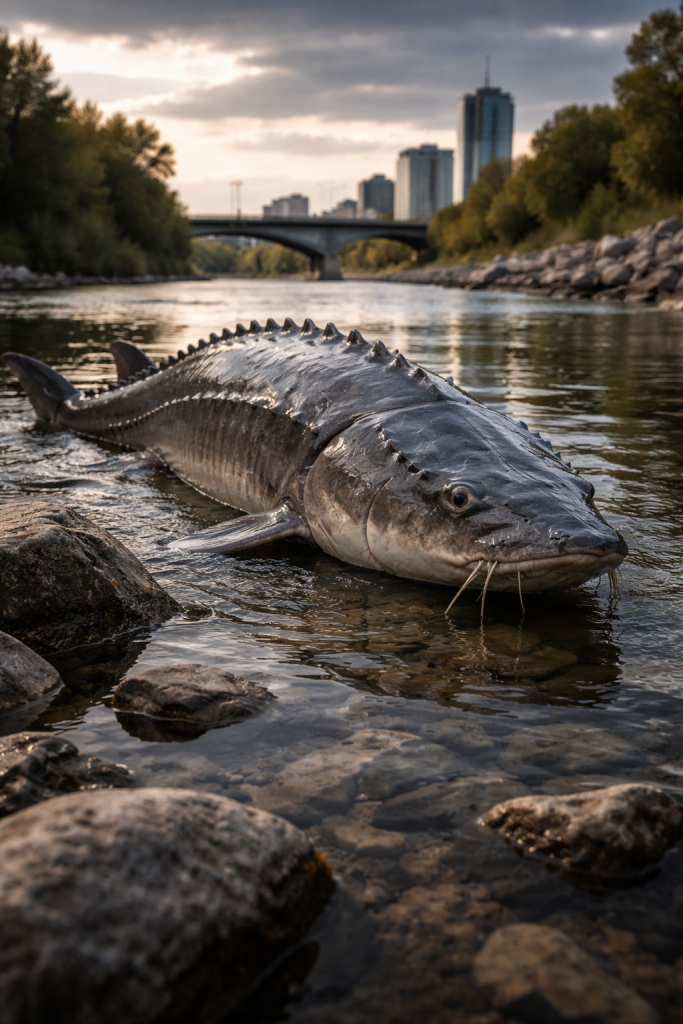
The Journey No One Sees Anymore
Species like Huso huso, Acipenser gueldenstaedtii, and Acipenser stellatus are anadromous, meaning they live mostly in saltwater but return to freshwater to reproduce.
In the past, these migrations were not short or occasional. Sturgeons would leave the Black Sea and travel hundreds, sometimes over a thousand kilometers upstream along the Danube, searching for very specific spawning grounds with the right currents and riverbed composition.
This was not random movement. It was precise, repeated across generations, guided by complex biological mechanisms involving water chemistry, flow patterns, and likely even geomagnetic cues.
And it didn’t happen often. Female Huso huso may take 15 to 20 years to reach maturity, and once they do, they don’t reproduce every year, but every 4 to 7 years. Each migration, in that sense, carries enormous weight for the survival of the species.
Where Everything Broke
For thousands of years, nothing interrupted these routes.
Then, in what is essentially a blink of an eye on a biological timeline, everything changed. The construction of major dams, especially at Iron Gates, completely disrupted these natural pathways.
These structures were not designed to accommodate large migratory fish like sturgeons. The result is stark and irreversible: a species that once crossed half a continent can no longer pass beyond certain points in the river.
The instinct is still there.
The path is not.
The Timișoara Myth — And What’s Actually True
This is where modern interpretations sometimes stretch reality too far, particularly when it comes to claims that sturgeons once lived near Timișoara.
The city is crossed by the Bega River, which is not part of the natural migratory route for sturgeons. While rivers such as the Timiș River are indirectly connected to the Danube system, there is no solid scientific evidence or consistent historical data showing stable sturgeon populations in that region.
The confusion often comes from extending a real fact — their extraordinary migration ability — beyond what documented evidence supports.
And the truth, as it turns out, is already remarkable enough.
Why Sturgeons Struggle to Recover
Sturgeons are not just large and long-lived; they are also biologically vulnerable to rapid change.
A single Huso huso can grow beyond 6 meters and live for over a century. But this longevity comes with a cost: slow growth, late maturity, and long gaps between reproductive cycles.
When you combine that with overfishing — especially for caviar — habitat destruction, and blocked migration routes, the impact becomes severe. Populations decline quickly, but recover very slowly, if at all.
Today, the most important remaining populations are found in the lower Danube, particularly around the Danube Delta, where natural conditions still allow reproduction, though at a much reduced scale compared to the past.
Encounters With a Disappearing Giant
Although rare, encounters with sturgeons still happen.
Fishermen along the lower Danube occasionally report accidental catches, many of which are now documented and followed by release, in line with conservation regulations. These moments are no longer routine — they are events.
For researchers and conservationists, each confirmed sighting matters. It is both a sign of resilience and a reminder of how fragile the current situation is.
A World That Disappeared Too Quickly
Perhaps the most striking part of this story is not that sturgeons are ancient, massive, or rare.
It’s that, not so long ago, there was a world where a fish could leave the Black Sea and travel, uninterrupted, into the heart of Europe.
This is not a change that took millions of years.
It’s a world that disappeared within a few decades.