
Sometimes what feels like a new discovery is actually something we’ve known for a very long time, just seen through a different lens. Hemp is one of those cases.
It isn’t new. It never was.
For centuries, it was part of everyday life in many parts of the world. In Eastern Europe, including Romania, hemp wasn’t considered innovative or special. It was simply practical. People used it to make clothing, household fabrics, ropes, and sacks—things that were necessary, not remarkable.
The same was true in early American history. Hemp was widely used for ropes, sails, and textiles—materials that were essential for shipping, trade, and daily life. Some colonies even encouraged its cultivation because it supported industries that the economy depended on.
And then, over time, it faded into the background.
Not because it stopped being useful, but because faster, cheaper, industrial alternatives took over. Synthetic materials replaced natural ones, and plants like hemp became less visible.
Now, in a completely different context, it’s being reconsidered.
Not because it changed.
But because we did.
A plant that grows almost in front of your eyes
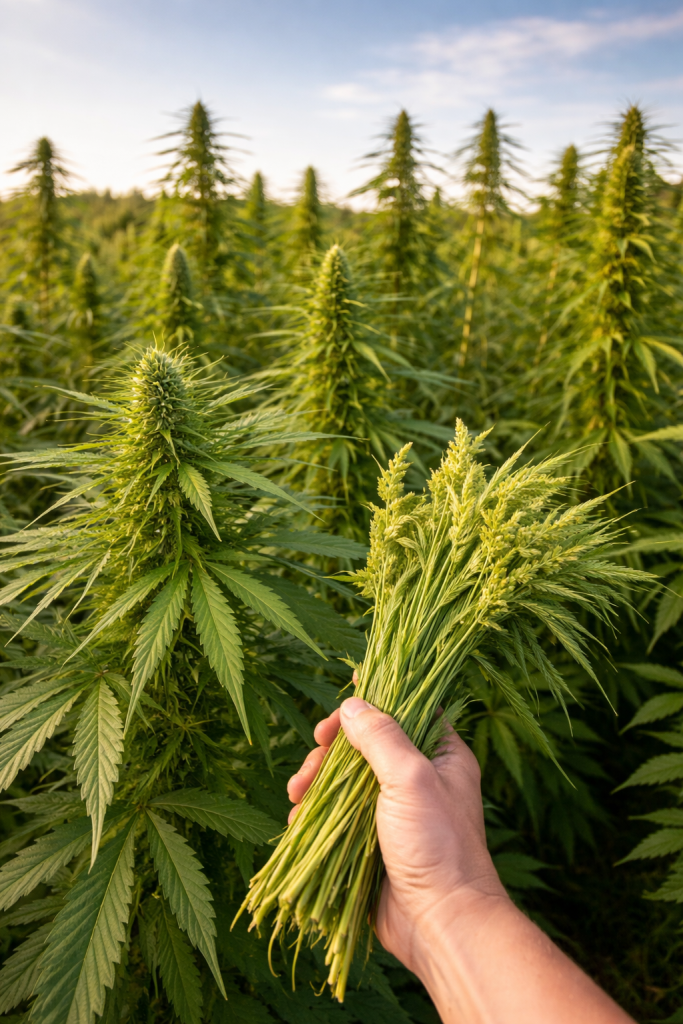
One of the first things that stands out about hemp is how quickly it grows. This isn’t a slow, barely noticeable process—it’s something you can almost observe week by week.
Within three to four months, the plant reaches maturity. In the right conditions, it commonly grows between 6 and 10 feet tall, and in some cases can exceed 12 feet. It’s dense, tall, and highly productive within a single growing season.
That combination—speed and size—translates into something simple: a large amount of plant material produced in a short time.
And that’s where the conversation about carbon begins to make sense.
Why it keeps coming up in discussions about CO₂
You’ll often hear that “hemp absorbs large amounts of CO₂,” and while that’s not wrong, it’s often simplified.
Like all plants, hemp absorbs carbon dioxide through photosynthesis. What makes it stand out is not a different mechanism, but the rate at which it grows and accumulates biomass.
Some studies suggest that hemp can capture roughly 8 to 15 tons of CO₂ per hectare per growing season (around 3 to 6 tons per acre), depending on conditions and cultivation methods.
That’s significant—but it’s not the whole story.
Because what really matters is what happens next.
If the plant is burned or decomposes quickly, much of that carbon returns to the atmosphere. If, however, it’s used in durable materials—such as construction components—it can remain stored for much longer.
So hemp isn’t a miracle climate solution.
But it is a meaningful piece of a much larger system.
The fibers — the reason it never truly disappeared
If there’s one thing that kept hemp relevant across centuries, it’s the strength and versatility of its fibers.
They are durable, resilient, and adaptable. Historically, they were essential. Today, they’re being reconsidered.
Compared to crops like cotton, hemp can require fewer pesticides and, in some cases, less water. That has made it increasingly attractive in conversations about more sustainable textiles.
And yet, it hasn’t fully replaced other materials.
The reason isn’t a lack of potential—it’s complexity. Processing hemp into fine, widely usable fabrics is more demanding and often more expensive. In a system driven heavily by cost and efficiency, that matters.
Hemp-based building materials — promising, but often misunderstood
One of the most talked-about modern uses is hemp-based construction material, often referred to as hempcrete.
At first glance, it sounds like a direct replacement for concrete. It isn’t.
Hempcrete is made from the inner woody core of the hemp plant, mixed with lime and water. It offers real advantages: it’s lightweight, provides good insulation, and can contribute to reducing the overall carbon footprint of a building. In some cases, it may even store carbon over time.
But it’s not structural. It doesn’t replace reinforced concrete in load-bearing elements.
Instead, it works alongside traditional materials—an example of how natural and industrial systems can complement each other rather than compete.
A versatile resource — but not a standalone solution
One of hemp’s strongest qualities is how much of the plant can be used. Its seeds, fibers, and oils all have different applications, from food products to industrial uses.
It can feel like a resource that “could do everything.”
But in reality, no single material works that way.
For hemp to become widely used, it depends on infrastructure, processing capacity, market demand, and economic viability. Without those, it remains a strong idea—but not a large-scale solution.
Why it matters now more than before
The renewed interest in hemp says as much about us as it does about the plant.
For the first time in a long time, there is real pressure to rethink how we produce, consume, and build. And in that context, any resource that is renewable, adaptable, and relatively efficient becomes relevant again.
Hemp isn’t remarkable because it does something extraordinary.
It’s remarkable because it does many things well enough to matter.
A perspective worth keeping
No, hemp will not solve environmental challenges on its own.
But it’s also not just another trend.
It represents a shift in perspective—a willingness to look again at resources we once considered ordinary and ask whether we overlooked their potential.
Because sometimes, the future isn’t built entirely from new discoveries.
Sometimes, it comes from understanding—properly, this time—what was already there.