
Most of the time, parents look at their child’s teeth with a certain level of reassurance: they’ll straighten out, they’re still growing, it’s too early to worry about braces.
And in many cases, that’s true.
But there are situations where what looks like a normal variation is actually a sign that the teeth or jaws aren’t developing the way they should. And the difference isn’t just about appearance — it affects how a child chews, speaks, and even breathes.
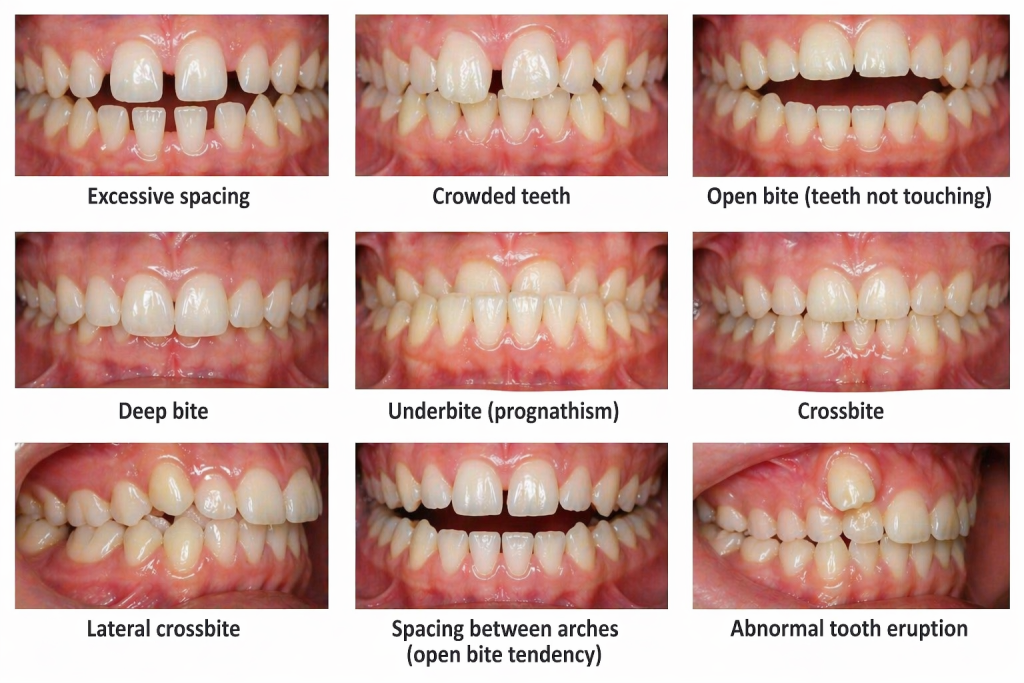
When gaps between teeth are more than temporary
Spaces between teeth are common, especially in baby teeth, and they can even be helpful by making room for permanent teeth later on.
But when those gaps are unusually large or persist over time, they can point to an imbalance between jaw size and tooth size. In some cases, it may also be related to the position of the labial frenulum — the small tissue connecting the upper lip to the gum.
These aren’t always things that simply resolve on their own.
Crowded teeth — more than just a cosmetic issue
When teeth are crowded, it’s not just that they “don’t have enough room.”
Often, it means the jaw is too small for the size of the teeth, or that teeth are erupting in the wrong direction. This can make proper cleaning more difficult, increasing the risk of cavities and gum inflammation.
Over time, it can also affect how the teeth come together when biting.
When the teeth don’t meet properly
It might seem like a small detail, but when upper and lower teeth don’t make proper contact (an open bite), it changes how chewing forces are distributed.
This can lead to:
– difficulty chewing food properly
– speech issues
– uneven wear on certain teeth
In some cases, it’s linked to habits like thumb sucking or prolonged mouth breathing.
Deep bite or underbite — signs that shouldn’t be ignored
A deep bite (when upper teeth excessively cover the lower ones) can gradually lead to wear on the lower teeth and strain on the jaw joint.
An underbite (when lower teeth sit in front of upper teeth) is even more important to evaluate, as it may reflect an imbalance in jaw development.
These are not issues that typically “correct themselves with age.”
When the jaws are not aligned
Sometimes the problem goes beyond the teeth and involves the entire jaw structure.
Differences between the upper and lower jaw can affect:
– facial profile
– breathing patterns
– head posture
– overall bite function
In these cases, early intervention can make a significant difference.
Abnormal eruption — an early warning sign
Teeth that grow in unusual positions, rotated, or outside the normal dental arch are not just a matter of appearance.
They often indicate that the eruption path is disrupted. Without guidance, the situation can worsen as more permanent teeth come in.
When should a child see an orthodontist?
Many parents believe an orthodontic visit is only necessary after all permanent teeth have appeared.
In reality, specialists recommend an initial evaluation around the age of 6–7.
Not because braces will be placed immediately, but because it allows early identification of how things are developing.
Some issues are much easier to guide and correct at this stage than later, when growth is more advanced.
Why this matters more than it seems
Teeth are not just about a straight smile.
They influence how a child eats, speaks, breathes, and even how confident they feel. Problems that seem minor at first can become more complex over time if left unaddressed.
The question worth asking early
It’s not about going to the orthodontist too soon.
It’s about not getting there too late.
Because sometimes, what looks like “it will fix itself” is exactly the thing that would have been easiest to correct… if it had been seen in time.