
A beginning that doesn’t look like success at all
When people look at the worldwide success of The Alchemist today, it’s tempting to imagine a clean, almost inevitable path. A strong idea, a talented writer, and a book that quickly finds its audience. In reality, the story is far less tidy—and far more interesting.
Paulo Coelho was born in 1947 in Rio de Janeiro, into a family that valued stability and a predictable future. In that context, becoming a writer didn’t fit the script. His parents hoped he would choose a more conventional profession, something that carried status and security.
As a teenager, that tension escalated to a point that still feels hard to process today. He was admitted multiple times to psychiatric institutions because his behavior and ambitions were seen as problematic. Coelho himself later spoke openly about those years, including the treatments he underwent. What sounds extreme now was, at the time, part of how nonconformity was sometimes handled.
Those experiences didn’t just mark his early life. They shaped the themes that would return again and again in his writing—the quiet conflict between what the world expects from you and what you feel compelled to become.
Success on the outside, something missing underneath
By the 1970s, Coelho wasn’t struggling anymore in the usual sense. He had built a career as a lyricist, working with well-known Brazilian musicians. He was earning money, gaining recognition, living a life that, from the outside, looked stable.
And still, something didn’t sit right.
He had wanted to be a writer since he was young, and that ambition never really went away. If anything, it became harder to ignore. There’s a kind of tension that builds when your life looks “successful” on paper but doesn’t match what you feel you’re meant to be doing. It’s subtle at first, then persistent.
That was the space he found himself in.
The road that changed everything
In 1986, at 38, he made a decision that didn’t make much sense to the people around him. He set out on the Camino de Santiago, a long pilgrimage route across northern Spain.
This wasn’t a casual trip. It meant long days of walking, physical strain, unfamiliar environments, and a lot of time alone with his thoughts. Experiences like this tend to strip things down. Without the usual distractions, people often begin to rethink priorities, identity, direction.
For Coelho, something shifted during that journey. Not in a dramatic, cinematic way, but in a quieter, more internal sense. He came back with a clearer direction and, more importantly, with a story forming in the background.
Writing The Alchemist
He began writing The Alchemist in 1987. It’s often said that the book was written in about two weeks. That’s partially true, but also a bit misleading. The actual writing process was fast, but the ideas behind it had been building for years.
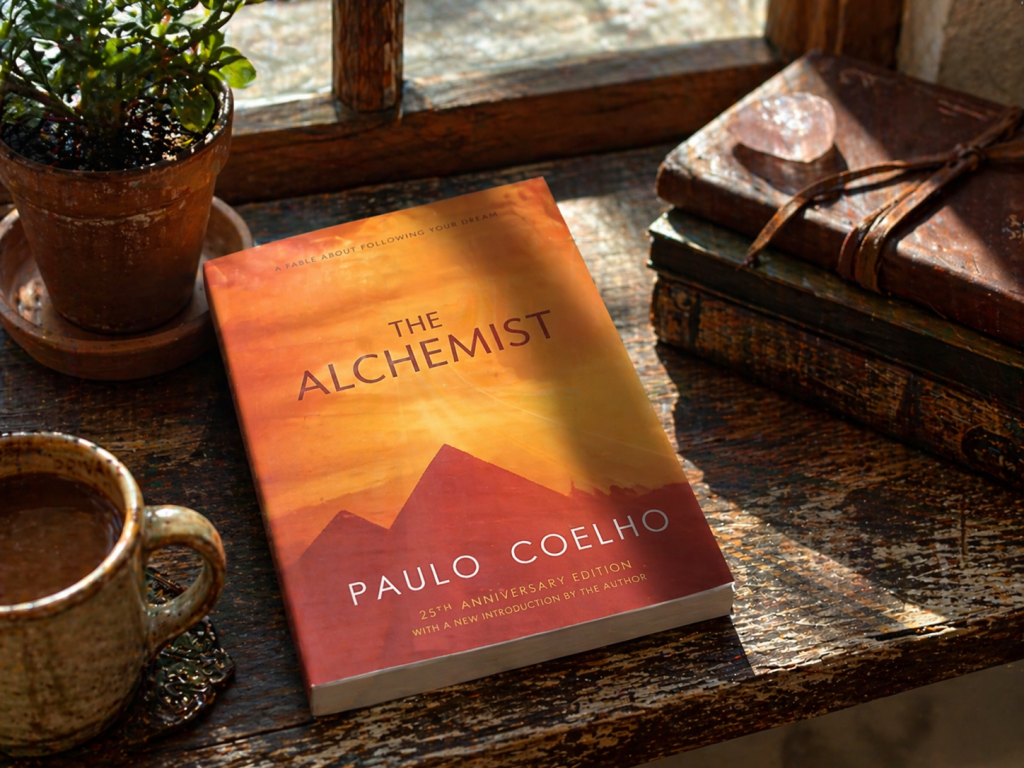
At its core, the story is simple: a shepherd sets out in search of treasure and ends up discovering something deeper about purpose and direction. The structure is almost like a fable, which is part of why it resonated with such a wide audience.
A quiet release—and almost no reaction
The first edition, published in Brazil in 1988, went largely unnoticed. There was no major promotion, no strong sales, no immediate recognition. The publisher eventually dropped the book.
That detail matters more than it might seem. It breaks the illusion of instant success. At that point, The Alchemist could easily have disappeared like many other books.
The slow second start
Coelho didn’t let it go. He found another publisher and released the book again. This time, things began to move—but slowly.
Readers started recommending it to each other. Not in a sudden wave, but gradually. One person, then another. Over time, it built momentum. By the early 1990s, the book was gaining traction beyond Brazil. The English translation, published in 1993, played a key role in opening the international market.
This kind of growth isn’t common, but it’s not mysterious either. Sometimes, a book spreads because it connects on a personal level, not because it’s heavily promoted.
From overlooked to global phenomenon
Today, The Alchemist has sold over 150 million copies and has been translated into dozens of languages. It appears on reading lists in very different contexts—schools, leadership programs, personal development circles.
Its success can’t be reduced to a single explanation. It’s not just the writing style or the timing. It’s the combination of a simple narrative, a universal theme, and a moment in which readers were open to that kind of message.
Where reality ends and interpretation begins
Many of the widely shared details about Coelho’s story are true at their core, but often simplified. The institutionalizations happened. The pilgrimage was real. The first edition struggled. The success came later.
At the same time, some of the more popular ideas associated with the book—like the notion that “the universe conspires in your favor”—belong more to interpretation than to verifiable fact. They reflect how readers connect with the story, not something that can be measured or proven.
Not a miracle story, but a long one
If you strip away the dramatic framing, what remains is not a story about sudden breakthroughs. It’s about persistence over time, about continuing when there’s little feedback, about staying with an idea longer than most people would.
And maybe that’s the part that matters.
Because in the end, the success of The Alchemist didn’t come from a single moment. It came from everything that happened before—and from the decision not to stop when it would have been easier to walk away.