
Some behaviors look strange on the surface, almost like childhood dares or passing curiosities, but start to make sense once you look a little deeper. The urge to eat things that aren’t food — chalk, ice, paper, even soil — is one of those cases. It’s not just a random habit. In medicine, this pattern has a name: pica.
This isn’t about a one-time impulse or a moment of curiosity. For it to matter from a clinical perspective, the behavior has to persist over time and appear outside normal developmental stages. In other words, it’s not about a toddler exploring the world by putting things in their mouth, but about a repeated, almost automatic tendency that shows up when it shouldn’t.
What’s happening inside the body when pica appears
What makes pica especially interesting is that there isn’t a single explanation. In many cases, it’s linked to nutritional deficiencies, most commonly iron deficiency. One of the best-known examples is the strong craving for ice, a pattern frequently observed in people with iron-deficiency anemia.
At first glance, it doesn’t make much sense. Ice contains no iron, and neither chalk nor soil provides the nutrients the body actually needs. That’s where it becomes fascinating. This isn’t a solution — it’s a signal. The body is reacting to an imbalance, but not in a direct or logical way. It’s as if it’s pressing the wrong button while still trying to draw attention to a real problem.
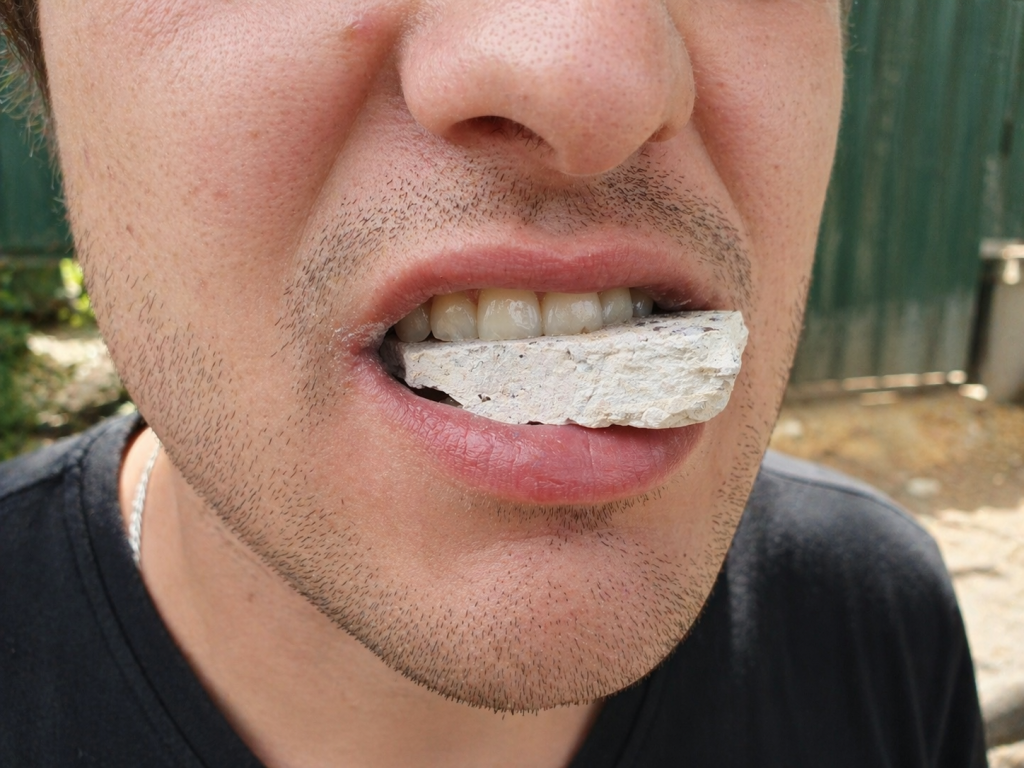
Beyond biology, there’s also a psychological layer. Pica is more often observed in situations involving stress, anxiety, or emotional vulnerability. For some individuals, consuming these substances may create a temporary sense of relief or control, even if that process isn’t fully conscious. This is one reason why it appears more frequently in children, during pregnancy, or in people going through challenging periods.
Not all forms of pica look the same
Pica doesn’t show up in just one way. It varies depending on what the person feels drawn to consume. Ice eating, known as pagophagia, is one of the most widely documented forms. There is also geophagia, which involves consuming soil or clay and has been observed in different cultures throughout history.
Other forms include cravings for raw starch, paper, soap, or chalk. In the case of chalk, the behavior may begin as simple curiosity, especially in school settings, but when it becomes repetitive and persistent, it can point to something deeper.
What matters most is not the specific substance, but the pattern itself — the repetition, the persistence, and the lack of real nutritional value.
The risks that aren’t obvious at first
At a glance, some of these behaviors may seem harmless, especially if they happen occasionally. But when they become frequent, they can carry real risks. Consuming non-food substances can irritate the digestive system, interfere with nutrient absorption, or introduce unwanted bacteria and chemicals into the body.
Take chalk as an example. The issue isn’t just that it lacks nutritional value, but that products made for classrooms or industrial use are not designed to be consumed. They may contain additives or impurities that are safe in normal use but not tested for ingestion. In other cases, repeated consumption can lead to complications such as digestive blockages or metabolic imbalances.
Why it’s more than just a “strange habit”
One of the biggest misunderstandings about pica is treating it as something trivial or odd. In reality, it’s often a signal. Not always an urgent one, but important enough to pay attention to. It can reflect a nutritional gap, a physiological imbalance, or even an emotional coping mechanism.
In many situations, when the underlying cause is addressed — for example, correcting an iron deficiency — the behavior fades on its own. This reinforces the idea that pica is not a conscious choice, but a response generated by the body.
The detail that changes how you see it
What makes pica truly interesting is how it shifts perspective. Something that might once have seemed like a joke — the idea of someone eating chalk — becomes, instead, a glimpse into how the body communicates when something is off.
It doesn’t always communicate clearly, and it doesn’t always choose the most logical path. But it does send signals. And sometimes, those unusual signals say more than obvious symptoms ever could.
Because in the end, this isn’t really about chalk, ice, or soil. It’s about a body trying, in its own imperfect way, to restore balance — and to be heard.