
There are certain ideas that people accept almost instantly, not because they’ve checked them, but because they feel right. They’re simple, visual, and easy to apply to real life. The “boiling frog” story is one of them.
You’ve probably heard it more than once, maybe in conversations about relationships, maybe in discussions about burnout, or even in motivational talks.
The image is always the same.
A frog is placed in a pot of cold water. The heat is turned on slowly. As the temperature rises little by little, the frog doesn’t notice the danger. It doesn’t react. It doesn’t jump. It simply adjusts… until it’s too late.
It’s a powerful image. Clean, memorable, and almost unsettling in how clearly it seems to explain human behavior.
There’s just one problem.
It isn’t true.
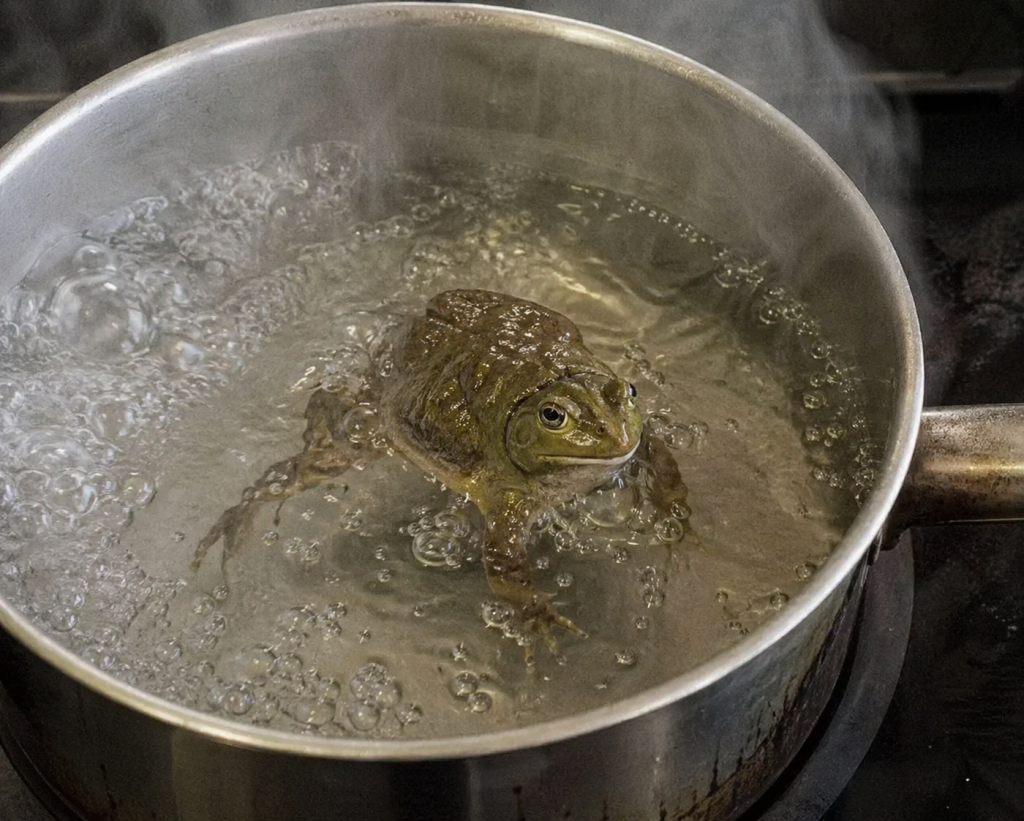
Where the story actually comes from
Like many widely accepted ideas, this one didn’t start as a deliberate myth. It traces back to 19th-century experiments where researchers were studying how living organisms respond to changes in temperature.
Over time, those observations were simplified, reinterpreted, and eventually turned into a story that was easier to understand and easier to pass on.
That’s usually how these things spread — not through intentional falsehood, but through oversimplification.
At some point, the metaphor stopped being treated as a metaphor and started being repeated as fact.
What really happens
In reality, frogs are not passive creatures sitting still in a dangerous environment. They are ectothermic animals, meaning their body temperature is influenced by their surroundings, but that doesn’t make them unaware.
On the contrary, they are sensitive to temperature changes.
As the water warms up, their bodies register the shift. There is a tolerance range, of course, but it’s not endless. Once the environment becomes uncomfortable or threatening, their instinct is to escape.
If they can jump out, they will.
The idea that a frog would remain there, unaware, until the very end doesn’t reflect real biological behavior. It’s a narrative device, not a scientific reality.
Why the story still makes sense to people
And yet, despite being inaccurate, the story continues to spread. You’ll hear it in psychology discussions, in business contexts, and especially in conversations about everyday life.
Not because it’s correct.
But because it feels true.
Humans don’t always react to gradual change. In fact, we’re wired to adapt to it.
If something breaks suddenly, we respond. If there’s a clear moment of danger, we notice. But when change happens slowly, step by step, something else takes over.
We adjust.
We tolerate a little more.
We delay reacting because it doesn’t feel urgent yet.
And those small adjustments don’t stay small. They accumulate.
Where this shows up in real life
You don’t need an experiment to see this pattern. It’s already part of everyday life.
In relationships, things rarely fall apart overnight. There isn’t always a dramatic moment that changes everything. Instead, communication fades, small frustrations build up, and emotional distance grows slowly, almost quietly.
At work, situations don’t usually become overwhelming in a single day. It happens over time — longer hours, constant pressure, less balance, less energy. Each step feels manageable on its own.
Even when it comes to health or lifestyle, the changes are often so gradual that they go unnoticed until the effects become impossible to ignore.
In all of these cases, there’s no clear alarm.
Just a slow shift.
The uncomfortable difference
Here’s the part that’s harder to admit.
Frogs, in reality, respond better than humans in this kind of situation.
They don’t rationalize discomfort. They don’t justify staying in an environment that no longer works for them. When conditions change, they react.
Humans, on the other hand, have the ability to explain things away.
We tell ourselves it’s temporary.
We convince ourselves we can handle it a little longer.
We wait.
And while we’re doing that, we stay longer than we should.
Why the metaphor refuses to disappear
The “boiling frog” story didn’t survive because it’s scientifically accurate.
It survived because it captures something real in a way that’s easy to understand.
It’s not about frogs.
It’s about how slowly things can change without triggering a reaction.
It’s about how we move our own boundaries without noticing.
And maybe that’s why it still resonates.
Not because it describes what frogs do.
But because, in certain moments, it describes exactly what we do.