
There are certain things people are vaguely aware of, but rarely stop to fully think through. Not because they’re hidden, but because they’re uncomfortable to look at closely. The idea that some animals are cooked alive falls into that category.
It isn’t a myth or an isolated exception. It’s a real practice, present in certain culinary traditions, shaped by history, necessity, and habit. At the same time, it’s a topic that has been receiving increasing attention in recent years, especially as science and ethics begin to intersect more openly.
It’s also important to understand the context. These practices typically don’t involve mammals or birds. They are mostly associated with marine life — particularly crustaceans and mollusks — where public perception has long been different.
Crustaceans: tradition meets scientific debate
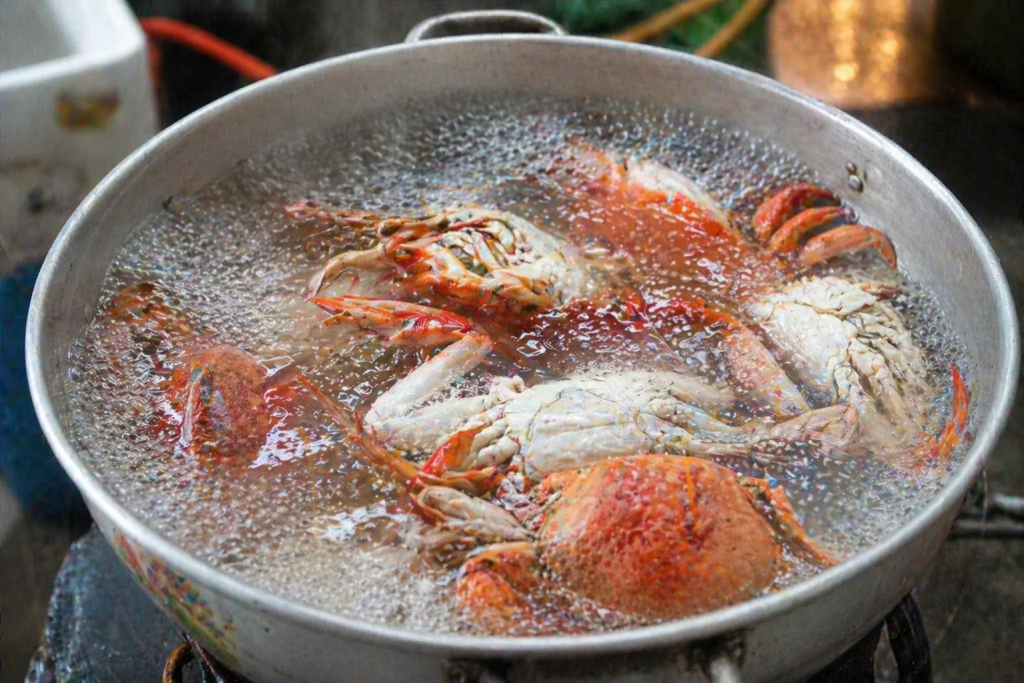
The most well-known examples are lobster and crab. In many kitchens, they are placed directly into boiling water or cooked immediately while still alive.
This approach didn’t appear randomly, and it isn’t based purely on habit.
The flesh of these animals begins to degrade quickly after death. Internal enzymes start breaking down tissue, and bacteria can multiply rapidly, potentially producing harmful compounds if the animal isn’t properly handled. Historically, when refrigeration wasn’t widely available, immediate cooking was a practical way to reduce risk.
There’s also a culinary argument. Many chefs believe this method helps preserve texture and flavor, maintaining a firmness that would otherwise be lost.
However, the conversation around this practice has shifted significantly.
Recent research on decapod crustaceans suggests that they may be capable of experiencing pain in more complex ways than previously assumed. Their responses are not limited to simple reflexes, but can involve behavioral changes and avoidance patterns.
As a result, some countries have begun to update their regulations. In Switzerland, for example, boiling crustaceans alive without prior stunning has been restricted, with more humane methods now required.
Mollusks: a more complex discussion
When it comes to mussels and oysters, the situation is less clear-cut.
These are often cooked alive or, in the case of oysters, consumed raw. Freshness is a key factor, and the fact that they are alive before preparation has traditionally been seen as a sign of safety.
The difference lies in their nervous systems. Bivalve mollusks do not have a centralized brain in the same way vertebrates — or even crustaceans — do. Their neural structure is much simpler, which is why the debate around their ability to feel pain remains ongoing.
Because of this uncertainty, the ethical discussion is less intense, although it is gradually gaining attention.
Less common but more controversial examples
There are also less frequent cases that tend to draw more public attention precisely because they feel more disturbing.
Preparations involving eel or even frog are sometimes mentioned in discussions, often in specific cultural contexts.
These examples are not representative of everyday cooking practices, but they highlight how different traditions can lead to very different standards — and reactions.
In many regions, such practices are already restricted or discouraged, either by law or by changing public attitudes.
Why these practices exist
If you look beyond the initial reaction, the reasons behind these methods become clearer.
Food safety has always been a major factor. Before modern refrigeration and transport systems, immediate preparation was often the safest option available.
Tradition also plays a strong role. Culinary practices are shaped over generations, and what begins as necessity can become identity.
Finally, perception matters. The way people view different types of animals directly influences how they are treated. There is a clear psychological difference between how we relate to mammals versus marine invertebrates.
What is changing today
In recent years, the conversation has been evolving.
Scientific research into animal sentience has challenged older assumptions, especially in the case of crustaceans. What was once seen as a simple biological process is now being reconsidered in terms of welfare and responsibility.
At the same time, technology has introduced alternatives. Devices designed to stun crustaceans quickly are becoming more accessible, offering a way to reduce suffering without affecting quality.
Consumers, too, are asking different questions. It’s no longer just about how food is prepared, but also about how it should be.
Between tradition and responsibility
This isn’t a simple topic, and it doesn’t have a universal answer.
It sits at the intersection of science, culture, habit, and ethics. And what makes it complex isn’t just the existence of these practices, but the way they force us to look at them more closely.
Because sometimes, the real question isn’t what ends up on the plate.
It’s how we choose to think about it once we know more.