
You’ve probably heard it countless times — “hourglass figure”, “pear shape”, labels that sound simple and almost official. They show up in conversations, in articles, across social media, and slowly they start to feel like something real, something we’re supposed to relate to.
But if you pause for a second… who actually decided these are the boxes we should fit into?
Because the body doesn’t really work in categories.
Hourglass, pear… or just a simplified way of seeing things
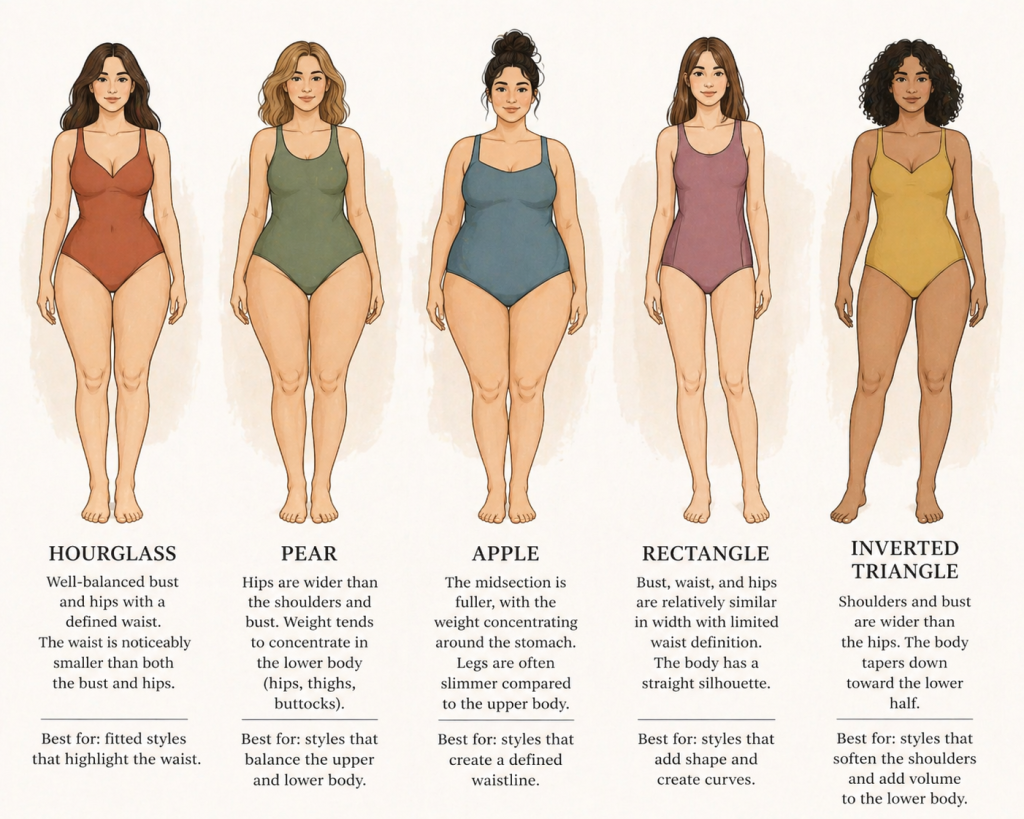
These labels didn’t come from medicine or biology. They come from fashion, from a need to describe proportions in a way that’s easy to visualize — shoulders, waist, hips.
The so-called hourglass figure, often treated as the “ideal”, describes a narrow waist with balanced proportions between the upper and lower body. The reality, though, is that this shape is far less common than we’re led to believe.
Meanwhile, the pear-shaped body — where the lower half is more pronounced than the upper — is much more frequent. And that’s not random.
What biology actually says
Beyond aesthetics, body shape is largely influenced by hormones and genetics, not preference or discipline.
Estrogen, the primary female hormone, tends to promote fat storage around the hips and thighs. That’s why many women naturally develop a pear-like distribution or something close to it.
Other hormonal patterns can lead to fat being stored more around the abdomen or more evenly across the body, resulting in very different silhouettes even among people with similar lifestyles.
In other words, two people can eat similarly, move similarly, and still look completely different — not because one is doing something wrong, but because their bodies are built differently.
The body doesn’t follow trends. It follows biology.
The health side no one really talks about
One detail that rarely makes it into popular conversations is that fat distribution actually matters for health.
Fat stored in the hips and thighs, typical for pear-shaped bodies, has been associated in many studies with a lower risk of metabolic conditions compared to abdominal fat.
So something often seen as an “aesthetic flaw” may, in fact, play a protective role.
It’s one of those cases where biological reality and social perception don’t quite align.
Why the “ideal” doesn’t match reality
Even though the hourglass figure is constantly promoted as a standard, most women don’t naturally fall into that category.
The most common body types are rarely the ones highlighted.
And this creates an interesting gap: people end up comparing themselves to something that is, statistically speaking, less common.
Not because there’s anything wrong with them, but because the reference point itself isn’t realistic.
What these labels leave out
Another important thing is that body shape isn’t fixed.
It changes over time, sometimes gradually, sometimes more noticeably. Hormones shift, metabolism adapts, life circumstances evolve, and the body responds accordingly.
That means the same person can go through different “shapes” throughout life without it meaning failure or loss of control.
It simply means the body is doing what it’s designed to do — adapt.
Between how we look and how we think we should look
Maybe the biggest gap isn’t between different body shapes, but between reality and expectation.
While the body follows complex biological processes, we try to fit it into simple, neat categories that don’t fully capture how diverse it really is.
And without realizing it, we start evaluating ourselves using a system that was never meant to define us in the first place.
The question that stays with you
Maybe the real question isn’t whether you’re an “hourglass” or a “pear”.
Maybe it’s why we feel the need to choose at all.
Because if you actually look around, most people don’t perfectly fit into any of these labels.
And yet… we keep measuring ourselves against them.