
Most of the time, there isn’t a clear moment when something “goes wrong.” No single event you can point to. It starts quietly: a bit of stiffness after sitting too long, a dull discomfort that comes and goes, that feeling that you need to stretch more often.
And because it’s not intense, we ignore it.
But according to World Health Organization, low back pain is one of the leading causes of disability worldwide. That says a lot. We’re not talking about rare cases, but about something extremely common, built over time through everyday habits.
What’s actually happening inside your spine
The spine isn’t just a rigid structure holding you upright. It’s a complex system made of vertebrae, intervertebral discs, ligaments, and muscles working together to support movement and balance.
The discs act like shock absorbers, taking on pressure and distributing it when you sit, walk, or lift things. One important detail highlighted in medical research is that these discs don’t have a strong direct blood supply, which makes their recovery slower compared to other tissues.
When you spend long periods sitting — especially leaning forward — the pressure on these discs increases. In fact, biomechanical studies show that sitting in a slouched position can put more stress on the lower spine than standing.
Not all back problems are the same
When we say “my back hurts,” we often treat it as one thing. In reality, there are several different conditions behind that discomfort.
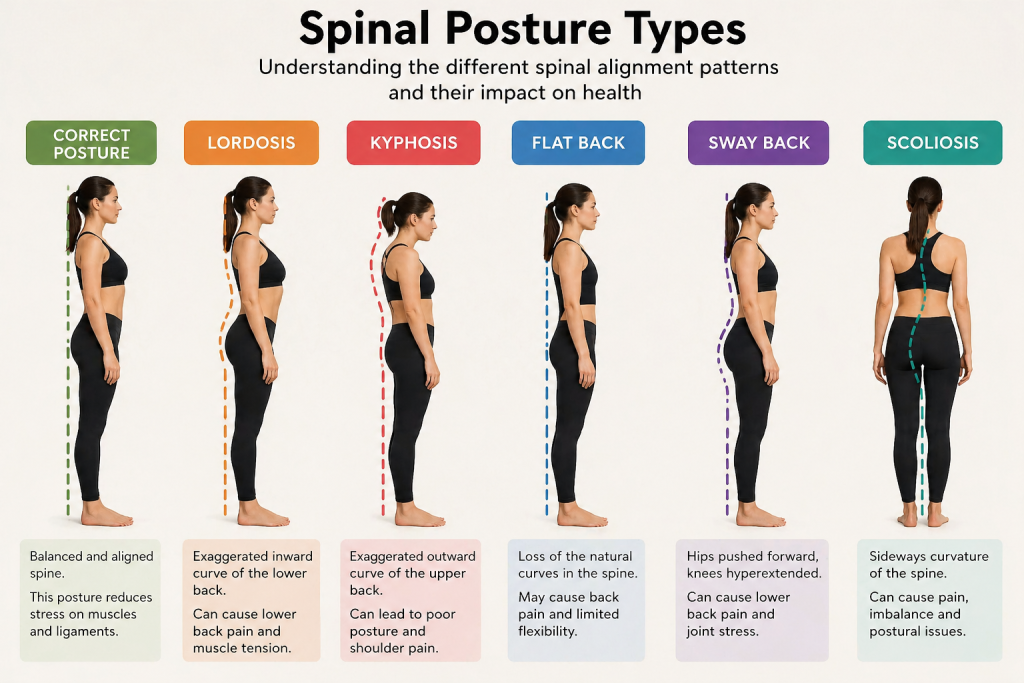
Scoliosis is a sideways curvature of the spine, often developing during childhood or adolescence. In many cases, it’s idiopathic, meaning there’s no clear cause, though genetics can play a role.
Kyphosis refers to an exaggerated forward curve in the upper back, leading to a rounded posture.
Lordosis is an increased inward curve in the lower back, sometimes linked to muscle imbalances or posture.
Spondylosis is related to wear and tear over time, involving degeneration of discs and joints.
A herniated disc occurs when a disc shifts or ruptures and presses on nearby nerves, often as a result of combined factors like posture, lifting habits, and inactivity.
Disc degeneration, often called discopathy, is a broader term describing changes in the discs before more serious complications appear.
Genetics or daily habits?
Some people are more prone to certain spinal conditions. But being predisposed doesn’t mean it’s inevitable.
In many cases, what really matters is routine: how much you sit, how often you move, how you position your body, and how you handle everyday loads.
Your spine doesn’t respond to what you intend to do. It responds to what you repeat.
The hidden cost of everyday actions
What we often overlook is how much the small, repeated actions matter.
Lifting children, for example, feels natural and harmless. But if you’re regularly picking up 15–25 kg, especially from awkward positions, the strain on your lower back can be significant. The risk increases even more when lifting involves twisting or bending forward.
Backpacks are another common issue. Health recommendations suggest that a child’s backpack should not exceed about 10–15% of their body weight. In reality, many exceed this limit, leading to postural changes and muscle strain.
Rolling backpacks (trolleys) seem like a better option, but they’re not perfect either. Pulling weight on one side of the body can create imbalance and uneven stress on the spine, especially over longer distances.
Even carrying groceries matters. When weight is held unevenly — for example, all bags in one hand — it places asymmetric load on the body, which over time can contribute to imbalance and discomfort.
The muscles that support everything
The spine doesn’t hold itself up alone. It relies on surrounding muscles, especially in the core, back, and pelvic area.
When these muscles are weak, more pressure is transferred to passive structures like discs and ligaments. When they are active and strong, they help distribute effort more evenly.
That’s why regular movement — even moderate — plays such an important role in maintaining spinal health.
What actually helps, in real life
You don’t need extreme changes. What matters is consistency.
Daily movement is more effective than occasional intense workouts.
Regular breaks are more important than trying to maintain a “perfect” posture all day.
Lifting correctly — using your legs instead of your back — reduces strain.
Balancing weight on both sides of the body makes a difference over time.
And maybe most importantly, paying attention to early signals before they turn into pain.
The routine that shapes your spine
You don’t damage your back in a single day.
You shape it every day.
Through repeated positions.
Through lack of movement.
Through “just a little” extra weight.
And because the effects don’t show up immediately, it’s easy to think it doesn’t matter.
The question that stays with you
Maybe the real question isn’t “why does my back hurt?”
Maybe it’s: what am I doing to it, every single day, without noticing?
Because over time, your spine doesn’t remember one moment.
It remembers your routine.