
Some things go viral almost instantly. Not always because they’re meaningful, but because they catch your attention. Sometimes it’s the energy. Other times, it’s that subtle feeling that something is… a bit off, even if you can’t explain it right away.
Lately, there’s been more and more discussion around children appearing in videos where they sing or dance to content that feels, at least to some, more aligned with adults than with them. It’s not just about lyrics. It’s the tone, the attitude, the way they’re encouraged to express themselves.
At first glance, it might not seem like a big deal. “It’s just a video.” “It’s just entertainment.” “Everyone does it.”
And still… if you sit with it for a moment, a question comes up that isn’t entirely comfortable.
Who is that content really for?
What we don’t always see at first
When it comes to children and public exposure, things are rarely simple. Organizations like the American Psychological Association have talked about “early adultification” — not just in appearance, but in behavior. It’s when a child begins to imitate or communicate things they don’t fully understand yet.
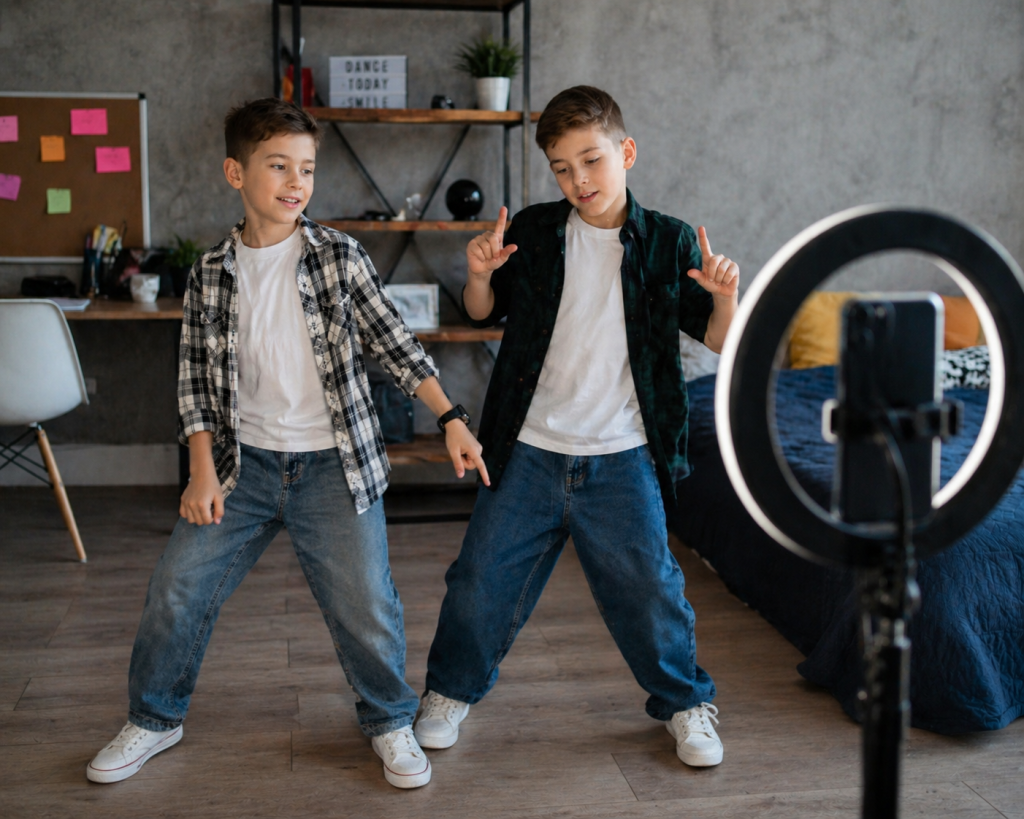
Research doesn’t say that every appearance is harmful. But it does suggest that, in certain contexts, children may develop a stronger need for external validation, feel pressure to perform, or struggle with forming a clear sense of identity.
At the same time, studies from Common Sense Media show that more and more children are growing up in environments where likes, comments, and shares become part of how they understand approval.
And that might shape more than we realize.
Somewhere between play and performance
On the surface, it can all look harmless. Kids have always sung, danced, and played.
The difference appears when there’s a camera, an audience, and sometimes something at stake — views, image, maybe even income.
At that point, things shift slightly. It’s no longer just play. It becomes performance.
And this isn’t necessarily about someone doing something “wrong.” Many parents genuinely see this as an opportunity — for confidence, visibility, maybe even a future path.
But even so, the question stays: how much does the child actually understand about the bigger picture?
The algorithm doesn’t see age
Social platforms aren’t built to protect childhood. They’re built to capture attention.
Content that generates reactions gets pushed further. And sometimes, what stands out the most is exactly that contrast between childhood and more “mature” behavior.
From the platform’s perspective, it doesn’t matter who’s in the video.
It matters how long people watch.
Are we really that different?
This is probably the part that made me pause the most.
Because the instinct is to say: “I wouldn’t do that.” Or “I wouldn’t expose my child like that.”
But if I’m being honest, I’m not sure the difference is always that big.
We share photos of our kids.
We film them.
We enjoy seeing them appreciated.
Sometimes we even encourage them to be funny, charming, noticeable.
There’s nothing inherently wrong with that. But the mechanism is there.
Validation. Attention. Image.
Maybe the difference isn’t in principle. Maybe it’s in how far each of us is willing to go.
Some take it further — for visibility, for opportunities, sometimes for money.
Others stop earlier, because something feels off.
But in a way, we’re still on the same spectrum.
So where is the line?
I’m not sure there’s a clear answer.
Maybe it’s not about deciding if something is right or wrong. Maybe it’s about asking a few questions more often than we usually do.
Does the child understand what they’re doing?
Can they say no?
Are they being protected, or simply exposed?
Are they encouraged to be themselves, or to perform a role?
And maybe most importantly… what stays with them afterward?
Because the internet doesn’t forget. And it doesn’t always filter things the way we would hope.
The question that stays
Maybe we’re not better or worse.
Maybe we’re just at different points along the same line.
And maybe the real difference isn’t whether you choose to share your child or not.
It’s how far you’re willing to go for attention, validation, or gain.
Where would you draw the line?