
There’s a quiet shift happening in how scientists talk about Mars. It’s no longer just a question of “Is there life there?” but something more unsettling: if the right conditions were once in place, how likely is it that nothing ever happened?
The latest findings don’t prove life existed. But they make that question harder to ignore.
A planet that didn’t always look like this
Billions of years ago, Mars was not the dry, frozen world we see today. Evidence gathered by the rover Curiosity inside Gale Crater shows that the area once hosted a long-lived lake, fed by rivers carrying fine sediments from higher ground.
Over time, those sediments settled into layers, forming clay-rich rocks. On Earth, this kind of environment is especially important because clay can trap and preserve delicate chemical compounds for extremely long periods, sometimes for billions of years.
But preservation is only part of the story. A stable lake system also means something else: persistent liquid water, relatively moderate conditions, and enough time for chemistry to evolve beyond simple reactions.
This wasn’t just water. It was a setting where complex chemistry had the chance to develop.
What the rover actually detected
Inside the rover is a compact laboratory called SAM (Sample Analysis at Mars), designed to study the chemical makeup of Martian rocks. The process involves heating drilled samples to release gases, which are then analyzed to identify their molecular structure.
In these recent analyses, scientists identified the most diverse set of organic molecules ever detected on Mars.
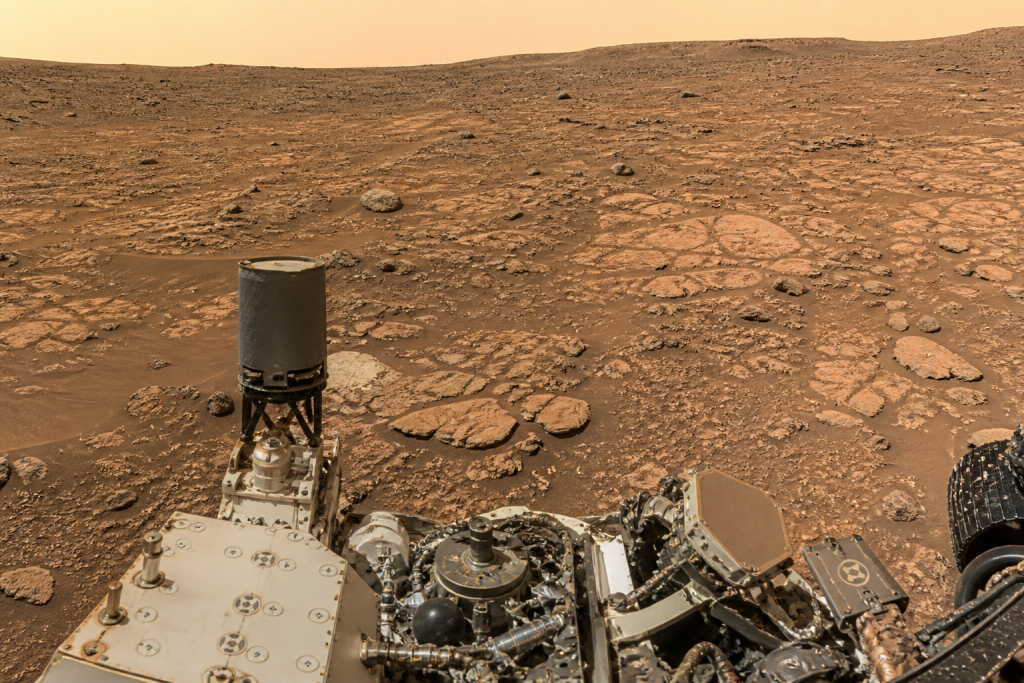
These compounds are carbon-based, and some include nitrogen, a key element in molecules like amino acids on Earth. What stands out is not just their presence, but their relative complexity compared to previous findings.
On our planet, similar molecules are often linked to biological processes. However, they can also form without life, through chemical reactions involving water, minerals, heat, or radiation.
So the discovery is not about what was found alone. It’s about how and where it was found.
Why the environment changes the meaning
If these molecules had been discovered in a harsh, unstable environment, heavily exposed to radiation and lacking signs of water, they could easily be explained as simple chemical byproducts.
But that’s not the case here.
They were preserved inside clay-rich rocks formed at the bottom of an ancient lake, shielded by layers that protected them over immense spans of time. This kind of preservation is strikingly similar to how ancient chemical traces are stored on Earth.
Even more important, the conditions that created and protected these molecules were not brief or accidental. They persisted long enough for chemical processes to build on each other, potentially increasing in complexity.
At this point, the question becomes difficult to avoid: when water, stability, and organic chemistry coexist, how far is that from something more?
Why this is not proof of life
Despite how intriguing this sounds, scientists are careful not to overstate what the data shows. Organic molecules are not, by themselves, evidence of life. They are better understood as building blocks, materials that life can use, but which can also form through non-biological processes.
To claim evidence of life, researchers would need far more specific signatures, patterns that cannot be explained without biological activity.
So far, Mars has not provided that level of proof.
Still, what has been confirmed is enough to reshape expectations. At some point in its past, Mars had conditions that were not just tolerable, but surprisingly close to those in which life emerged on Earth.
How Mars became the world we see today
The transformation didn’t happen overnight. Over time, Mars lost much of its atmosphere, largely because it lacks a strong global magnetic field like Earth’s.
Without that protection, solar wind gradually stripped away atmospheric particles, reducing pressure and allowing surface water to evaporate or freeze. As the atmosphere thinned, the planet became colder and more exposed to radiation.
The stable, water-rich environment disappeared, replaced by the harsh conditions we observe today.
Looking back, Mars doesn’t feel like a planet that never had a chance. It feels like one that lost it.
What comes next
Exploration is far from over. Missions like Perseverance are already collecting samples that could eventually be returned to Earth, where far more advanced instruments can analyze them in detail.
This next step is critical. Laboratory analysis on Earth could detect subtle chemical patterns that are impossible to confirm with onboard rover instruments alone.
For now, the discovery doesn’t close the case. It opens it wider.
Because once a planet shows it had water, long-term stability, and complex organic chemistry, the idea that absolutely nothing ever emerged there becomes a far more complicated assumption than it used to be.