
Some of the most effective dangers in nature don’t come with warning colors or aggressive behavior. They don’t try to scare you away. Instead, they do the exact opposite — they look harmless, soft, almost inviting.
This caterpillar, scientifically known as Megalopyge opercularis, is a perfect example of that kind of illusion. Often called the “puss caterpillar,” it resembles a small tuft of fur or even a soft brush. At a glance, there’s nothing about it that suggests danger.
And that is precisely what makes it risky.
Why it fools almost everyone who sees it
This larva is only a few centimeters long, yet it is completely covered in long, silky hairs that hide its actual body. You don’t see the typical segmented shape of a caterpillar, you don’t notice legs, and you certainly don’t see anything that signals “don’t touch.”
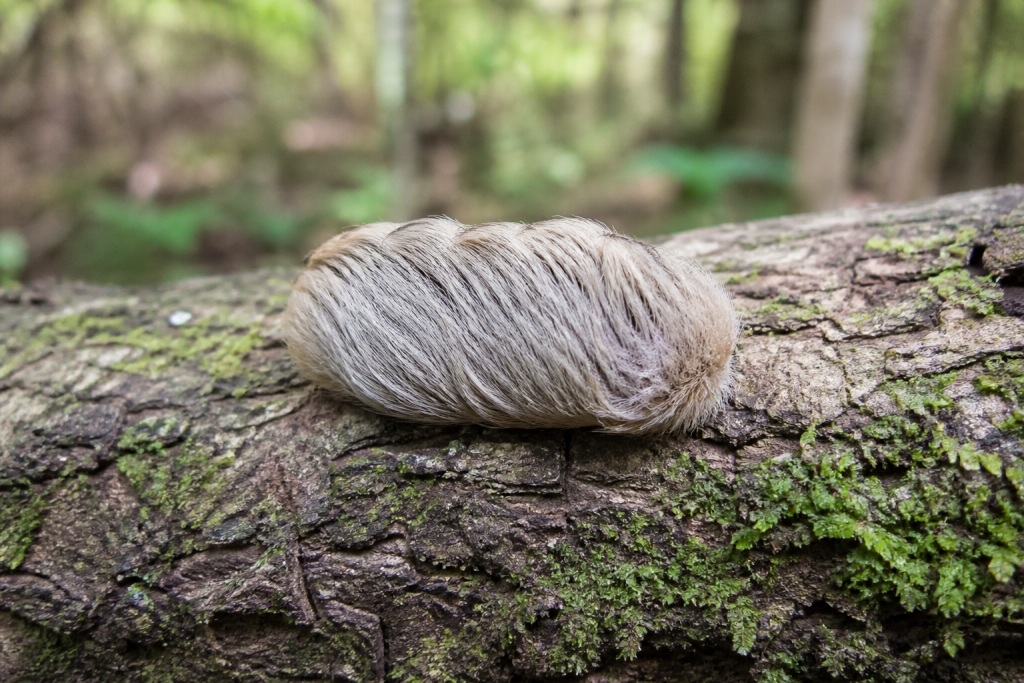
Its coloration ranges from pale cream to darker brown or gray tones, sometimes with a slight sheen that enhances its soft, almost fabric-like appearance. In natural light, it can easily be mistaken for debris, lint, or a small piece of fur caught on a leaf.
This isn’t accidental. From an evolutionary perspective, the lack of obvious warning signals reduces avoidance behavior in predators. It blends in not by hiding completely, but by appearing unthreatening.
Humans react the same way.
What’s hidden beneath that soft surface
Underneath that harmless-looking layer lies a surprisingly effective defense system. The visible hairs act like a cover, concealing tiny hollow spines connected to venom glands.
When the caterpillar is touched or pressed, these spines break off and embed into the skin, releasing venom into the tissue. Unlike bees or wasps, it doesn’t actively sting. Contact alone is enough to trigger the reaction.
Because the mechanism is passive and invisible, most people don’t realize what’s happening until the effects begin.
What happens after contact
The reaction is usually immediate. Many describe the pain as sharp and intense, with a burning sensation that appears within seconds and can become difficult to ignore.
Even though the contact area may be small, the discomfort doesn’t always stay localized. In some cases, the sensation can spread along the affected limb, creating a much broader feeling of pain than expected.
Visible symptoms often include redness, swelling, and a distinct rash pattern. Some people also report systemic effects such as headaches, nausea, or dizziness, especially after stronger exposure.
While most cases remain manageable, there are documented situations where the reaction was severe enough to require medical attention, particularly in children or sensitive individuals.
Where it lives and why people encounter it
This species is most commonly found in the southern and eastern United States, as well as parts of Mexico and Central America. It tends to inhabit trees like oak and elm, but it can also appear in gardens, parks, and residential areas.
It is most noticeable during warmer months, especially late summer and early autumn, when the larvae are larger and more visible.
Encounters with humans are not rare. In fact, they happen precisely because the caterpillar doesn’t look dangerous. People may try to remove it, brush it off, or simply touch it out of curiosity.
A lesser-known detail: the chemistry behind it
Recent research into caterpillar venoms suggests that some of the toxic components found in these species are unusually complex. There is even evidence indicating that certain toxin-related genes may have originated from bacteria through rare evolutionary processes.
This makes the caterpillar more than just an unpleasant encounter. It turns it into an example of how different biological systems can combine over time to produce highly effective defense mechanisms.
Why it keeps going viral
Because it challenges a very basic human instinct: the idea that appearance reflects safety.
Soft usually means safe. Small usually means harmless. This caterpillar breaks both assumptions in a way that’s hard to forget.
It doesn’t look dangerous. It doesn’t behave aggressively. It doesn’t warn you.
And yet, it’s one of those rare cases where the difference between how something looks and what it actually is can have very real consequences.
One simple thing worth remembering
If you ever see something that looks like a small tuft of fur attached to a leaf or a tree, the safest reaction is simple: don’t touch it.
Because sometimes, the quietest things are the ones hiding the most unexpected defenses.