
The story began before the crash
On February 9, 2004, 21-year-old Maura Murray was a nursing student at the University of Massachusetts Amherst. Officially, her disappearance begins that evening on a quiet road in New Hampshire, but the events leading up to it are part of what has made the case so difficult to understand for more than two decades.
Earlier that day, Maura emailed professors and supervisors saying there had been a death in the family and that she would be away for several days.
Later, her family clarified that no such death had occurred.
At the same time, she searched for directions, looked into possible lodging options in northern New England, packed belongings into her black Saturn sedan, and left campus.
None of these actions clearly explain what she intended to do.
But together, they suggest the trip was planned—at least to some degree.
Heading north
That afternoon, Maura drove away from Amherst toward the mountains of New Hampshire.
To this day, no confirmed explanation has been established for why she chose that destination. Investigators uncovered indications that she may have been considering areas connected to vacations, cabins, or places where she had traveled before, but no definitive plan was ever publicly identified.
This uncertainty became one of the central mysteries of the case.
Was she trying to get away for a few days?
Was she overwhelmed and seeking isolation?
Was she meeting someone?
Or was the trip never meant to become permanent at all?
From a psychological perspective, sudden departures like this can happen during periods of stress, emotional exhaustion, impulsive decision-making, or a desire to temporarily disconnect from daily pressures. None of that explains the disappearance itself, but it helps explain why her behavior remains open to interpretation.
The crash on Route 112
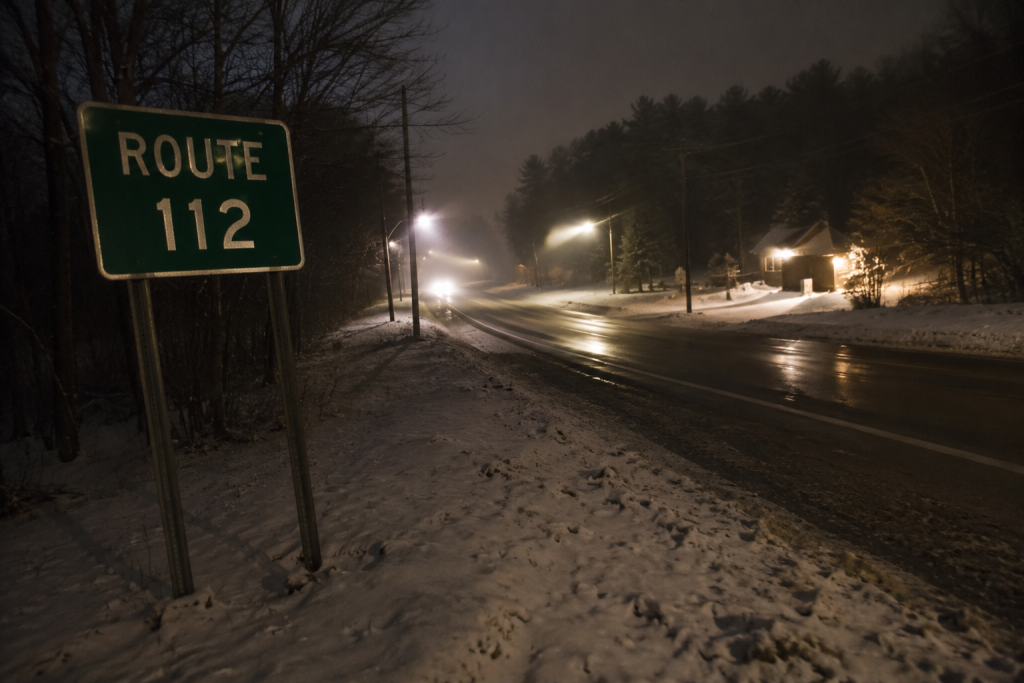
At approximately 7:30 p.m., Maura’s vehicle crashed along Route 112 near Woodsville, in the town of Haverhill.
The accident did not appear catastrophic. Her car had gone off the road and suffered damage, but there was no indication of a violent collision severe enough to explain an immediate disappearance.
A nearby resident called emergency services after noticing the vehicle.
Shortly afterward, a local school bus driver stopped and briefly spoke with Maura. According to public reports, she declined help and claimed she had already contacted roadside assistance, even though cellular service in the area was known to be poor.
That short conversation became one of the final confirmed interactions with her.
The minutes that changed everything
One of the most unsettling aspects of the case is how little time passed between the witness sightings and the arrival of law enforcement.
We are not talking about hours.
Only minutes.
When the first police officer arrived at the scene, Maura was gone.
Her car remained at the roadside, but there was no clear indication of where she had gone next. No confirmed footprints leading away. No reliable witness seeing her leave in another vehicle. No camera footage. No final message.
Inside and around the car were personal belongings and signs that suggested she had been there moments earlier. One frequently discussed detail was a rag found in the tailpipe—something her family later connected to a temporary measure related to mechanical problems with the vehicle.
But even that detail answered nothing.
Search efforts and difficult terrain
By the following day, Maura was officially treated as a missing person, and search operations intensified.
The conditions complicated everything:
snow-covered roads, freezing temperatures, dense wooded areas, and terrain where tracks could disappear quickly or become impossible to interpret accurately.
Search teams used tracking dogs and combed through the surrounding forests and roadside areas. According to reports, one scent trail appeared to continue briefly before stopping abruptly.
Some interpreted that as a possible indication she entered another vehicle.
But again, an indication is not the same thing as proof.
That distinction matters greatly in unresolved cases.
Theories—and the difference between theories and facts
Over the years, Maura Murray’s disappearance has generated countless theories.
Some believe she became disoriented after the crash and succumbed to the environment. Others think she encountered someone while trying to leave the area. There are also theories involving voluntary disappearance, although her family has repeatedly challenged that idea.
Officially, however, the confirmed facts remain relatively limited:
Maura left campus, drove north, crashed on Route 112, spoke briefly with a witness, and disappeared before police arrived.
The case remains open, and the FBI missing persons listing for Maura Murray continues to classify her as missing.
One of the internet’s earliest true-crime obsessions
Maura Murray’s disappearance became one of the most heavily discussed missing person cases online during the early growth of internet true-crime communities.
Forums, blogs, documentaries, podcasts, and social media discussions kept the story alive year after year.
That visibility helped ensure the case was never forgotten.
But it also blurred the line between verified information and speculation.
As often happens in long-running mysteries, people began analyzing every message, every decision, every small inconsistency—sometimes creating narratives far beyond what evidence could support.
For families, that kind of attention can become deeply exhausting.
What science and psychology can—and cannot—explain
From a behavioral perspective, the case contains several elements that can occur during periods of emotional strain or acute stress.
After a crash in an isolated area, especially at night and in winter conditions, people may make impulsive decisions driven by panic, fear of consequences, confusion, embarrassment, or a desire to avoid contact with authorities.
But psychology alone cannot solve the case.
Investigators often point out that the first minutes after a disappearance are critical. If someone leaves the scene quickly in an area with few witnesses and no surveillance cameras, reconstructing what happened afterward becomes dramatically more difficult.
In Maura’s case, the timeline is short—but the unanswered gap inside it is enormous.
A family still searching for answers
For years, Maura’s father, Fred Murray, continued speaking publicly about the investigation and pushing for renewed attention to the case. More recently, her sister Julie Murray has also worked to separate confirmed facts from rumor and speculation.
The family continues to believe someone may still know more than they have said publicly.
A story frozen between the crash and the arrival of police
The disappearance of Maura Murray remains unresolved.
There is a vehicle. A road. Witnesses. Phone calls. Emails. A timeline.
But the central piece is still missing.
What happened during those few minutes between the crash and the arrival of police?
Did she leave on foot and become lost?
Did she accept a ride from someone?
Did she panic and try to avoid the consequences of the accident?
Or did something happen that no one has been able to reconstruct?
More than twenty years later, there is still no confirmed answer.
And perhaps that is what continues to make the case so haunting.
Not because nothing is known—but because enough is known to make it feel as though the truth should have been close, just beyond reach, somewhere along that snowy stretch of Route 112 where the story suddenly disappears into the dark.