
In the summer of 1974, nine-year-old Pauline Dakin climbed into a Volkswagen camper with her mother and younger brother, convinced they were leaving for a short family trip. Nothing about that day suggested it would quietly erase the life they had known before. She would later remember the long drive, the tense silence between adults and the strange feeling that nobody wanted to answer simple questions directly. At first, it felt confusing. Later, it would feel terrifying.
After arriving in Winnipeg, Pauline’s mother told the children they would never be going back home.
For a child, the announcement made almost no sense. There had been no goodbye to friends, no explanation, no warning that their entire world had just disappeared. From that point forward, fear became part of everyday life. The family moved repeatedly, changed schools often and lived as if someone dangerous might appear at any moment.
Years later, Pauline would discover that her entire childhood had been shaped around stories involving organized crime, hidden enemies and secret protection networks. The most disturbing part was that much of it may never have been real at all.
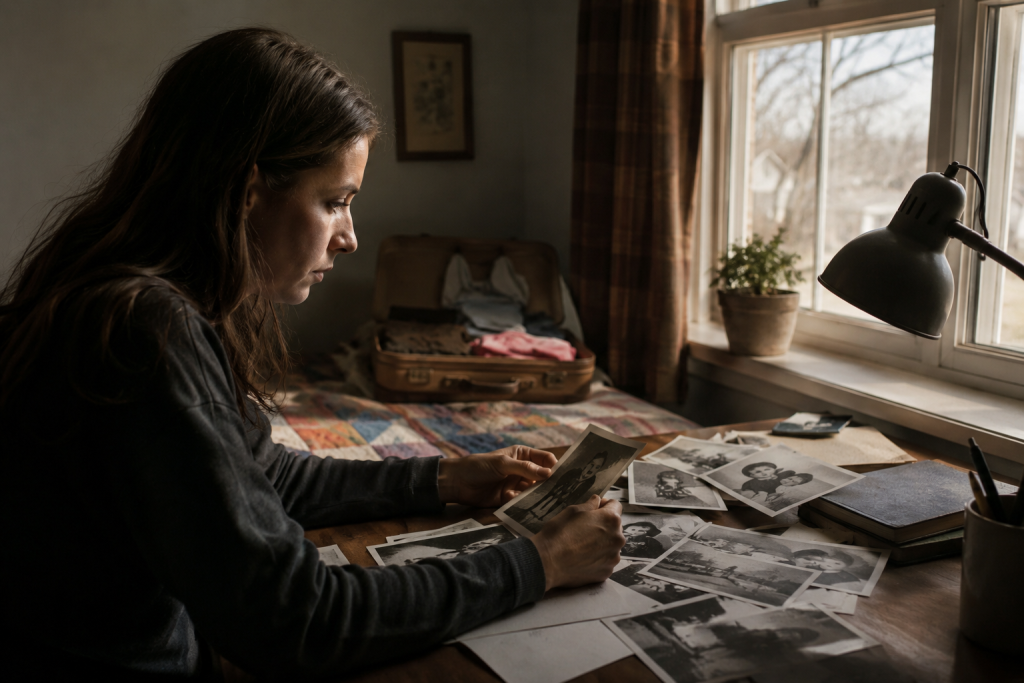
A childhood shaped by fear and secrecy
Pauline grew up in Canada during a time when her family already felt unstable. Her parents had separated when she was young, and her mother, Ruth, was left raising two children largely on her own. Pauline’s biological father was described as alcoholic and unpredictable, which made the separation appear understandable to those around them.
Not long afterward, a United Church minister named Stan Sears became deeply involved in the family’s life. At first, he appeared caring, intelligent and dependable. Pauline later explained that nothing about him matched the stereotype people usually imagine when they think about manipulation or delusion. He spoke calmly, behaved rationally and seemed genuinely concerned for the family’s safety.
Over time, however, Stan began introducing the idea that the family was in serious danger.
The warnings started subtly. The children were told not to share personal information. They were encouraged to be cautious around strangers. Eventually, the atmosphere became dominated by secrecy and suspicion. Pauline and her brother were raised to believe that their lives depended on staying invisible.
For children, fear communicated repeatedly by trusted adults can become indistinguishable from reality itself. Researchers studying childhood anxiety have long noted that children often absorb danger through the emotional reactions of parents and caregivers. When the adults around them appear constantly fearful, the brain begins treating the world as fundamentally unsafe.
That process seemed to define Pauline’s childhood.
Constant moves and the feeling that nowhere was home
Following the family’s sudden departure from Vancouver, life became a series of abrupt relocations. Pauline attended multiple schools across different provinces, sometimes leaving with almost no notice. Friendships disappeared overnight. Homes felt temporary. Stability became impossible.
She later described living with the constant sensation that everything could collapse at any moment.
Psychologists often associate repeated instability during childhood with hypervigilance, a condition in which the nervous system remains permanently alert for danger. Over time, this can affect trust, emotional regulation and a person’s long-term sense of safety. Children raised in unpredictable environments frequently struggle to feel secure even decades later.
What made Pauline’s experience even more confusing was the lack of clear explanations. Her mother repeatedly told the children that they would “understand when they were older.” The secrecy itself became part of the fear.
The shocking explanation that seemed to answer everything
When Pauline was in her twenties, her mother and Stan finally revealed what they described as the truth.
According to them, Pauline’s biological father had connections to organized crime and the family had spent years hiding from dangerous people connected to the mafia. Stan claimed he was linked to a covert protection network that secretly relocated vulnerable families and kept them alive.
Suddenly, years of confusion appeared to make sense.
The moves, the paranoia and the constant warnings finally seemed connected by a single explanation. Even though parts of the story sounded unbelievable, Pauline wanted desperately to understand her past, and this narrative offered a framework for everything she had experienced growing up.
Stan described hidden communities, surveillance systems and secret organizations operating behind the scenes. There was even internal language for this imagined world. Members of organized crime were referred to as “The O,” while safe areas were called the “Place of Hope.”
Looking back later in life, Pauline realized that the story became believable because it had been built slowly over many years. Fear had not arrived all at once. It had been introduced piece by piece until it shaped the entire structure of reality around the family.
When the entire story began to fall apart
By the early 1990s, Pauline had become a journalist. Her professional experience gradually changed the way she processed information. Instead of automatically accepting dramatic explanations, she began noticing contradictions and details that could never be verified.
Eventually, exhausted by years of fear, she decided to test the system herself.
Pauline falsely told her mother and Stan that her apartment had been broken into. In reality, nothing had happened.
Soon afterward, Stan began offering elaborate explanations about who had supposedly entered the apartment and why. For Pauline, the moment was devastating. It forced her to confront the possibility that the terrifying world she had been raised to believe in might never have existed.
The realization shattered far more than a single story.
She later described the experience as losing trust in reality itself. When someone grows up inside a carefully constructed system of fear, untangling truth from fiction can become psychologically overwhelming. Every memory suddenly feels uncertain.
Trying to rebuild a life after years of psychological manipulation
After distancing herself from the beliefs that had shaped her childhood, Pauline spent years trying to understand what had happened inside her family. Mental health experts later discussed the possibility that Stan Sears may have suffered from a severe persecutory delusional disorder and that Pauline’s mother had gradually become absorbed into the same worldview.
Some specialists also referenced a phenomenon known as shared delusional disorder, historically called “folie à deux,” in which one person’s fixed false beliefs are transmitted to someone emotionally close to them.
Pauline eventually built a respected career with CBC, working extensively in journalism and health reporting. Many readers later noted the irony that someone raised in an environment filled with paranoia and misinformation would dedicate her adult life to evidence, facts and verification.
In 2017, she published her memoir, Run, Hide, Repeat: A Memoir of a Fugitive Childhood. The book received widespread attention for its deeply personal exploration of fear, manipulation and the fragile nature of trust inside families.
What continues to fascinate people about Pauline Dakin’s story is not simply the mystery surrounding her childhood. It is the unsettling reminder that reality itself can become distorted when fear is repeated often enough by the people we trust most.