
A Friday night that looked completely ordinary
On March 31, 2006, 27-year-old Brian Shaffer was a medical student at the Ohio State University College of Medicine in Columbus. He was approaching spring break after an exhausting academic period filled with exams, long study hours, and the pressure that often comes with medical training.
Within days, he was supposed to leave for a vacation in Florida with his girlfriend, Alexis Waggoner.
From the outside, Brian’s life appeared stable and focused. He had career goals, close relationships, and plans for the near future. But there was also grief beneath the surface. Only weeks earlier, his mother, Renee Shaffer, had died from cancer, a loss that deeply affected the family and later became part of the public conversation surrounding the case.
That Friday evening began normally.
Brian had dinner with his father, Randy Shaffer, before heading out with friends near the university district. The area around South Campus Gateway was crowded with students, bars, music, and weekend nightlife. Nothing about the night initially suggested danger.
The bar where the timeline stops
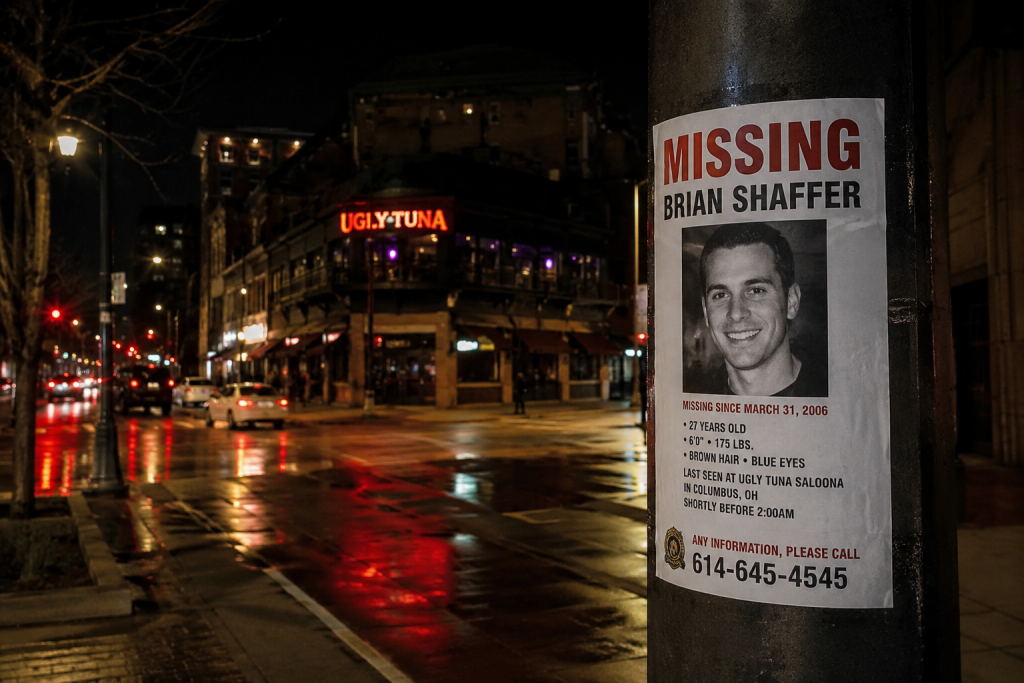
Later that night, Brian and his friends arrived at Ugly Tuna Saloona, a popular bar located on the second floor of the South Campus Gateway complex.
Security cameras captured Brian entering the area around 1:15 a.m. alongside his friend Clint Florence and Meredith Reed. Hours later, close to closing time, cameras recorded him again near the entrance, briefly speaking with two women.
Those images became the final confirmed sighting of Brian Shaffer.
What makes the case so unsettling is what happened afterward—or rather, what didn’t happen.
Investigators could not find any footage clearly showing him leaving the building.
When friends assumed he had already gone home
As the bar closed, Brian’s friends realized they had lost track of him. At first, this didn’t seem alarming. In crowded nightlife environments, people often separate temporarily, leave with other groups, or head home without warning anyone.
Initially, his friends believed exactly that:
that Brian had simply left before them.
But as hours passed and no one heard from him, the situation began to feel increasingly wrong.
He never returned home.
He never contacted Alexis.
He never used his bank cards again.
He missed the planned trip to Florida.
No confirmed activity connected to him appeared afterward.
What first looked like a simple misunderstanding quickly became one of the strangest missing person cases in modern American true crime.
The surveillance footage and the impossible question
Investigators focused heavily on the bar and surrounding building.
Security footage from the main entrance was reviewed repeatedly. Police examined exits, stairwells, nearby streets, construction areas, and service access points. One difficulty was that the building layout included areas not perfectly covered by cameras, including construction-related sections and employee exits.
Because of that, authorities considered the possibility that Brian may have left through an unmonitored route.
But even that theory raised problems.
Despite extensive review of surveillance footage from nearby businesses and surrounding streets, no confirmed footage ever showed Brian leaving the area after the final video appearance near the entrance.
The central question remained the same:
If he left, how did nobody see him?
Search efforts across Columbus
Police and volunteers searched the surrounding area extensively.
Investigators checked dumpsters, nearby alleys, construction zones, drainage areas, and locations around the campus district. Brian’s apartment was examined, and his vehicle remained parked where expected. There were no obvious signs suggesting preparation for a voluntary disappearance.
Tracking dogs were used.
Witnesses were interviewed.
Flyers spread throughout Columbus.
Yet nothing led to a definitive answer.
As the days turned into weeks, the case became increasingly difficult to explain because the disappearance occurred in a busy urban environment rather than an isolated location.
The phone calls that briefly gave hope
One of the most emotionally difficult parts of the case involved Brian’s cellphone.
After he disappeared, Alexis repeatedly tried calling him. At one point, reports indicated the phone appeared to ring rather than go directly to voicemail, briefly creating hope that Brian—or at least the phone—might still be active.
Later explanations suggested the signal may have resulted from network irregularities rather than deliberate use of the device.
For investigators, that distinction mattered technically.
For loved ones, it changed everything emotionally.
In unresolved disappearances, even a single uncertain signal can reopen hope for a moment before reality closes it again.
Theories and speculation
Over the years, many theories developed around the case.
Some people believe Brian may have suffered an accident somewhere within or near the building. Others think he successfully exited through an unmonitored route and encountered danger later. There have also been theories involving voluntary disappearance, particularly because of the emotional stress he had experienced following his mother’s death.
But publicly available evidence has never confirmed any of those possibilities.
Brian had future plans, close relationships, and no clear trail suggesting he intentionally started a new life elsewhere.
More sensational online theories eventually emerged as well, including attempts to connect the case to broader serial crime theories, though law enforcement has treated such claims cautiously and without confirmation.
And that is one reason the case remains so haunting:
there are possibilities, but very little certainty.
Why the case feels so disturbing
Many disappearances happen in isolated places.
Brian Shaffer vanished in a crowded entertainment district surrounded by people, lights, security cameras, and nearby witnesses.
Psychologically, that creates a powerful contradiction.
People naturally believe that modern surveillance and busy public spaces should prevent someone from disappearing completely. When a case appears to defy that expectation, the mind keeps searching for the missing piece:
a hidden exit,
a camera angle,
a witness who overlooked something,
a detail misunderstood at the time.
But after years of investigation, that missing piece still hasn’t appeared.
Additional tragedy for the family
The years following Brian’s disappearance brought another devastating loss for the Shaffer family.
In 2008, Brian’s father, Randy Shaffer, died after being struck by a falling tree branch during a storm while cleaning debris outside.
Shortly afterward, an online condolence message signed “Brian” appeared, claiming he was alive in the Virgin Islands. Investigators later traced the message to a public computer in Franklin County and determined it was likely a hoax.
For families of missing persons, false hope can become another form of trauma.
A case that remains open
Brian Shaffer’s disappearance has never been solved.
Authorities continue to receive occasional tips, and the case remains active. In 2021, an age-progression image was released showing how Brian might look years later if still alive.
Even now, investigators have never been able to reconstruct his movements after those final moments near the entrance of the bar.
What criminology and psychology reveal about cases like this
From an investigative perspective, crowded urban disappearances can become surprisingly difficult to solve.
Large amounts of information do not always create clarity. Cameras miss angles. Witnesses forget details. Alcohol, noise, fatigue, and distraction affect memory and observation.
Human memory does not function like perfect video playback. In a crowded nightlife setting, most people unconsciously filter out surrounding faces and movements unless something immediately appears important.
Only afterward does everyone begin trying to remember what they barely noticed at the time.
In Brian’s case, information exists.
But the crucial sequence—the moment explaining what happened next—appears to be missing.
A story that ends at the doorway of a bar
Today, Brian Shaffer’s disappearance remains one of the most discussed unsolved missing person cases in the United States.
There are surveillance images.
There are witnesses.
There is a timeline.
And still, there is no answer.
A medical student walked into a crowded bar during a normal Friday night out, appeared on security cameras shortly before closing time, and then disappeared from every confirmed trace.
Perhaps that is why the case continues to stay with people years later.
Not because nothing is known—
but because it feels as though the explanation should have been there somewhere all along, hidden in a hallway, a doorway, a missed camera angle, or a moment nobody understood in time.