
In 2014, a medical case from India captured worldwide attention after surgeons revealed that they had removed 232 tooth-like structures from the jaw of a 17-year-old boy. The story quickly spread across international media outlets, with many headlines describing it as “the boy with hundreds of teeth.”
Behind the shocking headlines, however, was a real and medically documented condition that specialists considered extraordinarily rare.
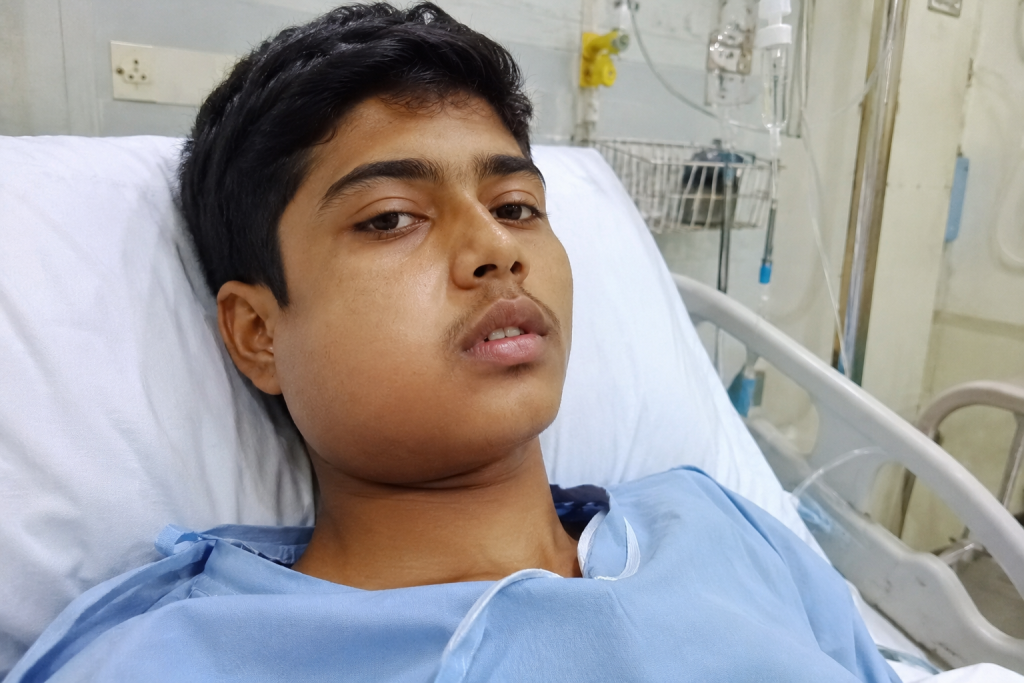
The teenager, Ashik Gavai, had spent months living with a painful swelling on the right side of his face before doctors finally discovered what was happening inside his jaw.
The Swelling That Continued to Grow
Ashik lived in the Indian state of Maharashtra and was still a teenager when the symptoms began. At first, the swelling appeared gradually and did not seem especially alarming. Like many families facing limited access to specialized medical care, his relatives initially assumed it might be a common dental problem or a temporary infection.
But over time, the swelling became impossible to ignore.
The right side of his lower face grew noticeably larger, and the pain intensified as the months passed. Reports published after the surgery stated that the condition had begun affecting both his appearance and his ability to live normally.
Eventually, his family brought him to Mumbai’s J.J. Hospital, where specialists in maxillofacial surgery examined the teenager more closely.
Doctors Realized Something Was Unusual
The medical team quickly understood that this was not a typical dental infection.
Scans of the jaw revealed a dense and highly unusual mass occupying part of the lower mandible. Because of the way the structure appeared on imaging tests, doctors suspected a type of odontogenic tumor, meaning a growth connected to the tissues involved in tooth development.
Even then, the surgeons did not anticipate the scale of what they were about to find.
According to statements made later by the medical team, the case became more surprising as the operation progressed.
The Seven-Hour Surgery
The surgery reportedly lasted around seven hours.
When surgeons opened the affected section of the jaw, they did not find a single compact mass. Instead, they began discovering numerous tiny calcified structures embedded inside the tissue.
Some resembled miniature teeth with recognizable crown-like shapes. Others were extremely small and appeared more like white pearls or fragments of hardened tissue.
The surgeons continued removing them one by one.
The number kept increasing.
By the end of the procedure, the medical team announced that they had extracted 232 separate tooth-like structures from the teenager’s jaw.
Photographs taken after the operation, showing the hundreds of tiny structures laid out on a tray, quickly circulated across the world and turned the case into an international medical curiosity.
What Doctors Actually Found
Although the story is often described online as “a boy who grew 232 teeth,” the reality is more medically complex.
Doctors diagnosed the condition as a compound odontoma, a rare benign odontogenic tumor formed from dental tissue.
Instead of producing normal teeth in the usual pattern, the tissue develops abnormally and creates multiple small tooth-like formations inside the jawbone. These formations can contain enamel, dentin, and other dental tissues, but they are usually malformed or incomplete.
Odontomas are considered the most common benign odontogenic tumors, yet most cases are relatively small and discovered accidentally during routine dental imaging.
Cases involving such a massive number of structures are exceptionally rare and remain highly unusual even in medical literature.
Why Conditions Like This Can Happen
Researchers still do not fully understand why odontomas develop.
Some studies suggest that genetics may play a role, while others discuss possible links to trauma, developmental abnormalities, or disruptions that occur while dental tissues are forming during childhood.
Under normal circumstances, tooth development is an extremely organized biological process. Specialized cells communicate through chemical signals that guide the formation of enamel, roots, and dental structure. When this process becomes disrupted, tissues may begin developing in abnormal ways.
In Ashik’s case, the growth expanded slowly inside the mandible and pushed against surrounding tissue, which explained the severe swelling and facial distortion.
Fortunately, the tumor was not cancerous.
Recovery and International Attention
Following the surgery, doctors stated that the teenager recovered well and that major facial deformities had been avoided. The operation relieved the pressure inside the jaw and allowed surgeons to reconstruct the affected area as carefully as possible.
The case continued to attract attention for years afterward because of how unusual it was, even by medical standards.
For many people, the idea that the human body could develop hundreds of tooth-like structures inside a single jaw sounded almost impossible. Yet the case was publicly documented through medical reports, hospital statements, imaging, and photographs released after the surgery.
Today, Ashik Gavai’s story is still frequently mentioned in discussions about rare dental abnormalities and unusual medical conditions.
Perhaps the most unsettling detail is how ordinary the first symptom seemed at the beginning: a swollen cheek that gradually kept getting bigger.