
In the first half of the twentieth century, severe neurological disabilities were often misunderstood in ways that are difficult to imagine today. Children who struggled to speak or control their movements were frequently labeled as “hopeless,” even when they were fully aware of everything happening around them. Many families were told there was little point in trying to educate them, and institutionalization was commonly recommended.
It was in that world that Christy Brown was born.
His story would later become one of the most remarkable examples of human determination ever documented, not because he fit the image of a flawless inspirational figure, but because he refused to disappear into the silence that society expected from him.
A Childhood Marked by Poverty and Misunderstanding
Christy Brown was born on June 5, 1932, in Dublin, Ireland, into a large working-class family struggling to survive during difficult economic times. He was one of 22 children born to Bridget and Patrick Brown, although several of his siblings died young, something that was sadly not uncommon in poor families of that era.
From infancy, it became clear that Christy could not control his body normally. His muscles were rigid, his movements unpredictable, and his speech development severely affected. Doctors eventually diagnosed him with cerebral palsy, a neurological condition caused by damage to the developing brain.
At the time, medical understanding of cerebral palsy was still limited. Because Christy could not communicate clearly and had almost no physical control, some doctors assumed he also had a severe intellectual disability. His parents were reportedly advised not to expect much from him academically or socially.
But one person refused to accept that conclusion.
The Mother Who Believed He Was Listening
Christy’s mother, Bridget Brown, had very little formal education herself. She was raising a huge family under extremely difficult financial conditions, yet she remained convinced that her son understood far more than people realized.
She noticed the way his eyes followed conversations. She saw his reactions to voices, emotions, and daily events inside the home. While many people spoke around him as though he were incapable of understanding language, she believed there was an intelligent child trapped behind the limitations of his body.
That belief changed everything.
Instead of isolating him from family life, Bridget Brown constantly involved Christy in conversation and daily activities. She searched for any sign that he could intentionally control part of his body.
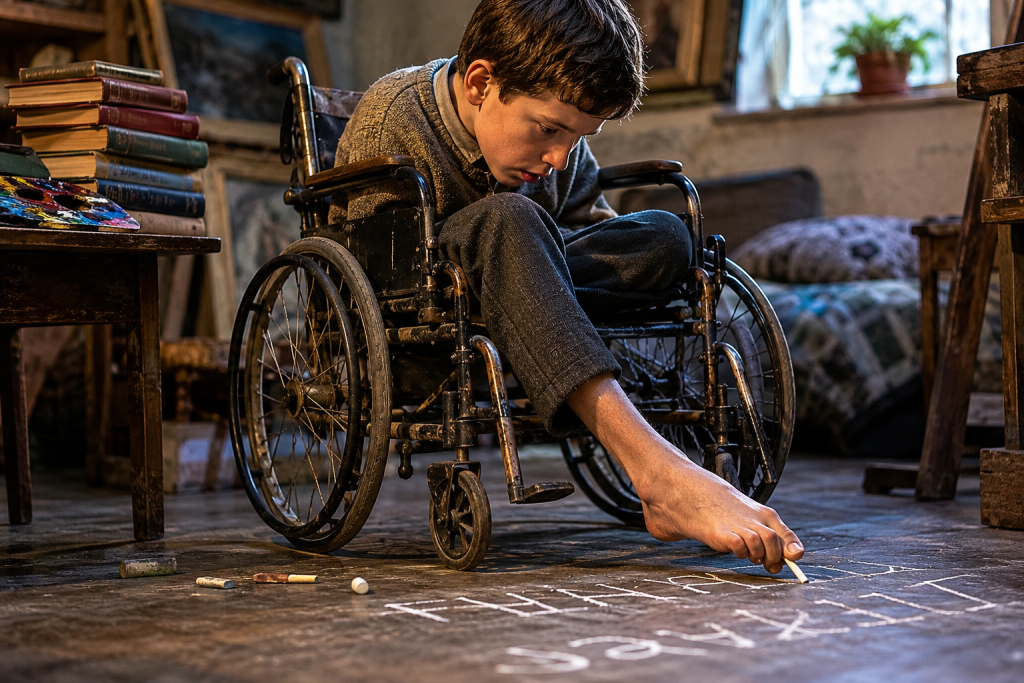
Eventually, she discovered that he had limited but meaningful control over his left foot.
The Moment That Changed His Life
According to Christy Brown’s own autobiographical accounts, one of the defining moments of his childhood came when he managed to grasp a piece of chalk between the toes of his left foot.
For most people, that sounds simple. For a child living with severe cerebral palsy, it represented an enormous neurological and physical challenge. His brain could form thoughts clearly, but translating those thoughts into controlled movement was incredibly difficult.
After repeated attempts, he succeeded in making marks on a surface.
Eventually, he formed letters.
The first meaningful word he reportedly wrote was “Mother.”
For his family, it was undeniable proof that the boy many people had dismissed as unreachable was fully aware, intellectually present, and capable of learning.
Understanding Cerebral Palsy Beyond the Stereotypes
Cerebral palsy is not a single disease but a group of neurological disorders that affect movement, posture, and muscle coordination. The condition is usually caused by damage to the developing brain before or during birth, or shortly afterward.
Modern medical research emphasizes an important fact that was often overlooked in earlier decades: physical disability and intellectual ability are not the same thing.
Some individuals with cerebral palsy do have cognitive impairments, while others possess average or even exceptional intelligence. In Christy Brown’s case, his greatest challenge was communication and motor control, not understanding.
His life later became an important example used in discussions about disability awareness and the dangers of judging intelligence solely through physical appearance or speech limitations.
Learning to Read, Write, and Create Art
With his mother’s support, Christy slowly developed the ability to write using his left foot. The process required enormous patience and years of practice. Over time, he learned to read fluently and later used a typewriter by pressing keys one at a time with his toes.
Writing became more than a skill. It became his way of entering a world that had largely excluded him.
He also began painting, holding brushes with his left foot and creating expressive works that attracted public attention. His artistic abilities challenged assumptions people had made about what someone with severe physical limitations could accomplish.
The Book That Introduced Him to the World
In 1954, Christy Brown published My Left Foot, the autobiography that would eventually make him internationally famous.
The book stood out because it avoided sentimental storytelling. Brown described his experiences honestly, including frustration, humiliation, anger, isolation, and the psychological burden of living in a society that often treated disabled people as invisible.
Readers connected not only with the extraordinary circumstances of his life but also with the sharpness of his observations and the emotional honesty of his writing.
Critics praised the memoir for its literary quality as much as for its personal story.
Fame, Art, and a Complicated Personal Life
As the years passed, Christy Brown continued writing novels, poetry, and autobiographical works. He also exhibited paintings and became a respected figure in Irish cultural life.
At the same time, his life was far from simple.
Biographical accounts describe him as brilliant, emotional, stubborn, charismatic, and sometimes self-destructive. He reportedly struggled with alcohol and difficult relationships, and he often resisted being turned into a symbol of “perfect inspiration.”
That complexity is one reason his story continues to resonate today. He was not remembered as a flawless hero but as a deeply human person who insisted on being treated as more than a medical condition.
The Film That Introduced His Story to a New Generation
In 1989, director Jim Sheridan adapted “My Left Foot” into the acclaimed film My Left Foot.
Actor Daniel Day-Lewis portrayed Christy Brown in a performance that became widely celebrated for its intensity and realism. Day-Lewis won the Academy Award for Best Actor, while the film itself brought Christy’s story to audiences around the world.
For many viewers, it was the first time they had seen a major film portray severe disability through the perspective of the person living with it rather than through pity or distance.
His Final Years and Lasting Legacy
Christy Brown died in 1981 at the age of 49. Reports from the time suggested that he may have choked during a meal, a tragic possibility given the physical complications associated with cerebral palsy and impaired muscle control.
Yet his influence did not end with his death.
Today, Christy Brown’s life continues to be discussed in conversations about disability rights, communication disorders, education, and social inclusion. His story remains a reminder that intelligence can exist behind barriers many people fail to understand.
More than anything, he challenged a deeply rooted assumption of his era: that a person unable to control their body could not also possess creativity, intelligence, humor, anger, ambition, and emotional depth.
The child many experts underestimated became a respected author and artist whose work survived long after the doubts surrounding him disappeared.
And he accomplished it using the only part of his body he could reliably control: his left foot.