
In late August 2005, the southern United States was bracing for a storm that meteorologists feared could become catastrophic. Hurricane Katrina had strengthened rapidly over the Gulf of Mexico, and millions of people along the coast were being warned to evacuate before landfall.
When Katrina reached New Orleans on August 29, the city’s worst nightmare began unfolding in real time. Although the hurricane weakened slightly before striking the area directly, the disaster that followed had less to do with wind and far more to do with water.
Levees protecting New Orleans started to fail.
Entire neighborhoods disappeared beneath floodwater. Electricity collapsed across large sections of the city. Emergency communication systems became unreliable. Thousands of residents were trapped inside homes, shelters, schools, and overpasses with little food, no transportation, and almost no clear information about when help would arrive.
In the middle of that chaos, a 20-year-old man named Jabbar Gibson made a decision that would eventually turn him into one of the most unexpected figures associated with Katrina’s aftermath.
A City Where Evacuation Was Impossible for Many Residents
Before the hurricane arrived, officials had ordered a mandatory evacuation. On paper, the plan sounded straightforward. In reality, tens of thousands of people in New Orleans had no realistic way to leave.
Many families lived below the poverty line. Large numbers of residents did not own vehicles. Public evacuation transportation was limited, disorganized, or arrived too late to make a meaningful difference in some communities.
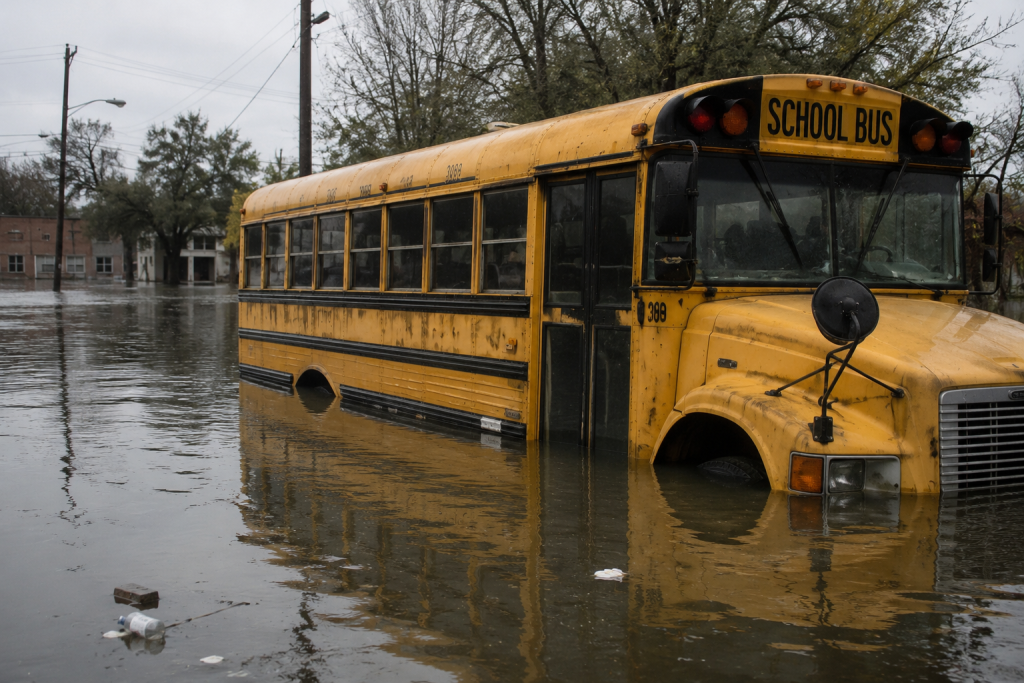
In the days after the storm, one of the most criticized images to emerge from Louisiana showed rows of school buses sitting abandoned and flooded. Those buses later became symbols of the logistical failures that surrounded the evacuation effort.
Federal investigations and congressional reports released after Katrina described serious coordination problems between local authorities, the state government, and federal emergency agencies. Federal Emergency Management Agency, commonly known as FEMA, faced intense criticism for the slow pace of relief operations during the first days of the disaster.
At the same time, public health experts warned that the floodwaters themselves posed major risks. Water moving through industrial areas, sewage systems, fuel storage zones, and damaged infrastructure carried bacteria, chemicals, and waste into residential neighborhoods. Combined with extreme heat and overcrowded shelters, conditions quickly became dangerous for survivors.
The School Bus Nobody Was Using
Jabbar Gibson lived in the Algiers neighborhood of New Orleans. Just days before Katrina struck, he had been released from jail.
He was not a trained rescuer. He had no disaster response experience. He was not part of any emergency organization.
According to interviews he later gave to the media, he simply reached a point where waiting no longer felt possible.
At some stage during the flooding, Gibson spotted an abandoned Orleans Parish school bus near a shelter area. The vehicle was still operational. Around him were families, elderly residents, children, and neighbors who had no transportation and no clear escape route out of the city.
So he climbed behind the wheel.
He began gathering people who needed to evacuate. Reports differ slightly regarding the exact number of passengers, but most accounts estimate that approximately sixty to seventy people boarded the bus, including members of Gibson’s own family.
For many of them, that bus may have represented the only available path out of New Orleans.
A Thirteen-Hour Drive Through Gridlock and Uncertainty
Gibson decided to head toward Houston, where emergency shelters were being established for evacuees fleeing Louisiana.
Under normal conditions, the trip would have taken only a few hours. After Katrina, it became a slow and exhausting journey through traffic jams, damaged roadways, fuel shortages, and widespread confusion.
Several contemporary reports stated that passengers pooled their money together whenever the bus needed gasoline. Food and water were shared among strangers. Adults tried to calm frightened children while everyone inside the bus struggled to process what they had just survived.
The journey reportedly lasted around thirteen hours.
During that drive, the passengers were moving through one of the largest internal displacements in modern American history. Hundreds of thousands of Gulf Coast residents were attempting to flee flooded regions at the same time, overwhelming highways and emergency infrastructure across multiple states.
Tension at the Houston Astrodome
When the bus finally arrived at the Houston Astrodome, the situation did not immediately become easier.
The Astrodome had been transformed into a massive emergency shelter for Katrina evacuees, and officials were already struggling to manage enormous numbers of displaced residents arriving from Louisiana.
Multiple reports say authorities were initially suspicious after discovering that the school bus had been driven by a civilian with no official authorization. Passengers were told to get off the vehicle while questions were asked about where the bus came from and how Gibson had obtained it.
His mother, Bernice Gibson, who had also been riding on the bus, reportedly explained that people had been trapped with no realistic alternative and that her son had acted because nobody else was coming.
After a period of confusion and verification, the group was finally allowed into the shelter.
Some later reports claimed Gibson’s bus was among the first civilian evacuation vehicles to arrive directly from New Orleans after the storm.
The Story That Spread Across America
As national media coverage intensified, Jabbar Gibson’s story quickly attracted attention across the country.
Newspapers and television networks described him as an unlikely rescuer: a young man recently released from jail who had chosen to evacuate dozens of strangers during one of the worst disasters in American history.
One of the most widely quoted articles came from The Times-Picayune, which contrasted the way some people viewed Gibson with the way survivors on the bus described him. To them, he was the person who got them out alive.
His story eventually led to television appearances and public recognition. He later met well-known public figures including Oprah Winfrey, Will Smith, and Spike Lee.
Spike Lee would later direct When the Levees Broke, a landmark documentary examining both the devastation caused by Katrina and the failures that followed.
The Disaster That Changed Emergency Planning in America
Katrina caused more than 1,800 deaths and produced over 100 billion dollars in damage, making it one of the costliest natural disasters in United States history.
Engineering investigations conducted afterward concluded that several levees failed not only because of the hurricane itself, but also because of structural weaknesses, design flaws, and construction problems. Researchers later argued that some flood protection systems had not been prepared for the level of pressure they ultimately faced.
At the same time, sociologists and disaster experts examined how poverty and inequality influenced survival rates during the evacuation. Communities with fewer financial resources often had fewer transportation options, less access to emergency information, and reduced ability to relocate quickly.
Long-term studies also found widespread psychological trauma among survivors. Many residents experienced depression, anxiety, and post-traumatic stress symptoms for years after the flooding ended.
Why Jabbar Gibson’s Story Still Resonates
Nearly two decades later, Jabbar Gibson’s story continues to appear in documentaries, articles, and discussions about Hurricane Katrina because it represents something larger than a single evacuation.
For many Americans, his actions became symbolic of what happened when ordinary people were forced to improvise survival while institutions struggled to respond fast enough.
He was not an official rescuer. He was not following a government plan. He was a 20-year-old man who saw families trapped in a collapsing city, found an unused school bus, and decided that waiting any longer was no longer an option.