
For many people, it happens in a completely ordinary moment. A brighter bathroom light, a close-up photo, or a quick glance in the mirror reveals something unexpected: a single gray or white hair standing out among the rest.
The discovery often sparks the same questions. Is it stress? Is it age? Did it suddenly happen overnight?
The reality is far more fascinating.
By the time you notice your first gray hair, the biological changes responsible for it have usually been developing for years. What appears to be a sudden transformation is actually the visible result of a gradual process taking place deep inside the scalp, long before any color change can be seen.
Even more surprising, most gray hairs do not become gray after they emerge. In many cases, they are created that way from the very beginning.
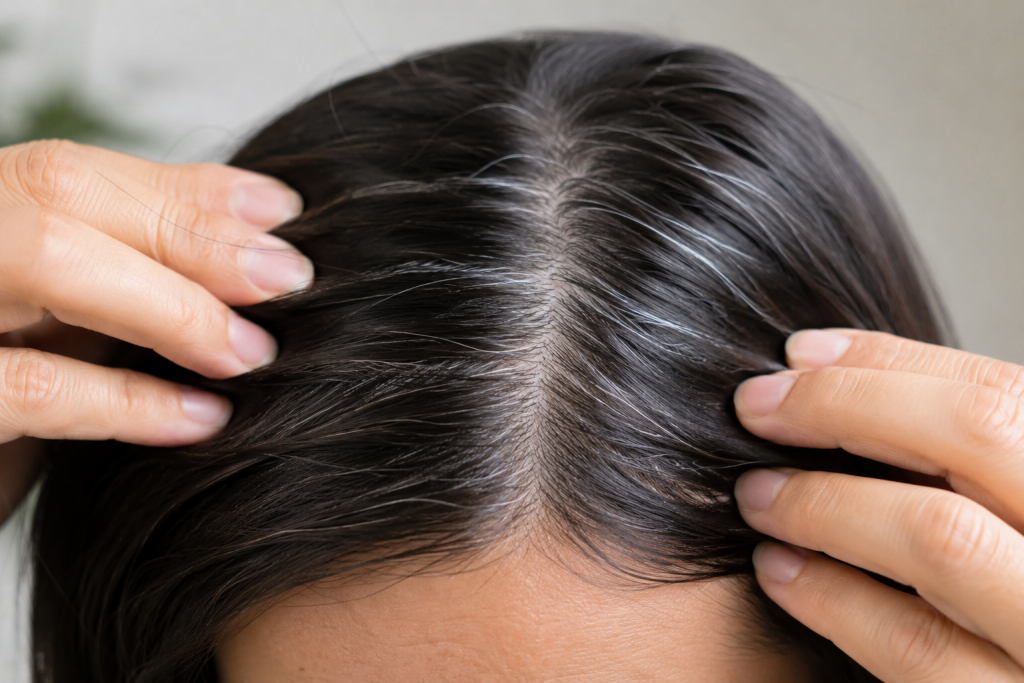
Where Hair Color Actually Comes From
Every strand of hair begins its life inside a tiny structure known as a hair follicle. The average human scalp contains roughly 100,000 of these follicles, each functioning as a miniature biological factory.
Near the base of each follicle are specialized cells called melanocytes. Their job is to produce melanin, the pigment responsible for hair color.
Two primary forms of melanin contribute to the wide range of natural hair shades seen around the world. Eumelanin creates darker brown and black tones, while pheomelanin contributes to blonde and red hues. The balance between these pigments determines an individual’s natural color.
As a new hair forms, melanocytes transfer pigment into developing hair cells. This means that the strand receives its color while it is still growing beneath the skin.
Once the hair emerges from the scalp, however, the visible portion is made up of dead keratinized cells. At that point, it can no longer actively produce pigment or change color on its own.
A Common Misconception About Gray Hair
Many people imagine that existing hair gradually loses color along its entire length, much like fabric fading in sunlight.
In reality, that is usually not what happens.
Instead, the follicle begins producing new growth with less pigment than before. Over time, melanocytes become less effective, and eventually some stop supplying pigment altogether.
The result is a new section of hair growing out gray, silver, or white directly from the root.
This is why people often notice darker hair farther from the scalp while newer growth appears noticeably lighter. The color change starts at the source rather than spreading through the strand itself.
Why Hair Turns Gray Before It Turns White
Hair rarely transitions directly from fully pigmented to completely white.
Most people experience a lengthy intermediate stage in which gray hairs become increasingly common.
This happens because pigment production usually declines gradually rather than stopping instantly. Some follicles continue producing reduced amounts of melanin, creating various shades of gray.
As more follicles lose pigment-producing capacity, the overall appearance of the hair changes. Eventually, when a large percentage of hairs contain little or no melanin, the hair may appear white.
Interestingly, truly white hair is not actually white in the same way paint is white. It appears white because it lacks pigment, allowing light to reflect differently from the hair shaft.
The Hidden Role of Stem Cells
For decades, scientists believed gray hair occurred simply because pigment-producing cells died off with age.
Recent research has revealed a more complicated story.
Within each follicle resides a population of melanocyte stem cells. These cells act as a reserve supply, helping replenish pigment-producing cells throughout life.
Scientists have discovered that aging may disrupt the normal behavior of these stem cells. Instead of moving through the follicle and maturing properly, some become trapped in locations where they can no longer contribute effectively to pigment production.
The follicle may continue producing healthy hair, but the mechanism responsible for coloring that hair becomes increasingly inefficient.
This finding has reshaped scientific understanding of why hair loses its color and has opened new avenues of research into the biology of aging.
Oxidative Stress and the Aging Hair Follicle
Another important factor involves oxidative stress.
Human cells constantly generate highly reactive molecules known as free radicals. Under normal conditions, the body uses antioxidants and specialized enzymes to neutralize them.
As people age, this balance can become less efficient.
Melanocytes are particularly vulnerable to oxidative damage. Over time, accumulated cellular stress may interfere with their ability to produce melanin and maintain normal pigmentation.
Researchers believe this helps explain why lifestyle factors such as smoking, chronic inflammation, environmental pollution, and long-term physiological stress have been associated with earlier graying in some individuals.
Can Stress Really Cause Gray Hair?
The idea that stress causes gray hair has existed for centuries.
Stories of people supposedly turning gray overnight appear throughout history and popular culture. While the dramatic version of this claim is largely a myth, modern science suggests that stress may play a genuine role.
Research has shown that intense physiological stress can influence the nervous system and affect melanocyte stem cells within hair follicles. Animal studies have demonstrated that severe stress responses may accelerate the depletion of these cells.
This does not mean a difficult week at work will instantly produce gray hair. However, long-term exposure to significant stress may contribute to biological processes associated with premature graying.
The relationship is far more complex than the old legends suggested, but it is not entirely fictional.
Why Some People Gray Earlier Than Others
Genetics remains the strongest predictor of when gray hair will appear.
If parents or grandparents developed gray hair relatively early, future generations are more likely to experience a similar pattern.
However, genetics is not the only factor involved.
Researchers have linked premature graying to several conditions and influences, including nutritional deficiencies, thyroid disorders, certain autoimmune diseases, smoking, and chronic oxidative stress.
Deficiencies involving vitamin B12, iron, copper, and folate have all been investigated for their potential role in hair pigmentation.
Even so, gray hair alone is not considered evidence of illness. In most cases, it represents a completely normal biological variation.
The Myth About Pulling Out Gray Hairs
One of the most persistent myths claims that pulling out a gray hair causes several more to grow back in its place.
Biologically, this is impossible.
Each follicle functions independently. Removing a single hair does not alter the pigment-producing capacity of neighboring follicles.
If the follicle that produced the gray hair continues generating pigment-free hair, the replacement strand will likely be gray as well. But pulling it out does not create additional gray hairs elsewhere.
Can Gray Hair Ever Regain Its Color?
For most people, graying is a progressive process that becomes increasingly permanent with age.
However, recent scientific observations have revealed something unexpected.
Researchers have documented rare cases in which individual hairs regained some pigmentation after periods of reduced physiological stress or changes in certain biological conditions.
These findings suggest that hair pigmentation may be more dynamic than previously believed.
Although there is currently no proven treatment capable of reliably reversing natural graying, the discovery has generated significant interest among scientists studying aging and cellular regeneration.
Why Gray Hair Often Feels Different
Many people notice that gray hairs seem coarser, drier, or more difficult to manage than pigmented hairs.
This perception is not entirely psychological.
Changes in pigment production are often accompanied by subtle structural changes within the hair shaft itself. Aging also affects oil production in the scalp, which can make hair feel less smooth and more resistant to styling.
As a result, gray hairs may appear wirier or more noticeable even when only a small number are present.
What Your First Gray Hair Really Means
The first gray hair is often viewed as a symbol of aging, but biologically it represents something much more intricate.
It reflects years of activity inside the hair follicle, involving stem cells, pigment-producing cells, genetic programming, oxidative stress, and the natural passage of time.
Rather than appearing suddenly, gray hair is usually the visible endpoint of a process that has been unfolding quietly beneath the surface for years.
The next time you spot a silver strand in the mirror, remember that you are looking at the result of an extraordinarily complex biological story—one that scientists are still working to fully understand.