
A remarkable construction project begins every spring
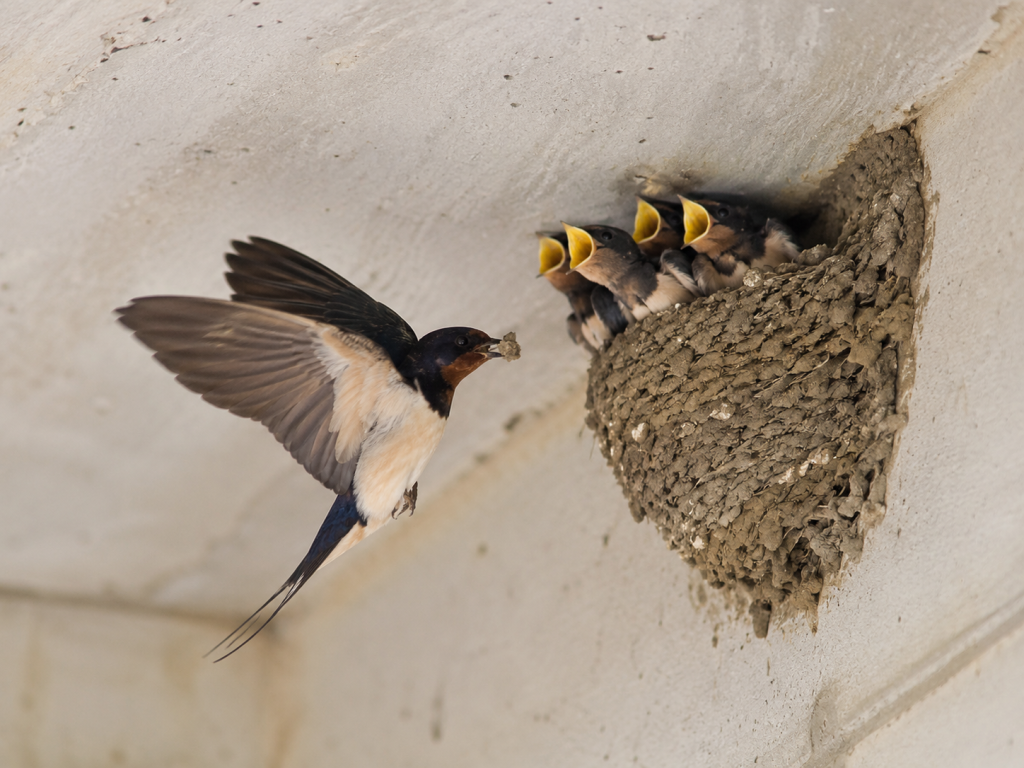
On a warm spring morning, a small bird weighing little more than a handful of coins lands beside a muddy puddle. It gathers a tiny piece of wet earth in its beak, flies to the underside of a roof, and carefully presses it into place. Moments later, it leaves to collect another.
Then another.
And another.
To a casual observer, these repeated trips might seem insignificant. Yet over the course of days, sometimes weeks, those countless journeys gradually become something extraordinary: a sturdy nest capable of protecting eggs, sheltering chicks, and supporting an entire new generation of birds.
This is the story of the swallow’s nest, one of nature’s most impressive examples of instinctive engineering.
What appears to be nothing more than a small lump of dried mud attached to a wall is actually the result of thousands of precise actions, refined through millions of years of evolution.
The long journey that happens before the first piece of mud is placed
Long before construction begins, many swallows have already completed one of the most demanding migrations in the animal kingdom.
The Barn Swallow (Hirundo rustica), one of the most widespread swallow species in Europe, spends the winter in Africa before returning north to breed. Each year, these birds travel thousands of miles across deserts, seas, and changing weather systems to reach familiar nesting grounds.
Some populations cover more than 10,000 kilometers in a single direction. A swallow nesting beneath a farmhouse roof in Europe may have spent the winter months far south of the Sahara.
The journey is dangerous. Storms, predators, food shortages, and exhaustion take a toll on migrating birds every year. Yet those that survive often return to the same region—and sometimes even the exact building—they used in previous seasons.
Choosing the perfect location
Once they arrive, swallows begin searching for a suitable nesting site.
Historically, their ancestors nested on cliffs and rocky ledges. Over time, many species adapted to life alongside humans, discovering that barns, bridges, sheds, and roof overhangs offered excellent protection.
A good location provides shelter from rain, safety from predators, and easy access to feeding areas rich in flying insects.
Research suggests that nest placement can significantly influence breeding success. A well-protected site helps maintain stable temperatures and improves the chances that chicks will survive until they are ready to leave the nest.
Building a home from mud and patience
Construction begins with a search for the right materials.
Swallows collect wet mud from puddles, riverbanks, and damp soil. Each trip yields only a tiny amount, which explains why building a nest requires such an enormous investment of time and energy.
Field observations have shown that a single nest may require hundreds or even well over a thousand individual mud deliveries. Every pellet is carried separately and added to the growing structure.
The birds carefully shape each layer with their beaks, gradually creating walls that become stronger as they dry. Saliva helps bind the materials together, acting as a natural adhesive during the building process.
Despite being made from simple materials, the finished nest can be surprisingly durable.
A design perfected by nature
Swallow nests are remarkable not because they are large, but because they are efficient.
Their shape distributes weight evenly while remaining securely attached to vertical surfaces. Raised edges help prevent eggs and chicks from falling, while the thickness of the walls provides insulation from changing temperatures.
Different swallow species construct different designs. Some create open cup-shaped nests, while others build nearly enclosed structures with a narrow entrance that offers additional protection.
Scientists often cite these nests as examples of how instinct alone can produce highly effective architectural solutions.
The beginning of a new generation
Once the structure is complete, the interior is lined with softer materials such as feathers, fine grasses, and plant fibers.
This layer helps keep eggs warm and creates a more comfortable environment for developing chicks.
A female swallow typically lays several eggs, which hatch after roughly two weeks of incubation. From that moment, the nest becomes the center of constant activity.
Growing chicks require enormous amounts of food. Their parents spend much of the day catching insects on the wing and returning repeatedly to feed them.
During favorable weather, a pair of swallows may make hundreds of feeding trips in a single day.
Why swallows matter
Beyond their beauty and graceful flight, swallows play an important ecological role.
Because they feed primarily on flying insects, they help regulate insect populations naturally. Their presence can also provide clues about environmental health.
In recent decades, researchers across Europe have reported declines in some swallow populations. Factors such as habitat loss, intensive agriculture, pesticide use, and decreasing insect numbers are believed to contribute to these trends.
For this reason, swallows are often considered valuable indicators of broader environmental change.
A lesson hidden beneath a roof
For centuries, people have associated swallows with homecoming, renewal, and the arrival of spring.
Perhaps that connection exists because their story is so familiar.
After surviving a journey that spans continents, a swallow returns and begins again. One small pellet of mud. Then another. Then hundreds more.
What starts as a collection of tiny, seemingly insignificant efforts eventually becomes a safe place where new life can begin.
And that may be the most remarkable part of all.
One of nature’s greatest construction projects is not built from steel, concrete, or advanced technology. It is built from mud, persistence, and an instinct refined over countless generations.