
A Journey That Began Before Smartphones Existed
In late 1998, while most of the world was preparing to enter a new millennium, a former British paratrooper stepped into the windswept landscapes of southern Chile and began a journey unlike almost anything attempted in modern times.
His name was Karl Bushby, and his goal sounded deceptively simple: walk home to England.
The challenge, however, came with one rule that would transform an ambitious trek into one of the most remarkable long-distance expeditions ever undertaken. Bushby would not use motorized transportation to move forward. No cars, no trains, no airplanes, and no shortcuts across the globe.
What started as a bold personal challenge eventually evolved into a life-defining mission that has stretched across continents, political borders, technological eras, and nearly thirty years of human history.
Today, the expedition known as the Goliath Expedition is regarded by many explorers as one of the longest continuous overland adventures ever attempted by a single individual.
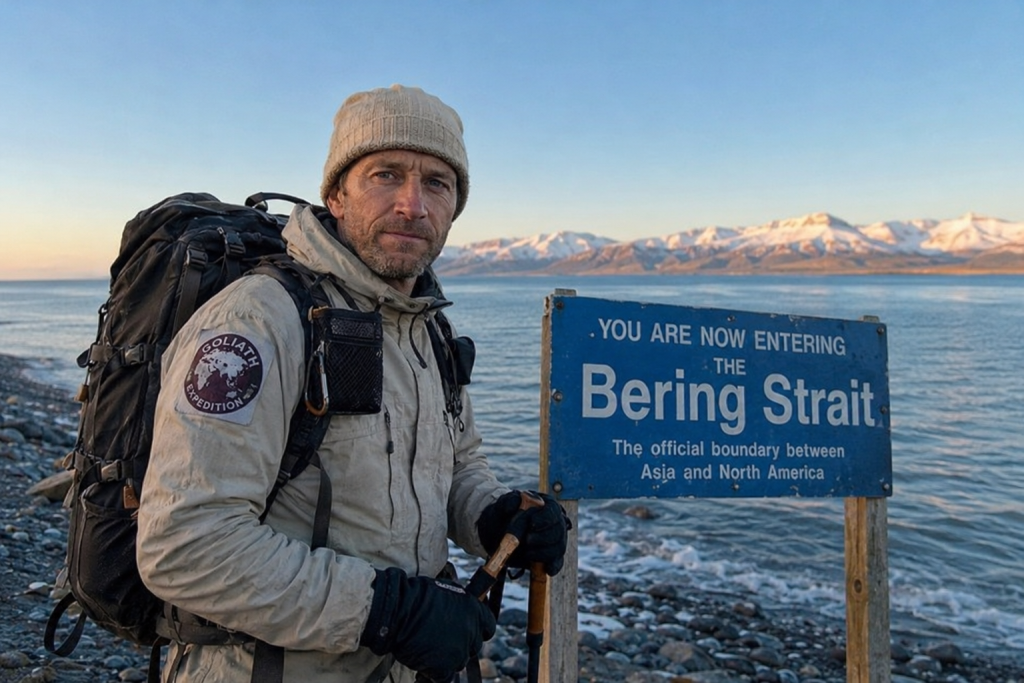
Who Is Karl Bushby?
Karl Bushby served in the British Army before setting out on the journey that would define his life.
Military service gave him resilience, discipline, and experience operating in difficult environments, but even that background could not fully prepare him for what lay ahead. The expedition would demand far more than physical strength. It would test patience, adaptability, and mental endurance on a scale few people ever experience.
Unlike many modern adventurers pursuing records or publicity, Bushby’s vision was rooted in something deeper. He wanted to reconnect with the world at a human pace and explore what happens when a person commits completely to a single objective, regardless of how long it takes.
The Rule That Changed Everything
Many people have traveled around the world. Others have crossed continents on foot. What makes Bushby’s journey unique is the uncompromising principle at its core.
Every mile of progress had to be earned without motorized transport.
At first glance, the rule sounds straightforward. In reality, it created an endless series of logistical challenges. Every river, mountain range, border crossing, and body of water became a puzzle that required creative solutions.
The greatest obstacles were not always found in nature. Quite often, they came in the form of paperwork, regulations, and international politics.
From Patagonia to North America
Bushby officially launched the Goliath Expedition in Punta Arenas, Chile, one of the southernmost cities in the world.
His route led him through the dramatic landscapes of Patagonia, where powerful winds, remote terrain, and rapidly changing weather conditions can challenge even experienced outdoor travelers.
As he moved northward through South America, Central America, and Mexico, the scale of the project gradually became apparent. What had initially seemed like an ambitious trek was turning into something far larger.
The expedition continued through the United States, adding thousands of miles to an already extraordinary journey. Desert regions, mountain ranges, forests, and vast stretches of open land became part of Bushby’s daily reality.
For most people, a long hike lasts a few days or weeks. For Bushby, walking became a way of life.
What Happens to the Human Body After Years of Walking?
One of the most fascinating aspects of Bushby’s story is the physical adaptation required to sustain such an extreme undertaking.
Anthropologists often describe humans as endurance walkers. Our species evolved with anatomical features that support long-distance travel, including efficient cooling systems, upright posture, and energy-saving locomotion.
Yet there are limits.
Research in exercise physiology shows that prolonged endurance activity places significant stress on the body. Over time, explorers and endurance athletes frequently experience joint degeneration, tendon injuries, chronic inflammation, sleep disturbances, and repetitive stress damage.
At the same time, the body develops remarkable adaptations. Cardiovascular efficiency improves, energy use becomes more economical, and muscular endurance increases dramatically.
Bushby’s journey offers a real-world example of how the human body can adapt to extraordinary demands while continuously balancing performance against wear and tear.
Crossing the Frozen Bering Strait
One of the most famous chapters of the expedition occurred in 2006.
Together with French adventurer Dimitri Kieffer, Bushby crossed the frozen Bering Strait between Alaska and Russia.
The crossing connected two continents and represented one of the most physically demanding segments of the entire journey. Arctic conditions, shifting sea ice, extreme cold, and isolation created an environment where small mistakes could quickly become life-threatening.
The achievement attracted international attention, but it also led to serious complications.
Upon entering Russia, Bushby encountered legal and administrative issues related to border regulations. Those problems would eventually delay the expedition for years and become one of the most significant challenges of the entire project.
When Bureaucracy Becomes a Bigger Obstacle Than Geography
Popular adventure stories often focus on storms, dangerous wildlife, or extreme environments.
Bushby’s experience revealed another reality of modern exploration.
In today’s interconnected world, international borders can sometimes be more difficult to navigate than mountains or deserts.
Visa restrictions, changing regulations, diplomatic complications, and legal requirements repeatedly interrupted his progress. Some delays lasted months. Others stretched into years.
The experience highlighted how contemporary explorers face a unique combination of natural and administrative barriers that previous generations rarely encountered on the same scale.
The Crossing of the Caspian Sea
Another remarkable chapter unfolded in 2013 when Bushby teamed up with British adventurer Adam Bradley to tackle the Caspian Sea.
The crossing is often simplified online as a long-distance swim, but the reality was far more complex. The pair used human-powered methods, including swimming and a manually propelled craft, to maintain the expedition’s commitment to avoiding motorized advancement.
The Caspian Sea, the world’s largest inland body of water, covers approximately 371,000 square kilometers. Weather conditions can change rapidly, making crossings both physically and mentally demanding.
Successfully navigating this stage demonstrated the creativity and persistence required to keep the expedition moving forward while remaining faithful to its original principles.
A Journey That Outlasted Technological Generations
Perhaps the most extraordinary aspect of the Goliath Expedition is not the distance traveled but the amount of time it has occupied.
When Bushby began walking, social media did not exist. Smartphones had not yet been invented. Streaming services, GPS navigation on mobile devices, and many of the technologies now taken for granted were still years away.
Over the course of his journey, the world experienced economic crises, geopolitical shifts, and a global pandemic that temporarily disrupted travel on an unprecedented scale.
Yet the expedition endured.
Few personal projects continue long enough to witness multiple generations of technological change. Bushby’s journey is one of those rare exceptions.
Measuring an Extraordinary Distance
Public estimates place the total route at roughly 36,000 miles, or nearly 58,000 kilometers.
To put that into perspective, Earth’s circumference at the equator is approximately 40,075 kilometers.
The comparison illustrates the true scale of the undertaking. Bushby has effectively covered a distance greater than a full circumnavigation of the planet, but not along an idealized route. Every mile has involved real terrain, real obstacles, and countless detours imposed by geography and international borders.
Approaching the Finish Line
As of 2026, Karl Bushby is entering the final stages of a journey that began nearly three decades ago.
If he reaches Hull as planned, the Goliath Expedition will stand as one of the most unusual and enduring achievements in modern exploration. More importantly, it will serve as a reminder that perseverance is not always measured by speed.
In a world increasingly focused on instant results, Bushby’s story offers a striking contrast. His accomplishment has been built one step at a time, across deserts, mountains, frozen seas, political boundaries, and years of uncertainty.
Long before he reaches the finish line, the journey itself has already become part of exploration history. It demonstrates that extraordinary achievements are not always the result of extraordinary moments. Sometimes they emerge from the simple decision to keep moving forward, day after day, year after year, no matter how distant the destination may seem.