
Every year, billions of birds embark on migrations that span continents, deserts, mountain ranges, and vast stretches of open ocean. While migration itself is one of nature’s most remarkable phenomena, some species push the limits of endurance so far that their journeys seem almost impossible.
One of the most extraordinary examples comes from the bar-tailed godwit (Limosa lapponica baueri), a shorebird that has evolved into one of the greatest long-distance travelers on Earth. In 2022, a young bird known to researchers as B6 completed a nonstop flight of approximately 13,560 kilometers from Alaska to Tasmania, setting a world record for the longest documented continuous flight by a bird.
The journey lasted more than eleven days. During that entire time, the bird never landed, never stopped to feed, and never had access to fresh water. What sounds like an exaggeration is, in fact, one of the most carefully documented migration events ever recorded.
A Shorebird Built for Extreme Migration
The bar-tailed godwit may not appear particularly unusual at first glance. It is a medium-sized shorebird with long legs, a slender bill, and relatively modest coloration compared to many other migratory species.
Its abilities, however, are anything but ordinary.
The subspecies Limosa lapponica baueri breeds in Alaska during the Arctic summer, taking advantage of abundant food resources and long daylight hours. Once the breeding season ends and temperatures begin to drop, these birds undertake an epic migration toward Australia and New Zealand.
Unlike many migratory birds that make several stopovers along the way, bar-tailed godwits often cross enormous sections of the Pacific Ocean in a single uninterrupted flight.
The Flight That Captured Scientists’ Attention
In October 2022, researchers monitoring migratory shorebirds through satellite tracking technology followed the movements of a young godwit identified as B6.
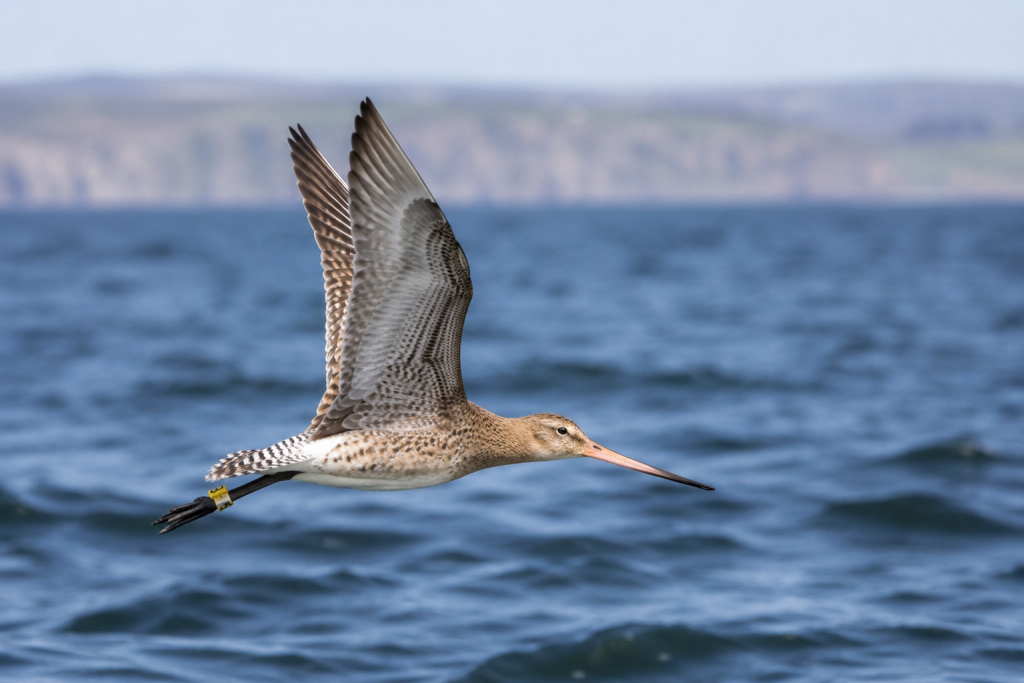
After leaving Alaska’s Yukon-Kuskokwim Delta region, the bird headed south across the Pacific. Instead of stopping on islands or coastal areas, it continued flying day after day over open water.
Satellite data later revealed the full scale of the achievement.
B6 traveled approximately 13,560 kilometers before finally reaching Tasmania. The flight lasted around eleven days and one hour, making it the longest nonstop flight ever documented in a bird using modern tracking technology.
The journey covered a distance comparable to traveling from northern Europe to southern Africa or crossing a significant portion of the globe without a single break.
Preparing for a Journey of This Scale
Such a feat would be impossible without extensive physiological preparation.
In the weeks leading up to migration, bar-tailed godwits enter a period known as hyperphagia, during which they dramatically increase their food intake. Their primary objective is to accumulate large reserves of body fat, which will serve as the sole fuel source during migration.
Fat is exceptionally energy-dense. Compared with carbohydrates and proteins, it provides far more usable energy per gram, making it the ideal fuel for endurance flight.
By the time migration begins, some individuals have increased their body mass by more than half compared to their normal weight.
Essentially, they transform themselves into highly efficient flying energy reserves.
The Remarkable Changes Inside the Bird’s Body
One of the most fascinating aspects of godwit migration is that the bird’s body temporarily restructures itself before departure.
Scientific studies have shown that parts of the digestive system, including the stomach and intestines, shrink significantly before long migratory flights. Since the bird will not be eating while airborne, maintaining large digestive organs would simply add unnecessary weight.
At the same time, systems involved in flight performance, oxygen delivery, and energy metabolism remain highly developed and efficient.
This temporary redistribution of resources allows the bird to maximize fuel storage while minimizing excess body mass.
Once migration is complete and normal feeding resumes, the digestive organs gradually return to their typical size.
Finding the Way Across an Entire Ocean
Perhaps one of the most astonishing aspects of long-distance migration is navigation.
How does a bird travel thousands of kilometers across open ocean and arrive at the correct destination?
Scientists believe the answer involves multiple navigation systems working together.
Research suggests migratory birds can use the position of the sun during daylight hours, patterns of stars at night, atmospheric cues, and information derived from Earth’s magnetic field.
Evidence gathered over recent decades indicates that many migratory species possess specialized biological mechanisms that allow them to detect magnetic information and use it for orientation.
Although researchers are still working to fully understand every aspect of this process, there is little doubt that migratory birds possess navigation abilities far beyond what was once thought possible.
Weather Can Determine Success or Failure
Even the best-adapted migrant must work with the environment.
Bar-tailed godwits carefully time their departures to coincide with favorable weather conditions. Tailwinds can significantly reduce energy expenditure and improve the odds of completing a successful migration.
Satellite observations have shown that these birds are capable of adjusting their routes in response to changing atmospheric conditions, demonstrating a level of flexibility that helps them survive journeys lasting more than a week without rest.
For a bird crossing the Pacific Ocean, choosing the right weather window can mean the difference between success and disaster.
Technology Revealed What Humans Could Not See
For much of history, scientists could only speculate about the true scale of bird migration.
The development of lightweight satellite transmitters changed that dramatically.
Modern tracking devices allow researchers to follow birds across oceans and continents, collecting precise information about routes, distances, travel speeds, and migration timing.
Without these advances, the extraordinary journey of B6 would likely have remained unknown.
The record highlights not only the bird’s remarkable abilities but also the growing role of technology in helping scientists understand some of nature’s most complex behaviors.
A Powerful Reminder of Nature’s Capabilities
The story of B6 is more than a migration record.
It is a reminder that some of the most astonishing feats on Earth are performed not by machines, but by living organisms that have evolved over millions of years.
A bird weighing only a few hundred grams managed to cross a vast ocean using nothing more than stored energy, finely tuned physiology, favorable winds, and an internal navigation system that scientists are still striving to fully understand.
Its journey remains one of the most impressive demonstrations of endurance ever documented in the animal kingdom and a striking example of how much there is still to learn about the natural world.