
Some stories disappear from public memory within days. Others linger for years because they touch on questions that have no easy answers.
The story of Harambe belongs firmly in the second category.
What began as a tragic incident at an American zoo in May 2016 quickly evolved into one of the most discussed animal-related events of the digital age. Within a matter of minutes, a young child had fallen into a gorilla enclosure, zoo staff were forced to make a life-or-death decision, and a healthy endangered animal was gone.
The child survived.
The debate never ended.
Nearly a decade later, Harambe remains one of the most recognizable animals in modern history, not because of how he lived, but because of the difficult questions his death left behind.
A Gorilla With an Important Role
Long before millions of people around the world learned his name, Harambe was known primarily to zookeepers, conservationists, and primate specialists.
Born on May 27, 1999, at a zoo in Texas, Harambe was a western lowland gorilla, a subspecies facing significant challenges in the wild due to habitat destruction, poaching, and disease outbreaks. Conservation programs around the world viewed animals like him as important contributors to the long-term survival of the species.
His name came from a Swahili word often translated as “working together” or “pulling together,” a fitting choice for an animal that would eventually become part of international conservation efforts.
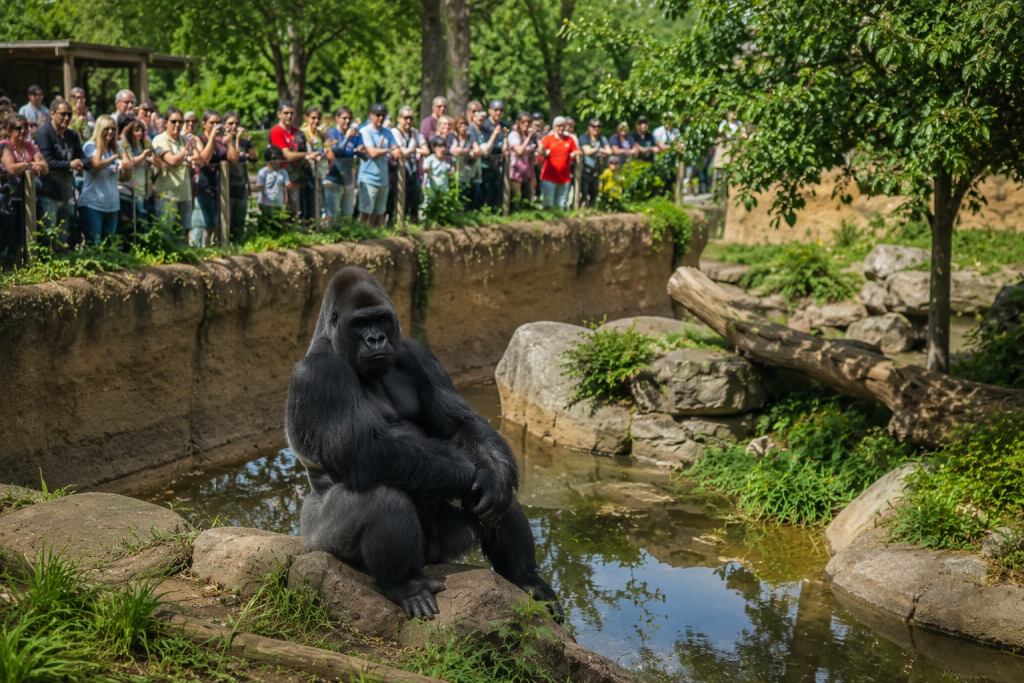
In 2014, Harambe was transferred to the Cincinnati Zoo, where he was expected to serve as the dominant silverback within a family group. By then, he had matured into an impressive adult male, weighing hundreds of pounds and displaying the confidence and authority typical of a silverback gorilla.
Visitors saw a powerful animal.
Researchers saw a valuable member of a carefully managed breeding program.
No one imagined he would soon become known around the world.
Understanding the Animal Behind the Headlines
One reason the incident generated such intense discussion is that gorillas often appear surprisingly human to us.
As one of our closest living relatives, gorillas share many behavioral traits that people instinctively recognize. They live in family groups, form social bonds, care for their young, and communicate through a combination of vocalizations, gestures, facial expressions, and body language.
This similarity can sometimes create misunderstandings.
Humans often interpret animal behavior through a human lens, assigning motives and emotions that may not accurately reflect what the animal is experiencing.
A silverback gorilla is not only intelligent but extraordinarily powerful. Adult males can weigh well over 180 kilograms and possess immense strength. Even movements that are not intended to be aggressive can cause serious injury to a small child.
That reality would become central to the decisions made on one spring afternoon in 2016.
The Day Everything Changed
On May 28, 2016, visitors at Cincinnati Zoo witnessed a situation that quickly escalated into an emergency.
A three-year-old boy managed to get past visitor barriers and entered the gorilla habitat. Reports later indicated that he climbed through protective structures before falling several meters into the enclosure below.
The incident unfolded rapidly.
As zoo personnel initiated emergency procedures, Harambe approached the child.
Videos recorded by visitors captured moments that would later be analyzed repeatedly by experts, journalists, animal advocates, and millions of viewers online. The footage showed the gorilla moving near the child, at times appearing curious and attentive, while at other moments dragging him through shallow water and relocating him around the enclosure.
Those few minutes became the focus of a global debate.
Was Harambe Protecting the Child?
This question remains one of the most contested aspects of the entire story.
Some observers believed Harambe was displaying protective behavior. They pointed to moments in the footage where the gorilla appeared to watch the child closely or remain near him without delivering an obvious attack.
Others cautioned against drawing conclusions from limited video clips.
Primatologists noted that determining the exact intentions of a wild animal in a stressful and unusual situation is extremely difficult. More importantly, they emphasized that intent was not the only concern.
Even if Harambe had no desire to harm the child, his size and strength meant that a sudden movement, an unexpected reaction, or a moment of agitation could have produced catastrophic consequences.
The challenge facing zoo officials was not determining what Harambe might do next with certainty.
It was deciding how much risk was acceptable when a child’s life was potentially at stake.
The Decision That Changed Everything
As the situation continued, zoo staff had only moments to evaluate their options.
One question raised repeatedly afterward was why a tranquilizer was not used instead of lethal force.
Wildlife experts explained that tranquilizers do not work instantly. Depending on the animal, the medication, and the dosage, it can take several minutes before sedation becomes effective. During that period, the animal may become disoriented, stressed, or unpredictable.
For an animal as powerful as an adult silverback, even a brief period of agitation could dramatically increase the danger.
Zoo officials concluded that waiting for a tranquilizer to take effect posed too great a risk.
The decision was made to use a firearm.
Harambe was killed, and the child was rescued shortly afterward.
The boy survived with relatively minor injuries.
The gorilla did not.
A Public Reaction Unlike Anything Seen Before
News of the incident spread with remarkable speed.
Within hours, videos, photographs, and opinions were circulating across social media platforms. Millions of people weighed in, often passionately, on every aspect of the story.
Some defended the zoo’s actions, arguing that protecting human life had to remain the highest priority.
Others viewed the death of an endangered animal as a preventable tragedy.
Many discussions focused on questions of parental responsibility, while others centered on zoo design, emergency planning, or the ethics of keeping large primates in captivity.
What made the reaction unusual was its scale.
The debate extended far beyond conservation circles and reached audiences that normally paid little attention to wildlife issues. For weeks, Harambe dominated online conversations around the world.
The Human Side of the Story
Lost amid much of the public argument were the people directly involved.
Zoo employees who had cared for Harambe for years suddenly found themselves grieving the loss of an animal they knew intimately.
Former caretakers described him as intelligent, expressive, and memorable. To them, he was not an internet phenomenon but a living individual with a distinct personality.
The family involved also found themselves at the center of intense public scrutiny. Their actions were examined and debated by countless strangers, often with little understanding of how quickly the incident had unfolded.
The event became a reminder of how rapidly modern public attention can transform a private tragedy into a worldwide controversy.
Changes That Followed
In the months after the incident, attention turned toward prevention.
Safety procedures and enclosure designs received renewed scrutiny. Cincinnati Zoo implemented additional protective measures, and the event prompted discussions throughout the zoological community about visitor barriers, emergency responses, and risk assessment.
Although no system can eliminate every possibility of human error, the goal became reducing the likelihood of a similar event occurring again.
The lessons learned extended far beyond a single institution.
How Harambe Became a Cultural Symbol
Few animals have left such an unusual legacy.
In the years following his death, Harambe became the subject of documentaries, artwork, online tributes, and countless references across internet culture. His name appeared in discussions ranging from conservation to social media behavior.
Part of the reason is that the story touched multiple issues at once.
It involved an endangered animal, a young child, public safety, parental responsibility, wildlife conservation, and the growing influence of online communities. Different groups saw different meanings in the same event.
As a result, Harambe became more than a gorilla.
He became a symbol onto which millions of people projected their own views about risk, responsibility, and the relationship between humans and animals.
Why the Story Still Matters
Years later, there is still no universal agreement about what should have happened that day.
Some believe the zoo made the only decision available under the circumstances.
Others continue to question whether alternative outcomes might have been possible.
What remains undeniable is the complexity of the situation.
The incident forced people to confront uncomfortable realities about wildlife, conservation, public safety, and decision-making under extreme pressure. It also demonstrated how quickly the internet can transform a local event into a global cultural moment.
Harambe’s story endures because it was never simply about a gorilla.
It was about the difficult choices that arise when competing values collide, and about how societies remember those moments long after the headlines have faded.
That is why, nearly a decade later, the name Harambe remains instantly recognizable around the world.