
History is full of stories that become larger than life over time. Some are backed by extensive records, newspaper reports, and official investigations. Others survive mostly through retellings, with many of the original details fading into obscurity.
The story of Lawrence Sullivan falls somewhere in between.
For decades, his name has appeared in discussions about unusual disappearances, survival stories, and historical mysteries. The basic outline seems straightforward: a three-year-old boy vanished in a remote part of Nevada in 1930, searchers combed the area for days, and against all odds, he was eventually found alive.
Yet the deeper researchers look into the case, the more complicated it becomes. While the story itself has been repeated for generations, many of the original records are difficult to locate today, leaving historians with a mixture of documented facts, later accounts, and unanswered questions.
America During the Great Depression
To understand why the incident attracted attention in the first place, it helps to look at the world in which it occurred.
October 1930 was a difficult period in American history. The country was already feeling the effects of the Great Depression following the stock market crash of 1929. Jobs were disappearing, businesses were struggling, and many families were searching for any opportunity to earn a living.
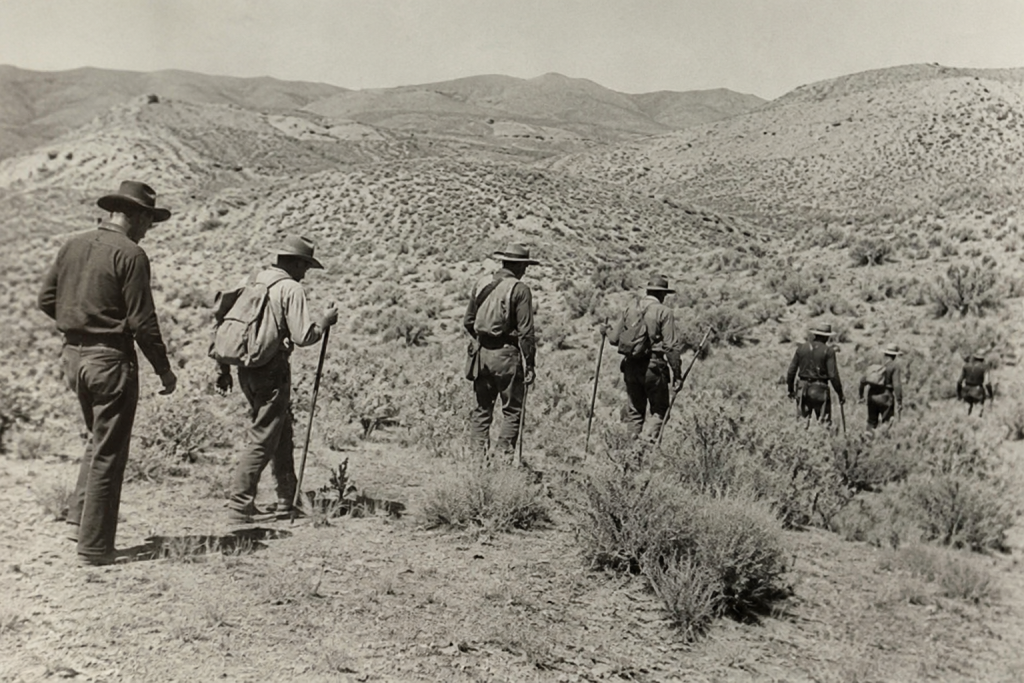
Across parts of the American West, prospectors still traveled through isolated regions in search of gold and other valuable minerals. Although the great gold rushes were largely over, prospecting remained a source of hope for some individuals trying to make a living in uncertain times.
These journeys often took people far from towns, paved roads, and reliable communication. In many places, help could be hours or even days away.
Nevada Was a Very Different Place in 1930
Modern Nevada is often associated with highways, tourism, and the bright lights of Las Vegas. The Nevada of 1930 looked very different.
Large areas of the state consisted of rugged mountains, dry valleys, rocky terrain, and vast stretches of desert. Travelers frequently faced long distances between settlements, limited access to water, and extreme temperature fluctuations.
Days could be hot and exhausting. Nights could become surprisingly cold.
Even experienced adults had to respect the dangers of the landscape. For a small child, those dangers were magnified dramatically.
The Disappearance of Lawrence Sullivan
According to the accounts that have circulated for decades, Lawrence Sullivan was three years old when he disappeared on October 16, 1930.
He was reportedly with his uncle, John Sullivan, who is commonly described as a gold prospector working in a remote area of Nevada.
At some point during the day, the boy wandered out of sight.
The exact details vary depending on the source. Some versions describe only a brief lapse in attention before the child vanished. Others provide slightly different circumstances. What remains consistent is that Lawrence was suddenly gone, leaving the adults around him facing every parent’s nightmare.
How Children Behave When They Become Lost
One reason the story continues to fascinate people is that many assume a three-year-old could not travel very far alone.
Search-and-rescue research suggests otherwise.
Studies of missing children have shown that young children often behave very differently from adults when they become lost. Rather than stopping and waiting for help, many continue moving. They may follow an animal, a trail, an interesting object, or simply keep walking without any particular destination in mind.
Children also tend to become frightened more quickly. In some cases, instead of responding to searchers, they hide.
This behavior has complicated countless search operations over the years and helps explain why missing children are sometimes found in locations that seem surprisingly far from where they were last seen.
The Search Effort
Once Lawrence disappeared, a search was reportedly organized to locate him.
Unlike modern rescue operations, searchers in 1930 had no helicopters, drones, GPS devices, thermal imaging equipment, or advanced communication systems.
The effort depended almost entirely on people covering ground on foot, watching for tracks, and carefully examining the landscape.
The environment itself presented a challenge.
Desert terrain, rocky hillsides, dry washes, and uneven ground can conceal a person remarkably well. Even today, experienced search teams sometimes discover missing individuals in areas that had already been examined multiple times.
Distance, visibility, terrain, and human perception can all work against rescuers.
The Question That Never Goes Away
The most discussed aspect of the case is not the disappearance itself but what happened afterward.
According to the versions most often repeated today, Lawrence Sullivan was eventually found alive after several days in the wilderness.
That detail has fueled speculation for decades.
At first glance, surviving alone in such conditions may seem impossible for a child so young. However, survival experts and medical researchers point out that human resilience can be remarkable, especially when circumstances are more favorable than they initially appear.
In many documented cases, lost children have survived far longer than expected. Access to even small amounts of water, sheltered areas, or favorable weather conditions can dramatically improve the chances of survival.
The challenge with the Lawrence Sullivan case is that the available public records do not provide enough information to reconstruct exactly how he managed to endure the ordeal.
When History Meets Storytelling
As the years passed, the case gradually moved beyond local memory and into collections of unusual disappearances.
Writers, researchers, podcasters, and documentary producers revisited the story, often focusing on the elements that seemed most extraordinary. Over time, the case became associated with broader discussions about unexplained disappearances.
This is not unusual.
Historians often observe that events become more dramatic as they are retold across generations. Certain details receive greater attention, while others fade away. Eventually, a real event can take on the characteristics of a legend without anyone deliberately changing the facts.
The process is a natural consequence of storytelling.
Separating Facts from Uncertainty
Nearly a century later, there are still important limitations to what can be confirmed.
Most researchers agree that Lawrence Sullivan was a real child and that reports of his disappearance have circulated for many decades.
There is also broad agreement that he was eventually found alive.
Beyond those core points, certainty becomes more difficult.
Specific distances, timelines, environmental conditions, and other frequently repeated details are not always supported by easily accessible primary documentation. As a result, responsible researchers tend to avoid making claims that cannot be independently verified.
Why the Story Endures
The enduring appeal of the Lawrence Sullivan case may have less to do with mystery than with human resilience.
Even without dramatic theories or sensational explanations, the basic story remains compelling. A very young child disappeared in one of the harshest environments in the American West. Searchers spent days trying to locate him. The odds seemed increasingly unfavorable.
Yet somehow, he survived.
That alone is enough to capture attention nearly one hundred years later.
Whether every detail of the popular version is accurate may never be known with certainty. What remains clear is that the story occupies a fascinating space between documented history and historical folklore, reminding us that the passage of time often leaves behind as many questions as answers.