
In the late summer of 1725, the French ship Le Chameau was nearing the end of a long Atlantic crossing. On board were colonial officials, soldiers, families, and valuable funds intended for France’s North American territories. After weeks at sea, land seemed close and the voyage appeared nearly complete.
Instead, disaster struck.
Caught in dangerous conditions off the coast of what is now Nova Scotia, the vessel was lost, and nearly everyone aboard perished. The tragedy became one of many maritime disasters linked to a remote strip of land that sailors would come to fear for generations.
That place was Sable Island, a narrow crescent of sand isolated in the North Atlantic. Today it is famous for its wild horses and unique ecosystem, but for centuries it was known for something far darker. Mariners gave it a nickname that still survives today: the “Graveyard of the Atlantic.”
Its reputation was built not on myths alone, but on a remarkable combination of geography, weather, and history.
An Island Built Almost Entirely of Sand
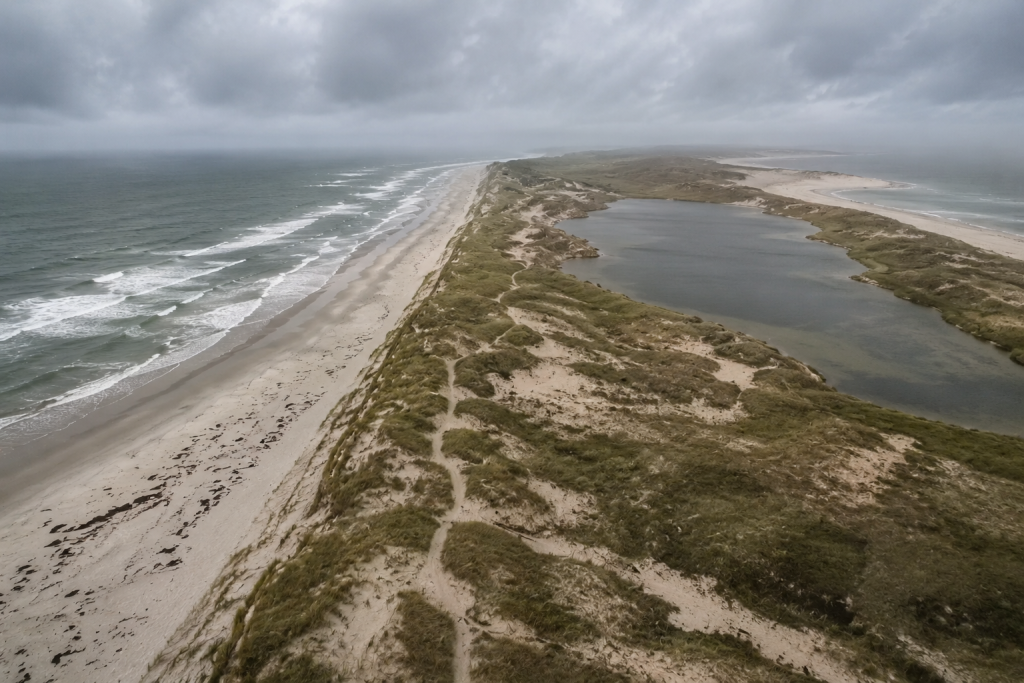
Sable Island lies roughly 300 kilometers southeast of mainland Nova Scotia. Unlike most islands, it is not defined by rocky cliffs, volcanic formations, or mountains. Instead, it is composed almost entirely of sand.
Stretching for about 42 kilometers while remaining relatively narrow, the island appears from above as a delicate arc floating in the ocean.
Scientists believe its origins trace back to the end of the last Ice Age. As massive glaciers retreated from northeastern North America, they left behind vast quantities of sediment. Over thousands of years, ocean currents and powerful waves gradually reshaped those materials into the island that exists today.
The process has never truly stopped.
Wind constantly moves the dunes. Shorelines shift. Sections of the island erode while new ones form elsewhere. Historic maps often show noticeable differences in shape and size, helping create the popular belief that the island itself moves.
While Sable Island does not drift across the ocean, it remains one of the most dynamic landforms in North America.
Where Powerful Ocean Forces Meet
The island occupies a location that has challenged sailors for centuries.
Cold waters flowing south from the Labrador Current encounter warmer Atlantic waters nearby, creating conditions that frequently generate dense fog and unpredictable weather.
Before radar, GPS, and modern forecasting systems, these conditions could be extremely dangerous.
Visibility could collapse within minutes. At the same time, vast underwater sandbars extended far beyond the visible shoreline. In many places, ships had little warning before running aground.
What looked like open water on the horizon could conceal one of the Atlantic’s most hazardous navigation zones.
The Rise of a Maritime Legend
European explorers and fishermen were familiar with the area as early as the sixteenth century. As trade routes between Europe and North America expanded, increasing numbers of ships passed through nearby waters.
Not all of them survived.
Storms, navigational mistakes, strong currents, and hidden shoals combined to create a deadly environment. Over time, reports of shipwrecks accumulated so rapidly that the region gained an ominous reputation.
Historians estimate that more than 350 documented shipwrecks occurred in the vicinity of Sable Island, though the actual number may never be known. Many early maritime losses were poorly recorded or never officially documented at all.
The Tragedy of Le Chameau
Among the island’s most famous shipwrecks is that of Le Chameau.
The vessel was carrying senior colonial officials, military personnel, and valuable cargo destined for New France. A violent storm drove the ship into dangerous coastal waters, resulting in one of the deadliest maritime disasters of the era.
For generations, stories circulated about the treasure lost with the ship.
Centuries later, underwater exploration teams recovered coins, artifacts, and personal belongings from the wreck site, providing historians with a rare glimpse into life aboard an eighteenth-century Atlantic vessel.
The Disaster of the Atlantic
Another catastrophe helped cement the region’s fearsome reputation.
In April 1873, the passenger liner Atlantic was making a transatlantic voyage carrying nearly a thousand passengers and crew members. A series of navigational decisions made under difficult conditions brought the ship dangerously close to shore.
During the night, it struck rocks near Nova Scotia.
More than 500 people lost their lives.
At the time, the sinking ranked among the worst civilian maritime disasters in history and prompted renewed discussions about navigational safety across the North Atlantic.
The Men and Women Who Watched the Shores
As shipwrecks became increasingly common, authorities recognized the need for permanent rescue operations.
Life-saving stations were eventually established on the island, staffed by people willing to live in one of the most isolated environments in North America.
Their work was demanding and often dangerous.
After storms, rescue crews patrolled long stretches of coastline searching for survivors, wreckage, or anyone washed ashore by the sea. In harsh winter conditions, they frequently traveled through fog, freezing temperatures, and strong winds.
Their efforts saved countless lives and became an important part of the island’s history.
The Wild Horses of Sable Island
Today, Sable Island is perhaps best known for a very different reason.
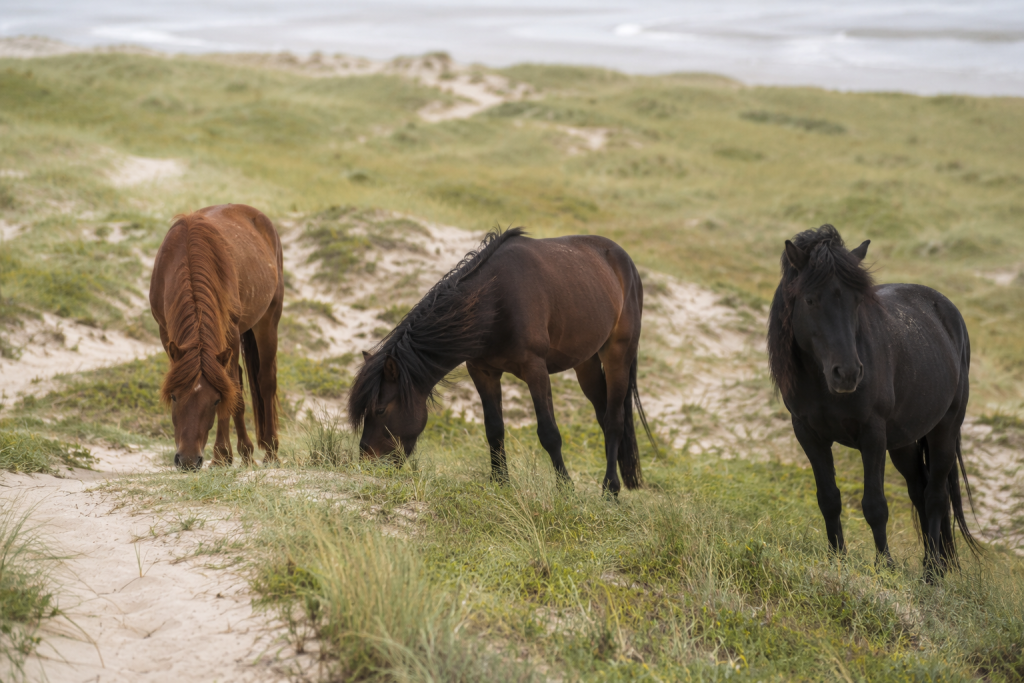
Its population of free-roaming horses has become one of the island’s defining features.
Researchers believe the animals descend from horses introduced centuries ago. Isolated from the mainland, they adapted to the island’s challenging conditions and developed into a unique population.
Protected by law, these horses roam freely among the dunes and grasslands, attracting the attention of scientists and nature enthusiasts from around the world.
A Haven for Wildlife
The island is also home to one of the most significant grey seal breeding areas on Earth.
Each year, enormous numbers of seals gather in the region to reproduce, making the island a valuable site for marine biology research.
Bird species migrating across the Atlantic also depend on the island as a resting point, adding to its ecological importance.
Because of its isolation and relatively undisturbed environment, Sable Island provides researchers with exceptional opportunities to study coastal ecosystems and environmental change.
Separating Fact from Fiction
Over the years, numerous stories have emerged claiming that unusual magnetic forces or unexplained phenomena surround the island.
Scientific evidence tells a different story.
While natural variations in Earth’s magnetic field exist in many locations worldwide, researchers have found no proof that Sable Island possesses extraordinary magnetic properties capable of causing mysterious disappearances.
Most historical accidents can be explained through well-understood factors such as severe weather, difficult navigation conditions, limited visibility, and shifting underwater sand formations.
The Mystery of Time Perception
Some maritime accounts describe strange sensations experienced by sailors near the island, including reports that time seemed to pass unusually quickly or slowly.
Modern psychology offers a far more grounded explanation.
Extreme stress, exhaustion, fear, cold exposure, and isolation can all influence how the human brain perceives the passage of time. Similar experiences have been documented among explorers, disaster survivors, mountaineers, and individuals facing life-threatening situations.
There is no scientific evidence suggesting that time itself behaves differently around the island.
The mystery lies not in physics, but in human perception.
From Shipwreck Graveyard to Protected National Treasure
In 2013, Sable Island was officially designated a protected national park reserve under the management of Parks Canada.
Access remains tightly regulated in order to preserve its fragile ecosystem.
Today, scientists continue to monitor coastal erosion, dune migration, wildlife populations, and the effects of climate change. The island has evolved from a feared maritime hazard into one of Canada’s most important natural research sites.
Why Sable Island Still Captivates the World
For centuries, sailors approached these waters with caution. Shipwrecks, storms, and isolation created an atmosphere that encouraged myths and speculation. Yet the true story of Sable Island may be even more remarkable than the legends.
It is a place shaped by relentless natural forces, where geography influenced history and where a narrow strip of sand altered the fate of countless voyages.
The island remains a reminder that some of the world’s greatest mysteries do not require supernatural explanations. Sometimes, the combination of ocean, weather, and time can create a story far more compelling than fiction.