
A cold case, a forgotten conviction, and the DNA breakthrough that finally revealed the truth
On an ordinary morning in late 2018, a 74-year-old man stopped for coffee in California. To everyone around him, he appeared to be just another retiree going about his daily routine. Nothing about the scene seemed remarkable.
What he did not know was that investigators had been quietly watching him.
After finishing his drink and discarding the cup, detectives retrieved it and sent it for DNA testing. That seemingly insignificant piece of trash would soon become one of the most important pieces of evidence in a case that had remained unsolved for decades.
Within days, laboratory results confirmed what investigators had begun to suspect.
The man was John Arthur Getreu.
For the families of two young women murdered in the 1970s, it was the breakthrough they had waited nearly fifty years to see.
A violent crime committed long before California knew his name
The story of John Getreu did not begin in California.
Years before investigators connected him to the Stanford-area murders, he had already been convicted of a killing overseas.
In 1963, while serving in the U.S. military in West Germany, Getreu was involved in the murder of 15-year-old Margaret Williams. Military authorities investigated the crime, and he was ultimately convicted.
At the time, it appeared that justice had been served.
What nobody could foresee was that his conviction would become only the first chapter in a much larger and more disturbing story.
After serving several years in prison, Getreu was released and returned to the United States.
Looking back, many investigators and crime researchers have pointed to that moment as a critical turning point. Had he remained incarcerated longer, later tragedies might never have occurred.
Building a new life while hiding an old secret
Following his release, Getreu settled in California.
To neighbors and coworkers, he appeared unremarkable. He worked various jobs, blended into the community, and managed to maintain the image of an ordinary citizen.
This ability to remain unnoticed is something criminologists often discuss when examining long-unsolved cases. Contrary to popular portrayals in movies and television, violent offenders do not always fit an obvious profile. Many are capable of living seemingly normal lives while concealing serious crimes from those around them.
For decades, that appeared to be exactly what Getreu had accomplished.
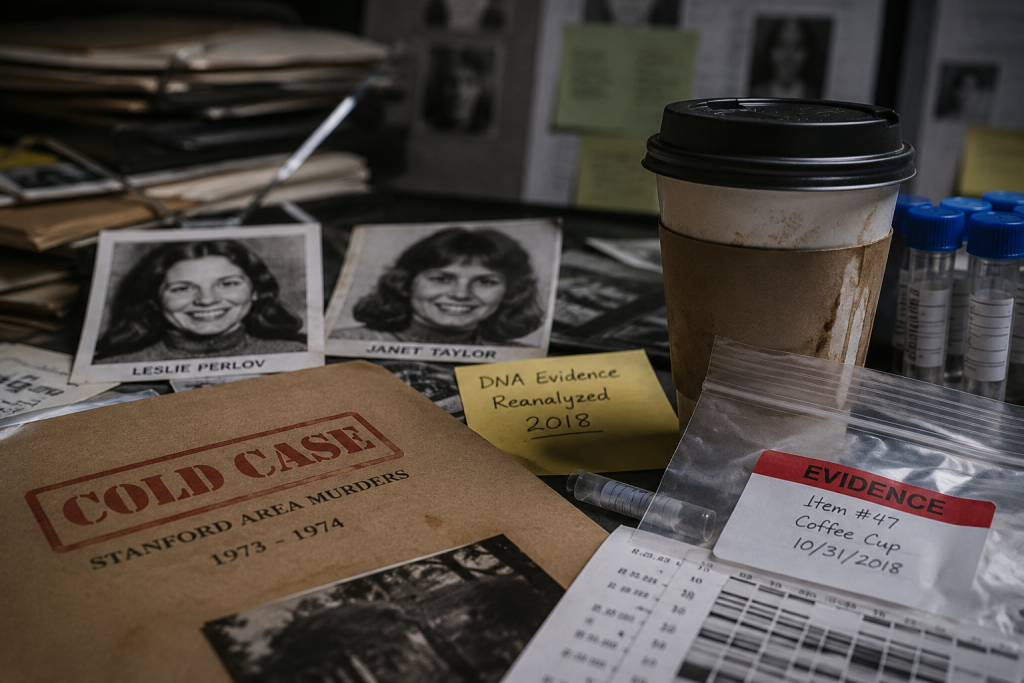
The disappearance of Leslie Perlov
In February 1973, 21-year-old Leslie Perlov was beginning adulthood with her future ahead of her.
A Stanford graduate, she worked at a law library in the Palo Alto area and was known by friends and colleagues as intelligent, hardworking, and independent.
On February 13, she was last seen leaving work.
When she failed to return home, concern quickly turned into alarm. Family members and friends contacted authorities, and a search effort began.
Days later, her body was discovered in the hills above Stanford.
Investigators determined that she had been sexually assaulted and killed. The crime shocked the local community and immediately became a major investigation.
Detectives collected evidence carefully, preserving biological material and other items that they hoped might eventually identify the person responsible.
At the time, however, the technology needed to unlock those answers simply did not exist.
Another young victim, another mystery
Just over a year later, tragedy struck again.
In 1974, 21-year-old Janet Taylor was found dead near Stanford lands in San Mateo County.
Taylor was the daughter of a former Stanford athletic director, and news of her death spread rapidly throughout the region.
Investigators noticed similarities between the two cases. Both victims were young women. Both crimes occurred in the same general area. Both involved similar circumstances.
Yet despite extensive investigative work, authorities could not establish the identity of the killer.
The cases gradually became part of a growing collection of cold cases that seemed destined to remain unsolved.
Why investigators could not solve the murders in the 1970s
Modern readers often ask the same question: how could someone avoid detection for so long?
The answer lies largely in the limitations of forensic science at the time.
Today, DNA evidence can identify individuals with extraordinary accuracy. In the early 1970s, that capability did not exist.
Investigators could collect biological evidence, but they had no way to convert it into a name.
As a result, detectives were forced to rely heavily on witness statements, physical evidence, and traditional investigative methods.
Although they worked diligently, the technology needed to solve the case would not arrive for decades.
The scientific revolution that changed everything
The late twentieth century transformed criminal investigations through the development of DNA analysis.
For the first time, biological evidence left at a crime scene could be linked directly to an individual.
Years later, forensic science took another major leap forward through the emergence of genetic genealogy.
Rather than searching only for exact matches in criminal databases, investigators could now identify distant relatives and reconstruct family trees. By working backward through generations of records, they could narrow their search to a specific person.
This technique gained worldwide attention through several famous cold-case investigations and quickly became one of the most powerful tools available to detectives.
Following the genetic trail
Decades after Leslie Perlov’s murder, investigators revisited the evidence preserved from the original case.
Advances in forensic science allowed them to extract and analyze genetic material that had remained silent for nearly half a century.
The DNA profile did not immediately identify a suspect.
Instead, it pointed investigators toward relatives.
Genealogists and detectives spent months tracing family connections, reviewing records, and narrowing the list of possibilities.
Eventually, every lead began pointing toward the same individual.
John Getreu.
Investigators then obtained DNA from an item he had discarded and compared it with the genetic evidence preserved from the 1973 crime.
The match was conclusive.
After decades of uncertainty, the mystery was finally beginning to unravel.
The phone call a family had waited decades to receive
For Leslie Perlov’s family, the breakthrough was more than just an investigative success.
It was deeply personal.
For years, relatives had continued searching for answers while hoping the case would not be forgotten.
When detectives finally identified the suspect, they were able to deliver news that many had feared would never come.
After nearly fifty years, there was finally a name attached to the crime.
The person responsible had been found.
Convictions and accountability after decades
Following his arrest, prosecutors assembled evidence linking Getreu to both the Perlov and Taylor murders.
Court proceedings revealed the extraordinary timeline of the investigation and highlighted the role modern DNA technology had played in solving the cases.
He was ultimately convicted in connection with Janet Taylor’s murder and later admitted responsibility in the killing of Leslie Perlov.
For the victims’ families, no legal outcome could undo the loss they had experienced.
What the convictions provided was something different: certainty.
After decades of unanswered questions, they finally knew who had taken their loved ones away.
The lasting significance of the case
John Getreu died in prison in 2023 at the age of 79.
His death closed the final chapter of a case that had stretched across generations, continents, and nearly fifty years of investigative work.
Today, the case is remembered not only because of the crimes themselves but because of what it demonstrated about the future of forensic science.
When investigators collected evidence in 1973, they had no way of knowing that the technology needed to interpret it would not exist until decades later.
Yet they preserved that evidence carefully.
Because they did, answers eventually emerged.
The story of John Getreu serves as a powerful reminder that even when justice appears out of reach, scientific advances can give forgotten evidence a voice. In this case, that voice spoke nearly half a century later—and finally revealed the truth.