
In communist Bulgaria, where the state tightly controlled the press, civic organizations, and much of public life, there was one place where the usual rules seemed to bend.
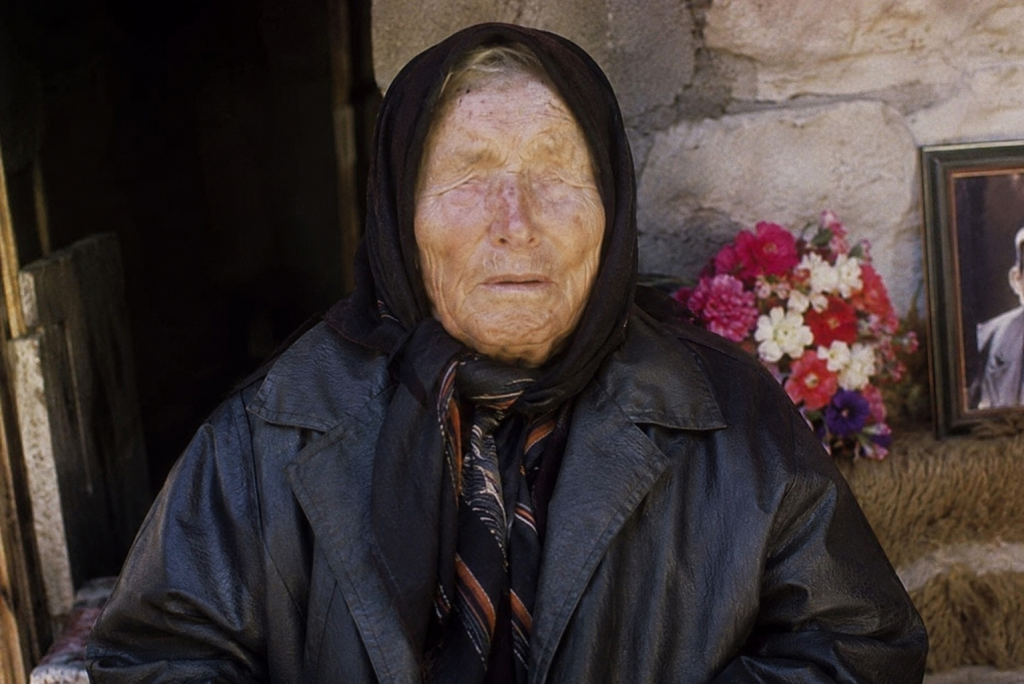
Near the town of Petrich, close to the borders of Greece and what is now North Macedonia, people from every walk of life gathered in long lines for a chance to spend a few minutes with an elderly blind woman. Some arrived carrying faded photographs of loved ones. Others brought personal belongings that had once belonged to missing relatives. Parents searched for answers about children serving in the military. Families wanted reassurance about illness, financial hardship, or uncertain futures.
The woman they had come to see was known as Baba Vanga.
Nearly three decades after her death, her name remains instantly recognizable far beyond the Balkans. Every year, new articles, documentaries, and social media posts revive claims that she predicted some of the most significant events of modern history. Depending on the source, she is credited with foreseeing everything from the collapse of the Soviet Union to the rise of artificial intelligence.
Yet the real story of Baba Vanga is far more complex than the viral predictions that continue to circulate online. Behind the myths lies a documented historical figure whose life unfolded against the backdrop of war, political upheaval, and dramatic social change.
Growing Up in a Region Shaped by Constant Change
Baba Vanga was born Vangeliya Pandeva Gushterova on January 31, 1911, in Strumica, a town that was then part of the Ottoman Empire and is now located in North Macedonia.
Her early years coincided with one of the most turbulent periods in Balkan history. Within a short time, the region would experience the Balkan Wars, the First World War, and repeated shifts in political control. Borders changed, governments rose and fell, and ordinary families were forced to adapt to realities beyond their control.
Historical accounts suggest that Vanga’s life began under difficult circumstances. She was reportedly born prematurely and struggled with health issues during infancy. Her mother died while she was still young, and her father was drafted into military service during wartime.
After the war, the family’s situation deteriorated further. Because of his pro-Bulgarian political activities, her father reportedly lost much of his property under the new Yugoslav authorities. The family slipped into poverty, a reality that shaped much of Vanga’s childhood.
Understanding these early hardships is important because they reveal the environment in which she grew up. She was not raised in privilege, nor in stability. She came of age in a region where conflict, economic uncertainty, and political upheaval were part of everyday life.
The Storm That Became the Foundation of a Legend
The defining event of Vanga’s childhood is also the story most often associated with her rise to fame.
According to accounts later shared by relatives and biographers, she was caught in a powerful storm during her early teens. The story claims that a violent whirlwind lifted her from the ground and threw her some distance away. When she was found, her eyes were reportedly filled with dust, sand, and debris.
Over the following years, she gradually lost her sight.
While historians cannot independently verify every detail of the incident, it is well documented that Vanga became blind during adolescence.
From a modern medical perspective, severe eye trauma combined with infection and limited access to treatment could plausibly result in permanent blindness. In the rural Balkans of the 1920s, specialized ophthalmological care was not easily available.
For many of her followers, however, the loss of her vision marked more than a personal tragedy. It became the moment when they believed she gained an extraordinary ability to perceive things beyond ordinary human understanding.
The Forgotten Years
Popular retellings often jump directly from Vanga’s blindness to stories of prophecy and visions. The reality was far less dramatic and far more human.
After losing her sight, she attended a school for blind children in what is now Serbia. There she learned Braille, household skills, and techniques that helped her navigate daily life independently.
This period is frequently overlooked, yet it challenges the common image of Vanga as an isolated mystic disconnected from society. She received an education, interacted with other students, and learned practical skills that would help her adapt to life without sight.
Her studies were eventually interrupted when family circumstances forced her to return home. Following the death of her stepmother, she became responsible for helping care for younger siblings. Daily survival, not prophecy, dominated much of her young adulthood.
The Beginning of Her Reputation
In 1939, Vanga reportedly developed pleurisy, a serious inflammatory condition affecting the lungs. Contemporary accounts suggest that doctors feared she might not survive, but she eventually recovered.
A few years later, Europe was engulfed in the Second World War.
As uncertainty spread across the continent, stories about Vanga began to circulate more widely. Families searched desperately for information about soldiers who had disappeared, relatives who had stopped writing home, and loved ones whose fate remained unknown.
According to local accounts, people began visiting Vanga seeking answers. Some later claimed that she provided information they believed she could not have known through ordinary means.
Whether those stories were accurate, exaggerated, or influenced by hindsight remains a matter of debate. What is certain is that her reputation started to grow beyond her immediate community.
Reports from the period suggest that even Tsar Boris III of Bulgaria may have visited her during the war years. While details remain unclear, the association with such a prominent figure contributed significantly to her growing fame.