
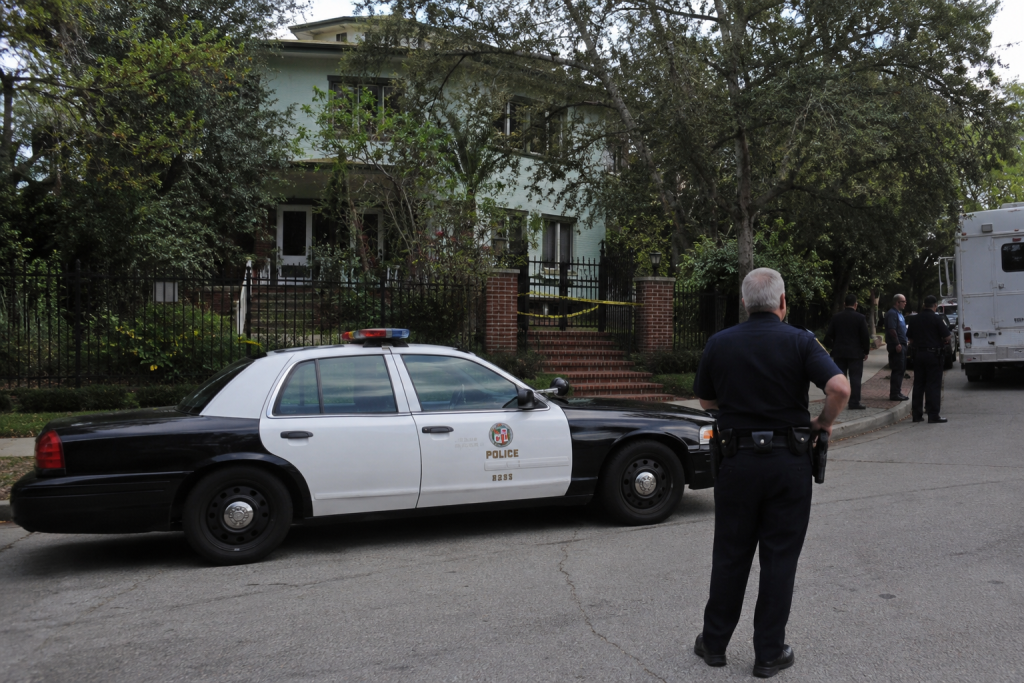
On the morning of September 26, 2012, a quiet residential neighborhood in Los Angeles became the setting for one of Hollywood’s most disturbing real-life tragedies. Neighbors reported hearing screams and loud noises coming from a home in the Los Feliz district. By the time police arrived, they found a scene that seemed almost impossible to comprehend: 81-year-old homeowner Catherine Davis had been killed inside her house, while actor Johnny Lewis lay dead in the yard below.
To television audiences, Lewis was best known as Kip “Half-Sack” Epps from Sons of Anarchy, one of the defining television dramas of its era. To colleagues, he was remembered as a talented young performer with a promising future. To his family, however, the final years of his life had become increasingly difficult as they watched dramatic changes in his behavior unfold without fully understanding why.
The days following the tragedy generated widespread speculation. Initial reports focused on drugs, mental illness, and suicide, yet many of those early assumptions would later prove inaccurate. Even today, the case remains notable not only because of its shocking outcome but because it sits at the intersection of criminal investigation, mental health, and neurological science—an area where clear answers are often difficult to find.
A Young Actor Finding His Place in Hollywood
Jonathan Kendrick Lewis was born on October 29, 1983, in Los Angeles, California. Growing up in the heart of the entertainment industry did not automatically guarantee success, but from an early age he showed a natural ability in front of the camera.
Raised in a family with strong religious values, Lewis entered acting gradually rather than becoming an overnight child star. As television production expanded rapidly during the early 2000s, casting directors were searching for young performers who could convincingly portray both dramatic and comedic roles.
Lewis quickly built a reputation as one of those dependable actors producers enjoyed working with. While he was rarely the lead, his performances consistently earned him new opportunities.
During those years, audiences saw him appear in popular television series including Malcolm in the Middle, Boston Public, American Dreams, CSI: Miami, Drake & Josh, Cold Case, Criminal Minds, and The O.C.. He also expanded into film, appearing in productions such as Aliens vs. Predator: Requiem and The Runaways.
Those who worked alongside him later described him as professional, respectful, and committed to his craft—qualities that made the events of 2012 even more difficult to understand.
The Role That Changed Everything
Lewis’ career reached a new level in 2008 when he joined the cast of Sons of Anarchy, the acclaimed drama created by Kurt Sutter.
Set within the fictional world of an outlaw motorcycle club in California, the series explored loyalty, family, violence, and power while drawing inspiration from aspects of real motorcycle club culture. It quickly became one of FX’s most successful original productions and attracted a devoted international audience.
Lewis portrayed Kip “Half-Sack” Epps, a young prospect eager to prove himself within the club. Although his character ranked near the bottom of the organization’s hierarchy, Half-Sack’s humor, vulnerability, and unwavering loyalty made him one of the show’s most memorable supporting characters.
For Lewis, the role represented a turning point. After years of guest appearances and supporting performances, he finally seemed positioned for larger opportunities in film and television.
In hindsight, there is an unsettling irony. The series that elevated his career revolved around motorcycles, and just a few years later, a real motorcycle accident would become one of the central topics discussed after his death.
Life Away From the Spotlight
Unlike many rising actors of his generation, Johnny Lewis largely stayed away from celebrity culture and tabloid headlines.
One aspect of his private life that attracted public attention was his relationship with singer Katy Perry, long before she became an international pop superstar. The relationship lasted roughly eighteen months and ended quietly, without public controversy.
Years later, following Lewis’ death, Perry shared a message expressing concern about the shortcomings of the mental health system in the United States. She did not comment directly on the investigation but suggested that many people struggling with serious mental health issues fail to receive the support they need.
Signs That Something Had Changed
Around 2010, people close to Lewis began noticing changes in his behavior.
According to later statements made by family members, he became increasingly impulsive and unpredictable. Decisions that once seemed completely out of character started becoming more frequent.
At the same time, legal problems began to accumulate.
Over the following two years, Lewis faced several arrests involving allegations that included burglary, assault, and other violent incidents. He also spent time in both jail and psychiatric treatment facilities.
Viewed individually, these events might have appeared unrelated. Looking back, however, they revealed a pattern of escalating instability.
The Motorcycle Crash That Became Central to the Story
In 2011, Lewis was involved in a motorcycle accident that resulted in a head injury.
What happened afterward has remained one of the most debated aspects of the entire case.
His father later stated publicly that his son was never the same after the accident, believing the injury had fundamentally altered his personality and judgment.
Modern neuroscience acknowledges that traumatic brain injuries can, in some cases, affect regions of the brain responsible for impulse control, emotional regulation, planning, and decision-making. Individuals with moderate or severe brain injuries may experience personality changes, increased irritability, or impaired judgment.
However, specialists also emphasize an equally important point: these outcomes vary widely from patient to patient. The overwhelming majority of people who sustain traumatic brain injuries never become violent.
In Johnny Lewis’ case, no official medical investigation established that the motorcycle accident directly caused the violent events that followed. His family’s observations are well documented, but they remain distinct from medically proven conclusions.
That distinction continues to shape how experts discuss the case today.
The Final Days Before the Tragedy
By September 2012, Lewis’ life had become increasingly unstable.
Court records show he had recently encountered additional legal troubles and had spent time in custody. Only days before the events of September 26, he had been released from jail.
At the time, few could have imagined that his story was approaching such a devastating conclusion.
September 26, 2012
That morning, Johnny Lewis arrived at the Los Feliz home of Catherine Davis, an 81-year-old woman who had previously rented rooms to people in need of temporary housing.
Investigators believe Lewis had stayed at one of her properties for a short period, although it remains unclear whether he was still living there on the day of the incident.
Exactly what occurred inside the house has never been fully reconstructed.
The official investigation concluded that Lewis fatally attacked Davis. The medical examiner determined that she died from a combination of manual strangulation, blunt force injuries, and head trauma sustained during the assault. One of her pet cats was also killed during the incident.
Neighbors reported hearing screams before seeing Lewis climb onto the roof of the house.
Moments later, he fell from the roof into the yard below.
Investigators found no evidence that another individual had caused his death. The Los Angeles County Medical Examiner ultimately ruled that Lewis died from injuries sustained in the fall, classifying the manner of death as accidental rather than suicide.
What the Autopsy Revealed
In the hours immediately following the tragedy, many news reports speculated that drugs had played a significant role.
The autopsy told a different story.
Medical examiners found no evidence of alcohol or illegal drugs in Lewis’ system. Only prescribed medications were detected, and investigators did not conclude that those medications explained his behavior that day.
This finding became one of the most significant aspects of the investigation because it challenged one of the earliest and most widely repeated assumptions.
Yet eliminating drugs as an explanation still left investigators with the central question: what had triggered such extreme violence?
Separating Facts From Assumptions
The years since Lewis’ death have produced countless articles, documentaries, and online discussions attempting to explain what happened.
Some conclusions are supported by evidence. Others are not.
It is well documented that Lewis suffered a traumatic brain injury, experienced legal and psychiatric difficulties during the final years of his life, fatally attacked Catherine Davis, and died after falling from the roof of her home. It is equally well established that toxicology tests did not reveal alcohol or illegal drugs.
What remains unproven is the claim that the motorcycle accident directly transformed him into a violent individual.
Medical researchers continue to study the long-term effects of traumatic brain injuries, but no official investigation concluded that the injury alone explains the events of September 26, 2012.
A Story That Still Defies Simple Answers
More than a decade later, Johnny Lewis is remembered for two very different reasons. One is the talented young actor whose career appeared to be gaining momentum. The other is the tragic figure at the center of one of Hollywood’s most unsettling criminal cases.
Perhaps the lasting lesson of his story is that complex human tragedies rarely have simple explanations.
The investigation answered many factual questions surrounding the deaths of Johnny Lewis and Catherine Davis. Yet it also highlighted the limits of medicine and criminal investigation when neurological injury, mental health, and human behavior intersect.
For that reason, the case continues to be discussed not only by true crime enthusiasts, but also by neurologists, psychiatrists, and researchers seeking to better understand how the brain influences behavior—and where certainty ends and unanswered questions remain.