
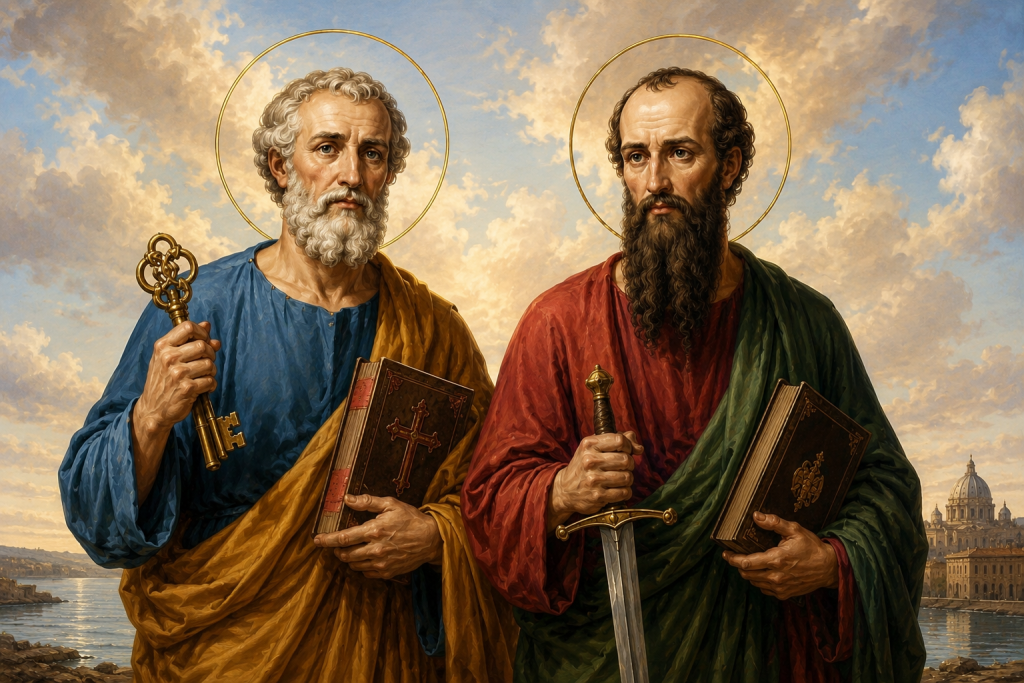
A Feast Day That Celebrates Faith, Redemption, and Courage
Every year on June 29, Christians around the world commemorate Saints Peter and Paul, two of the most influential figures in the history of Christianity. Their feast day is observed by millions of Catholics, Orthodox Christians, and many other Christian communities, honoring the remarkable legacy of two men whose lives could hardly have been more different.
Peter was a fisherman from the shores of the Sea of Galilee. Paul was a highly educated Pharisee who once considered Christians enemies of the faith. One followed Jesus during His earthly ministry. The other encountered Him only after the Resurrection.
Despite these striking differences, history remembers them side by side. Together, they helped transform a small group of believers into a movement that spread throughout the Roman Empire and eventually reached every corner of the world.
Their story is not only about religion. It is also about second chances, personal transformation, and the extraordinary impact that ordinary people can have when their lives take an unexpected direction.
The World They Lived In
To understand Peter and Paul, it helps to step back into the first century, when the Roman Empire dominated much of Europe, North Africa, and the Middle East.
Roman roads connected distant cities, trade flourished across the Mediterranean, and imperial authority reached almost every province. Judea, however, remained a land marked by political tension and deep religious expectation. Many Jewish people believed the long-awaited Messiah would soon arrive and restore Israel’s independence.
When Jesus of Nazareth began preaching, His message challenged those expectations. Rather than calling for political revolution, He spoke about forgiveness, compassion, repentance, and the Kingdom of God. His teachings inspired many but also alarmed religious leaders and Roman authorities alike.
Among those who answered His call was a fisherman named Simon.
Simon: The Fisherman Who Became Peter
Before the world knew him as Saint Peter, he was simply Simon, a fisherman living in Capernaum on the shores of the Sea of Galilee. Alongside his brother Andrew, he earned his living through demanding physical labor.
Fishing in the first century was far from easy. Long nights on the water, heavy nets, uncertain catches, and harsh weather made survival anything but guaranteed. Archaeological discoveries, including a remarkably preserved fishing boat dating from that era, offer historians a glimpse into the difficult life Simon would have known.
Nothing suggested he would one day become one of history’s most recognizable religious figures.
That changed when he met Jesus.
According to the Gospels, after an unsuccessful night of fishing, Jesus instructed Simon to cast his nets one more time. It seemed like an unreasonable request to an experienced fisherman, yet Simon chose to trust Him.
The catch that followed was so large that the nets began to tear.
Realizing he was witnessing something extraordinary, Simon fell to his knees in humility.
Jesus responded with words that would define the rest of his life:
“Do not be afraid. From now on you will fish for people.”
Leaving behind his boat and livelihood, Simon began a journey that would change history.
Why Did Simon Become Peter?
In biblical tradition, a change of name often marked the beginning of a new purpose.
Jesus gave Simon the name Peter, derived from the Greek word Petros, meaning “rock.”
The well-known passage in which Jesus says, “You are Peter, and on this rock I will build my Church,” has been interpreted differently throughout Christian history. While Christian traditions understand its theological meaning in different ways, all recognize Peter as one of the principal leaders of the early Church.
More importantly, the story illustrates that remarkable responsibilities are not always entrusted to the most educated or influential people. Sometimes they are given to those willing to learn, grow, and persevere despite their weaknesses.
A Disciple Who Was Deeply Human
One of the most compelling aspects of Peter’s story is that the Gospels never portray him as flawless.
He is passionate, courageous, and deeply devoted, but also impulsive and occasionally overwhelmed by fear.
He boldly steps out of the boat to walk toward Jesus on the water, only to begin sinking when doubt takes over. He promises never to abandon his Teacher, yet later denies knowing Him three times during the night of Jesus’ arrest.
These failures do not diminish Peter’s importance.
Instead, they make him profoundly relatable.
His story reminds readers that faith is not the absence of weakness but the willingness to rise again after failure. Peter’s journey is one of humility, repentance, and renewal, which is precisely why it continues to resonate with millions of believers today.
From Failure to Leadership
Peter’s denial was not the end of his story.
After the Resurrection, the Gospels describe a moving encounter between Jesus and Peter on the shores of the Sea of Galilee. The setting is significant. It is the same region where Peter’s calling had first begun.
Three times Jesus asks Peter whether he loves Him.
Many biblical scholars see these three questions as a symbolic reversal of Peter’s three denials.
Each time Peter responds, Jesus entrusts him with the care of His followers.
The message reaches beyond theology. Peter’s life demonstrates that failure does not have to define a person’s future. Mistakes can become the beginning of profound personal growth.
The Early Christian Community
Following Pentecost, Peter emerged as one of the central figures of the early Church in Jerusalem.
His preaching attracted growing numbers of believers, even as Christians faced increasing suspicion and persecution. The Book of Acts describes several occasions when Peter was arrested, questioned, and threatened because of his faith.
Neither intimidation nor imprisonment persuaded him to abandon his mission.
Ancient Christian writers, including Clement of Rome and later Eusebius of Caesarea, record the long-standing tradition that Peter eventually traveled to Rome, where he spent the final years of his ministry.
While Peter was helping strengthen the Church, another remarkable story was unfolding hundreds of miles away.
It belonged to a man named Saul.
Saul of Tarsus: Christianity’s Fierce Opponent
If Peter represents the humble fisherman called to an extraordinary purpose, Saul represents one of history’s most dramatic personal transformations.
Born in the city of Tarsus, Saul received an exceptional education. He studied Jewish law under Gamaliel, one of the most respected teachers of the period, and also enjoyed the privileges of Roman citizenship.
Convinced that the emerging Christian movement threatened Judaism, Saul actively participated in the persecution of Christians.
The Book of Acts places him at the execution of Stephen, Christianity’s first martyr, where he approved of the sentence being carried out.
Years later, Saul himself openly acknowledged the intensity with which he had opposed the followers of Jesus.
Few could have imagined that this determined persecutor would eventually become one of Christianity’s greatest missionaries.
The Road to Damascus
Everything changed during a journey to Damascus.
Armed with authority to arrest Christians, Saul set out determined to stop the spread of the new faith.
According to the New Testament, a brilliant light suddenly surrounded him, forcing him to the ground.
He heard a voice asking:
“Saul, Saul, why are you persecuting Me?”
When he asked who was speaking, the answer came:
“I am Jesus, whom you are persecuting.”
Saul discovered he could no longer see.
His companions led him into Damascus, where he remained blind for three days without eating or drinking.
Whether viewed as a miraculous event, a profound spiritual experience, or through another historical lens, there is little doubt about its impact.
It transformed Saul completely.
After being visited by the disciple Ananias and receiving baptism, his sight returned.
From that moment forward, the man who had hunted Christians devoted the rest of his life to proclaiming the very faith he had once tried to destroy.
At first, many believers struggled to trust him. His sudden conversion seemed almost impossible to believe.
Over time, however, his sincerity became undeniable.
The former persecutor would soon become known as Paul, embarking on missionary journeys that would forever shape the future of Christianity.