
Shrimp are among the most popular seafood choices in the world. They appear on fine dining menus, in traditional family recipes, and in countless dishes across Asia, Europe, and the Americas. Yet one small detail has sparked decades of confusion: the dark line running along the back of the shrimp.
For many people, seeing it for the first time is enough to raise uncomfortable questions. Social media is filled with alarming claims suggesting it is a vein full of blood, a toxic organ, or something that should never be eaten. The reality, however, is far less dramatic—and far more fascinating.
From a biological perspective, that dark line is neither a vein nor a blood vessel. It is simply a normal part of the shrimp’s anatomy, and the reason so many people mistake it for something dangerous is rooted in a mix of marine biology, culinary tradition, and surprisingly persistent terminology.
Shrimp Have Been Part of the Human Diet for Thousands of Years
People have harvested shrimp since ancient times. Archaeological evidence shows that coastal civilizations were catching and eating them long before modern fishing methods existed. What changed over the past few decades was scale.
Thanks to advances in aquaculture, shrimp have become one of the most widely traded seafood products on Earth. According to the Food and Agriculture Organization of the United Nations (FAO), global production now reaches several million metric tons each year, making shrimp one of the world’s most valuable seafood commodities.
Countries such as China, India, Ecuador, Vietnam, Indonesia, and Thailand dominate production, supplying supermarkets and restaurants across the globe. As shrimp became a staple in home kitchens, more consumers began noticing the dark line beneath the shell—and with it came countless misconceptions.
Why People Call It a “Vein”
The term is so common that even cookbooks and restaurant menus still use it.
The misunderstanding largely comes from the English culinary term deveining, which describes the process of removing the dark line before cooking.
Despite the name, chefs have long known that the structure is not actually a vein. The word survived simply because it describes what the line looks like rather than what it truly is.
Today, marine biologists routinely point out that the terminology is anatomically inaccurate, yet it has become so deeply embedded in culinary language that it continues to be used worldwide.
Shrimp Anatomy Is Very Different from Human Anatomy
To understand why the dark line cannot be a vein, it helps to look at how shrimp are built.
Shrimp belong to the crustacean family, making them close relatives of crabs, lobsters, and prawns. Like all arthropods, their internal anatomy differs significantly from that of mammals.
Humans have a closed circulatory system in which blood travels through arteries, veins, and tiny capillaries.
Shrimp do not.
Instead, they possess an open circulatory system. Their heart pumps a fluid called hemolymph into body cavities, where it bathes organs directly before returning to the circulatory system.
Because of this arrangement, shrimp do not have veins comparable to those found in humans.
That simple anatomical fact immediately rules out one of the internet’s most common myths.
So What Is the Dark Line?
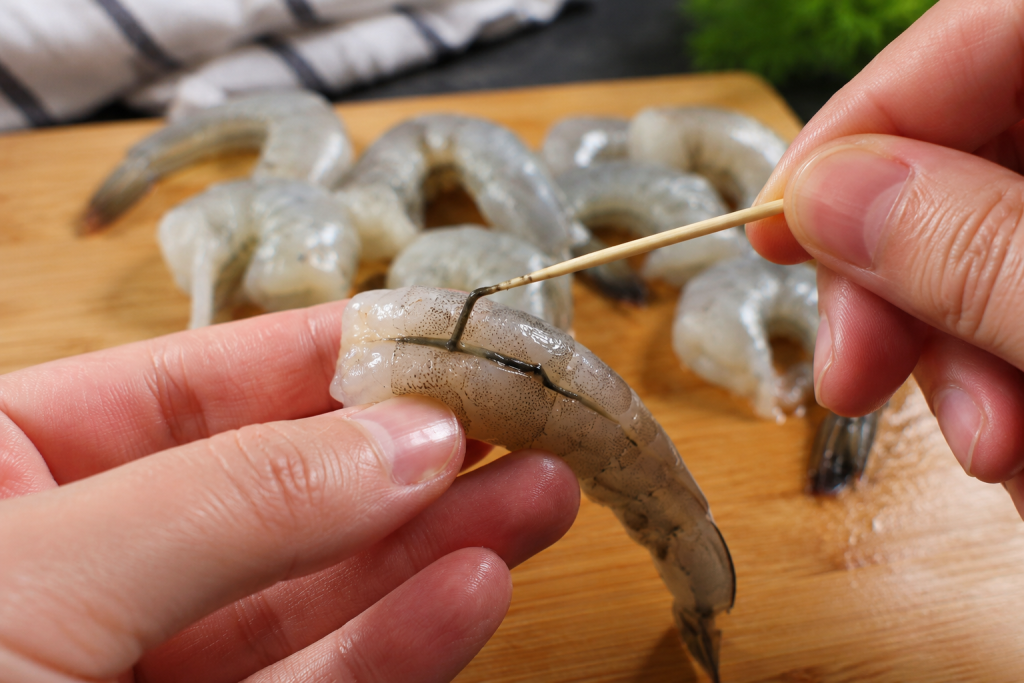
The dark line is the shrimp’s digestive tract.
It begins just behind the stomach and runs almost the entire length of the body before ending near the tail.
Inside it are whatever materials happen to be passing through the digestive system at the time the shrimp is harvested.
Depending on where it lived and what it had been feeding on, the tract may contain microscopic algae, plankton, organic matter, tiny invertebrates, fine sand, or other marine sediments.
In larger shrimp, the digestive tract is thicker and easier to see through the translucent flesh. In smaller species, it may be barely visible—or nearly transparent.
Why Does Its Color Change?
One common misconception is that a darker digestive tract indicates spoiled shrimp.
In reality, its color depends primarily on the shrimp’s recent diet.
Shrimp that have consumed large amounts of algae may have a greenish digestive tract.
Those feeding along muddy or sandy sea floors often develop a much darker appearance.
Others may appear gray, brown, or almost colorless.
The color alone tells you very little about freshness or food safety.
Does It Contain Waste?
This is perhaps the question people ask most often.
The answer is yes—but with important context.
Because it is the digestive tract, it may contain partially digested food along with digestive waste.
However, it is not simply a tube filled entirely with feces, as many viral posts suggest.
In some shrimp, the tract is nearly empty.
In others, it contains only tiny amounts of organic material or fine sediment.
Is It Safe to Eat?
According to major food safety authorities, the digestive tract itself is not considered hazardous when shrimp are properly handled and thoroughly cooked.
The greater concern comes from eating spoiled seafood or consuming shrimp that have not been cooked to a safe internal temperature.
Organizations such as the U.S. Food and Drug Administration (FDA) and the Centers for Disease Control and Prevention (CDC) recommend cooking seafood thoroughly to reduce the risk of harmful bacteria, including naturally occurring marine species such as Vibrio.
For healthy individuals, eating a properly cooked shrimp with the digestive tract still intact is generally not considered a significant health risk.
That helps explain why millions of people around the world regularly eat shrimp that have never been deveined.
Why Do Chefs Usually Remove It?
The answer has much more to do with culinary quality than food safety.
If the digestive tract contains fine sand or sediment, it can create an unpleasant gritty texture.
It may also introduce a slightly earthy or bitter flavor in certain dishes.
For restaurants—particularly those serving fine dining cuisine—presentation matters just as much as taste.
Removing the digestive tract creates a cleaner appearance and a more consistent eating experience, which is why most professional kitchens routinely perform this extra step.
Not Every Cuisine Removes It
Interestingly, deveining is far from universal.
Many traditional Asian dishes use small shrimp with the digestive tract left intact because removing it would be impractical and would result in unnecessary loss of meat.
The same is true for numerous Mediterranean seafood recipes where shrimp are cooked whole.
For smaller species, the digestive tract is often so tiny that most diners never notice it.
How Is It Removed?
Once the shell has been peeled, a shallow cut is made along the shrimp’s back.
Using the tip of a knife or a small skewer, the digestive tract is gently lifted out in one continuous piece.
If it breaks during removal, the remaining fragments can simply be rinsed away under cold running water.
Another Line That Causes Confusion
Some people notice a second thin line running along the underside of the shrimp.
This is not another digestive tract.
Nor is it a vein.
It is part of the shrimp’s ventral nerve cord, an essential component of its nervous system.
Unlike the digestive tract, it is rarely removed during food preparation.
How Can You Tell If Shrimp Have Gone Bad?
The presence of the digestive tract is far less important than the overall condition of the seafood.
Fresh shrimp should have firm flesh, a clean ocean-like smell, and a slightly moist surface.
Warning signs of spoilage include:
- A strong ammonia-like odor.
- Slimy or sticky flesh.
- Soft, mushy texture.
- Significant discoloration.
- Extensive black spots caused by enzymatic or bacterial deterioration.
If any of these signs are present, the shrimp should not be eaten regardless of whether they have been deveined.
A Culinary Myth That Refuses to Disappear
Few misconceptions have become as deeply rooted in cooking as the belief that the dark line inside a shrimp is a vein.
Modern biology tells a very different story. Shrimp do not have veins like humans, and what we see through their translucent bodies is simply the digestive tract—a perfectly normal anatomical structure that may contain partially digested food and tiny marine sediments.
From a food safety perspective, proper storage and thorough cooking matter far more than whether this structure has been removed. Deveining is largely a matter of appearance, texture, and personal preference rather than a requirement for safe consumption.
So the next time you spot that dark line running along the back of a shrimp, you’ll know you’re not looking at a vein or a hidden health hazard. You’re simply seeing one of the most misunderstood—and surprisingly ordinary—features of one of the world’s favorite seafood delicacies.