
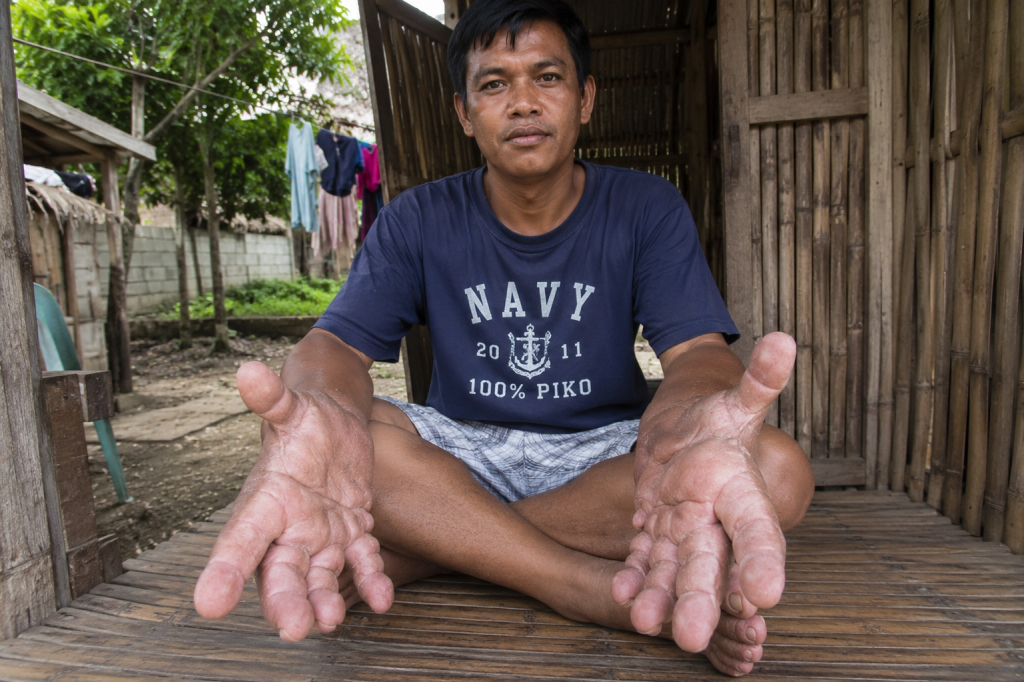
At first glance, most people assume the image isn’t real.
Some believe it has been digitally altered. Others are convinced it was created with artificial intelligence. His hands appear so unusually large that many simply cannot accept they belong to a real person.
But they do.
Mark Davidson Jacildo, from the Philippines, is living with one of the rarest congenital conditions known to medicine. His story, featured in TLC’s Most Extreme Humans, is not about breaking records or becoming famous. It is about learning to live with a body that has challenged him since birth—and finding the courage to keep moving forward.
A condition so rare that few doctors ever encounter it
Mark was born with macrodactyly, an exceptionally uncommon congenital disorder that causes one or more fingers—or, in severe cases, an entire hand or foot—to grow far beyond their normal size.
Unlike ordinary growth, macrodactyly affects nearly every structure within the limb. Bones, nerves, blood vessels, fatty tissue, and skin all enlarge together, often leading to significant physical limitations.
His condition affects both his hands and feet, making everyday tasks far more difficult than most people realize.
Although researchers have linked some cases to genetic mutations involving cellular growth pathways, macrodactyly remains poorly understood because of its rarity. Every patient experiences the condition differently, and treatment must be tailored to the individual.
Everyday life is built around adaptation
For most people, putting on shoes, holding a coffee mug, or using a smartphone requires no thought at all.
For Mark, those same tasks can demand patience, creativity, and constant adjustment.
Finding properly fitting footwear is extremely difficult, and many everyday objects were never designed for someone with hands of his size. Simple activities often require alternative techniques that most of us never have to consider.
These challenges have become part of his daily routine—not because he chose them, but because he has learned to adapt to the life he was given.
The fear that kept him away from doctors
For years, Mark avoided returning to medical specialists.
During earlier consultations, he was told that while surgery might help preserve function or reduce complications, severe progression of the condition could eventually leave amputation as one possible treatment option.
The possibility of losing part of his hand or foot was overwhelming.
Rather than face that uncertainty, he chose to live with increasing limitations, adapting as best he could while staying away from hospitals.
Becoming a father changed everything
Eventually, something happened that proved stronger than fear.
Mark became a father.
In Most Extreme Humans, he explains that his daughter completely changed the way he viewed his future. His decisions were no longer only about himself. He wanted to remain healthy enough to watch her grow up and continue being part of her life.
When he noticed new changes in his condition, he made a decision he had postponed for years.
He returned to doctors—not because he had stopped being afraid, but because protecting his future with his family had become more important than avoiding difficult conversations.
More than a medical case
To viewers, Mark’s condition may seem extraordinary.
To him, it is simply everyday life.
He did not agree to share his story in order to shock people. Instead, he hoped to show that behind every unusual medical condition is a human being with responsibilities, dreams, fears, and loved ones.
His appearance may be the first thing people notice.
It is certainly not the most important thing about him.
Understanding macrodactyly
Macrodactyly is an extremely rare congenital disorder involving abnormal enlargement of fingers or toes due to excessive growth of bones, nerves, blood vessels, fat, and soft tissue.
The condition is present from birth and may continue progressing throughout childhood and, in some patients, into adulthood. Treatment often involves multiple surgeries aimed at preserving function, improving mobility, or slowing further complications. In the most severe cases, when function can no longer be maintained or serious complications arise, amputation may become the last available medical option.
Because each case is unique, treatment plans vary significantly from one patient to another.
Looking beyond the photograph
Images of Mark often spread across social media because they seem almost impossible to believe.
Yet the photograph tells only a fraction of his story.
Behind it is a man who has spent his entire life adapting to an exceptionally rare condition, a father determined to remain present for his child, and someone who continues to face uncertainty with remarkable resilience.
His story reminds us that the most extraordinary part of a person’s life is not always what makes them look different.
Sometimes, it is the quiet determination to keep moving forward despite challenges most of us will never experience.