
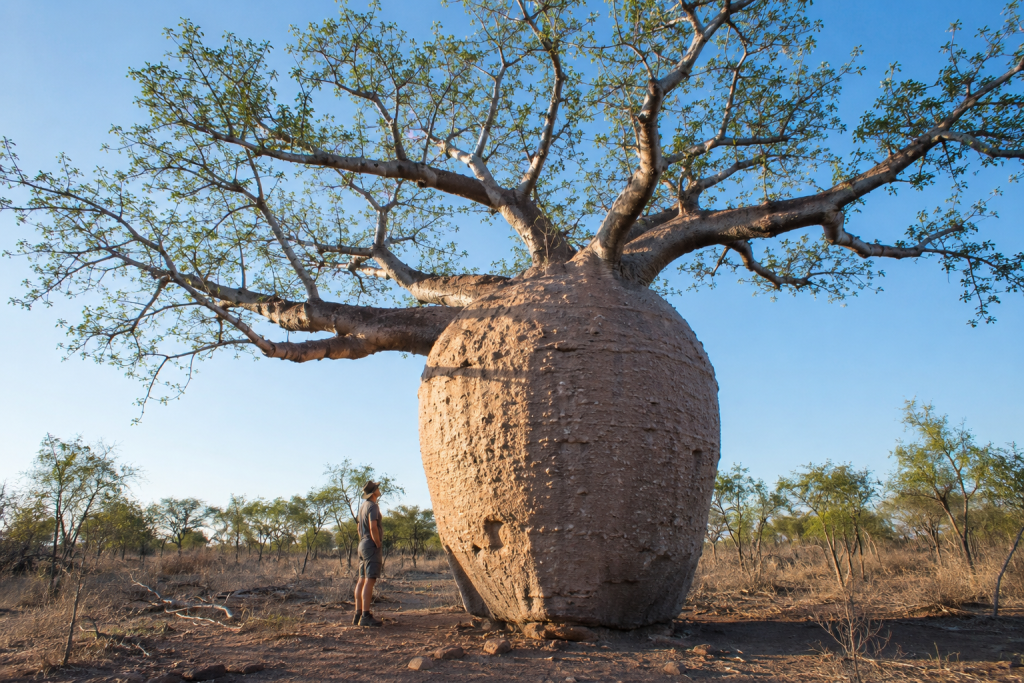
At first glance, it hardly looks like a tree at all. With its swollen trunk and relatively small canopy, Australia’s boab seems more like a giant wooden bottle rising from the ground than a living plant. Yet this unusual shape is exactly what has allowed it to survive in one of the harshest environments on Earth.
The Australian boab (Adansonia gregorii) is the only baobab species native to Australia. It grows naturally across the Kimberley region of Western Australia and parts of the Northern Territory, where scorching temperatures and long dry seasons make water one of nature’s most valuable resources.
Built for a Climate of Extremes
The boab’s massive trunk is far more than an eye-catching feature. Its thick, spongy tissues are able to absorb and retain large amounts of water during the rainy season. Instead of storing water inside a hollow chamber, the tree holds it throughout its living tissues, gradually drawing on those reserves when rainfall disappears for months.
This remarkable adaptation allows the boab to endure droughts that would seriously challenge many other tree species. Every rainy season becomes an opportunity to prepare for the next stretch of dry weather.
More Than Just an Unusual Tree
A mature boab often becomes the center of life in an otherwise dry landscape. Its shade offers relief from the intense Australian sun, while hollows in older trunks provide shelter for birds, bats, reptiles, and countless insects.
Its large white flowers, which typically open at night, attract pollinators such as bats and nocturnal insects. Later, the tree produces woody fruits containing nutritious pulp and seeds that have long been valued by Aboriginal Australians as a traditional food source.
A Living Landmark
Boabs grow slowly and can live for centuries. Over time, many develop distinctive shapes, making individual trees easy for local communities to recognize. Some have become well-known landmarks, drawing visitors who are amazed by their enormous trunks and sculptural appearance.
One of the most famous examples is the Boab Prison Tree in Western Australia. While stories surrounding its historical use remain the subject of debate among historians, the tree itself has become an important cultural and historical landmark.
Nature’s Ingenious Design
The Australian boab is a reminder that survival is not always about growing faster or becoming stronger. Sometimes it depends on adapting in ways that seem almost impossible.
Its swollen trunk, unusual silhouette, and ability to store water are the result of millions of years of evolution in an unforgiving climate. What may appear unusual to us is, in reality, a beautifully efficient solution designed by nature itself.
Standing alone against the vast Australian landscape, the boab is more than a remarkable tree. It is a living example of resilience, proving that even in places where water is scarce, life can find extraordinary ways to endure.