
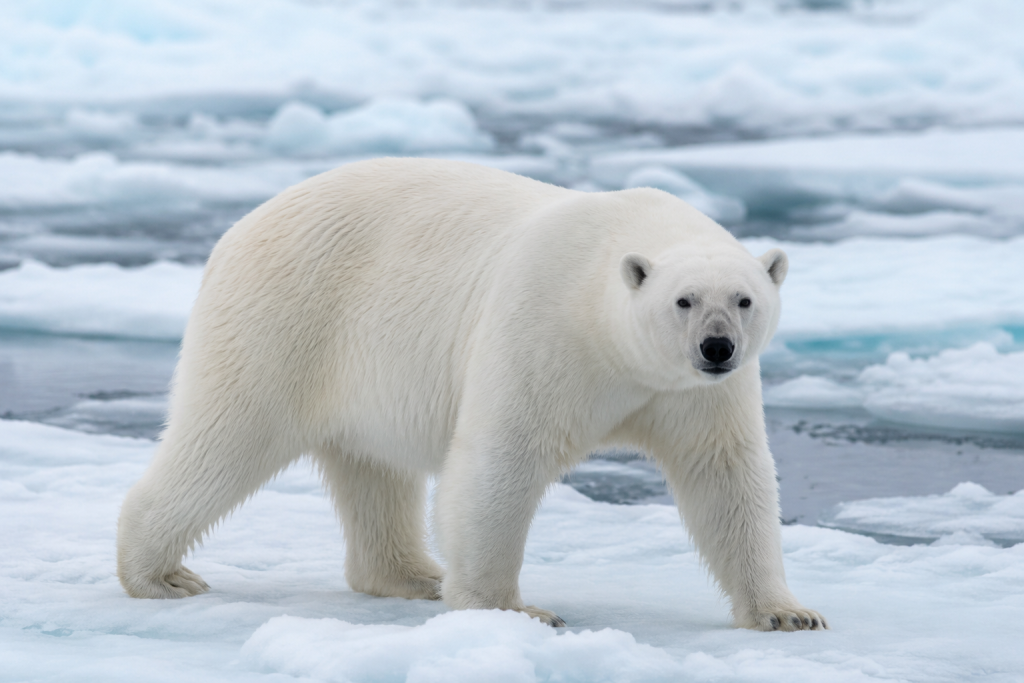
When most people picture a polar bear, they imagine a brilliant white animal disappearing into a frozen Arctic landscape. It seems like the perfect color for life surrounded by snow and ice.
The surprising part is that the bear’s fur isn’t truly white at all.
If you were to examine a single strand under a microscope, you wouldn’t find white pigment. Instead, each hair is hollow and almost transparent. As sunlight passes through and scatters around these tiny structures, our eyes interpret the reflected light as white. Depending on lighting conditions, age, and even the cleanliness of the coat, a polar bear can sometimes appear cream-colored or slightly yellow.
It’s a remarkable reminder that what we see isn’t always what actually exists.
A Masterpiece of Arctic Engineering
Beneath that seemingly white coat lies another surprise: the polar bear’s skin is black. The dark pigmentation helps absorb whatever solar radiation reaches the skin, although the bear’s ability to survive brutal Arctic winters depends even more on something else.
A thick layer of body fat, which can exceed four inches (10 centimeters), works together with an exceptionally dense coat to trap heat. This natural insulation allows polar bears to remain active in an environment where temperatures can plunge well below -45°C (-49°F), even when icy winds make the cold feel harsher.
Every part of the animal’s body is designed with one goal in mind—survival.
More Than Just Camouflage
The pale appearance of a polar bear does far more than make it look at home in the Arctic.
Its coat helps it blend into a landscape dominated by snow, sea ice, and bright daylight. This camouflage gives the bear an important advantage when stalking seals, its primary prey. In a place where hunting opportunities are unpredictable and every successful catch matters, remaining unnoticed can mean the difference between eating and going hungry.
What appears to us as beauty is, in reality, highly efficient biology.
Evolution’s Quiet Genius
Polar bears are often admired for their size and strength, but one of their greatest adaptations is something most people never notice. Their famous “white” appearance is not created by color at all, but by the way light interacts with millions of specialized hairs.
Nature rarely wastes energy on decoration. Nearly every feature of a polar bear serves a practical purpose, shaped over countless generations by one of the harshest environments on Earth.
So the next time you see a polar bear standing against the Arctic ice, remember this remarkable fact: the world’s most iconic white bear isn’t truly white. Its color is an illusion—one that perfectly demonstrates how evolution can solve multiple challenges with a single elegant design.