
History often remembers generals, political leaders, and famous resistance fighters. Yet some of the greatest acts of courage were carried out by ordinary people whose names almost disappeared with time.
One of those people was Gita Wisgardisky, a Jewish mother imprisoned in the Kovno Ghetto during World War II. Faced with the certainty that her young daughter would not survive if she stayed, Gita made a decision that few parents could imagine—and even fewer would have had the strength to carry out.
Life Behind the Barbed Wire
When Nazi Germany occupied Lithuania in 1941, tens of thousands of Jewish residents of Kaunas were forced into what became known as the Kovno Ghetto. Surrounded by fences, armed guards, and constant surveillance, it was a place where starvation, forced labor, and fear became part of everyday life.
Among those trapped inside were Gita Wisgardisky, her husband Jona, and their little daughter, Henia, who was barely eighteen months old.
Many people still hoped deportations meant relocation. Gita believed otherwise. From what she had learned, she feared the Nazis were carrying out something far more horrifying. As the months passed and thousands of people vanished, her fears proved tragically accurate.
When Children Became Targets
The danger inside the ghetto grew worse with each passing year. During one of the most devastating operations against the Jewish population, children were taken away in large numbers, leaving countless families shattered forever.
Parents responded with desperate creativity. Hidden compartments appeared behind walls, beneath floors, inside attics, and anywhere a child might escape notice for a few precious minutes.
Jona built a concealed space behind a false pantry wall in their apartment. During one search, little Henia remained hidden there while German forces inspected the home.
The family survived that day.
But they understood that relying on the same hiding place again would be a dangerous gamble.
A Plan That Seemed Impossible
If Henia was going to live, she had to leave the ghetto entirely.
The problem was obvious. Every entrance and exit was heavily guarded, and anyone caught attempting an escape could be executed immediately.
Fortunately, before the war Jona had worked at a chemical factory, where he had earned the trust of Jonas Stankiewicz, a Lithuanian foreman. Despite the enormous risk to his own family, Stankiewicz agreed to help protect the little girl outside the ghetto.
Getting her there would be the greatest challenge.
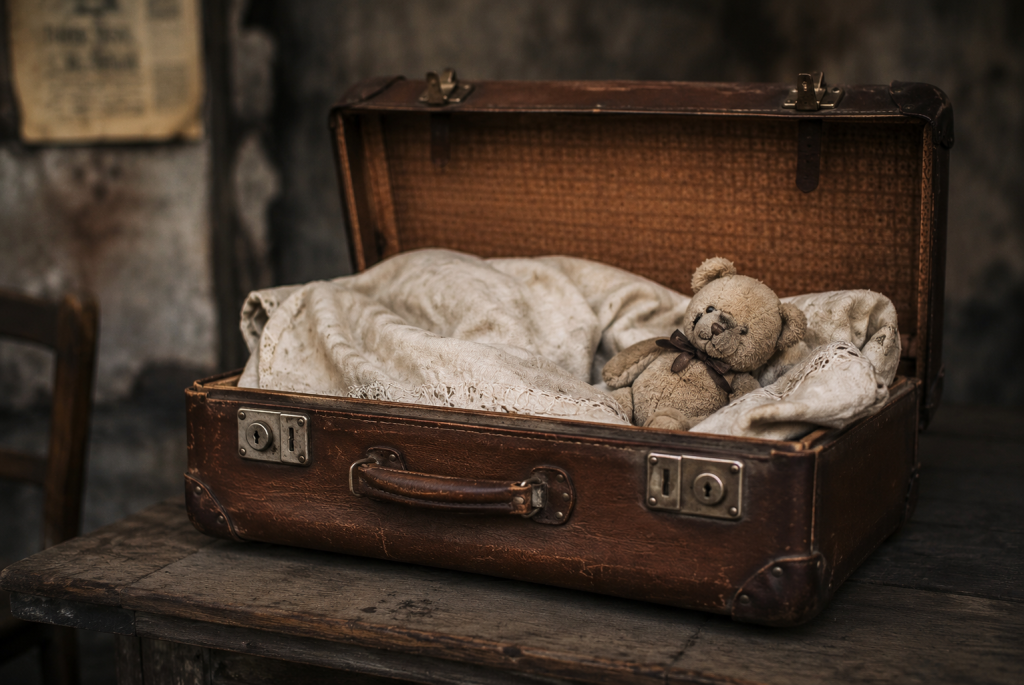
To keep Henia from crying during the journey, she was lightly sedated. Gita carefully wrapped her daughter in blankets, placed her inside a large leather suitcase, and walked toward the checkpoint.
Everything depended on remaining calm.
If a guard decided to inspect the luggage more carefully, or if the child made even the smallest sound, the consequences would almost certainly be fatal.
Against all odds, the suitcase passed through the gate.
Inside it was not luggage.
It was a child’s future.
A Story That May Have Been Bigger Than One Family
Henia survived the war in hiding with the Lithuanian family that sheltered her.
Years later, survivor testimonies suggested that Gita may have helped other Jewish children escape the Kovno Ghetto using similar methods. Historians have not been able to establish exactly how many children she assisted, and no surviving official records provide a definitive number.
For that reason, these accounts are generally presented as survivor recollections rather than fully documented historical fact.
Even so, they reflect the extraordinary risks taken by people who chose compassion over self-preservation during one of history’s darkest periods.
Survival Against Extraordinary Odds
Eventually, Gita and Jona also escaped the ghetto. For months they remained hidden beneath a potato farm, depending entirely on people willing to risk execution for helping Jews.
Of the roughly 40,000 Jews imprisoned in the Kovno Ghetto, fewer than 2,000 survived the Holocaust.
After the war, the family spent time in the Zeilsheim displaced persons camp in Germany before emigrating to Palestine. Henia later settled in the United States, became a teacher, and devoted much of her life to sharing her experiences with younger generations, believing that remembering the past was one of the strongest defenses against repeating it.
Courage That Never Asked to Be Remembered
Not every hero receives public recognition.
Some leave behind no medals, no monuments, and only a handful of surviving witnesses who remember what they did.
Gita Wisgardisky belongs among those quiet heroes.
Whether she saved one child or many more, one fact is beyond question: she refused to surrender to hopelessness. In a world where fear ruled nearly every decision, she chose courage instead.
Perhaps that is why her story continues to resonate today. It reminds us that history is not shaped only by armies or governments, but also by ordinary people who make extraordinary choices when humanity needs them most.