
As the rescue helicopter swept over the wreck of the Costa Concordia, Rose Metcalf feared the worst.
She could hear the aircraft circling overhead, close enough to know help had arrived. Yet it never slowed down. From where she stood on the steeply tilted cruise ship, it seemed impossible that the rescuers could miss them. But from hundreds of feet in the air, a handful of people stranded on a massive vessel were almost invisible.
At that moment, Rose realized that surviving the disaster was only part of the challenge.
Someone still had to find her.
Reaching into her pocket, she pulled out an ordinary flashlight. It wasn’t emergency equipment or a distress beacon. Acting on instinct, she began flashing the light toward the helicopter, hoping the intermittent beam would catch someone’s attention.
It did.
Those brief flashes became the difference between remaining trapped aboard one of history’s most infamous cruise ship disasters and being safely lifted to shore.
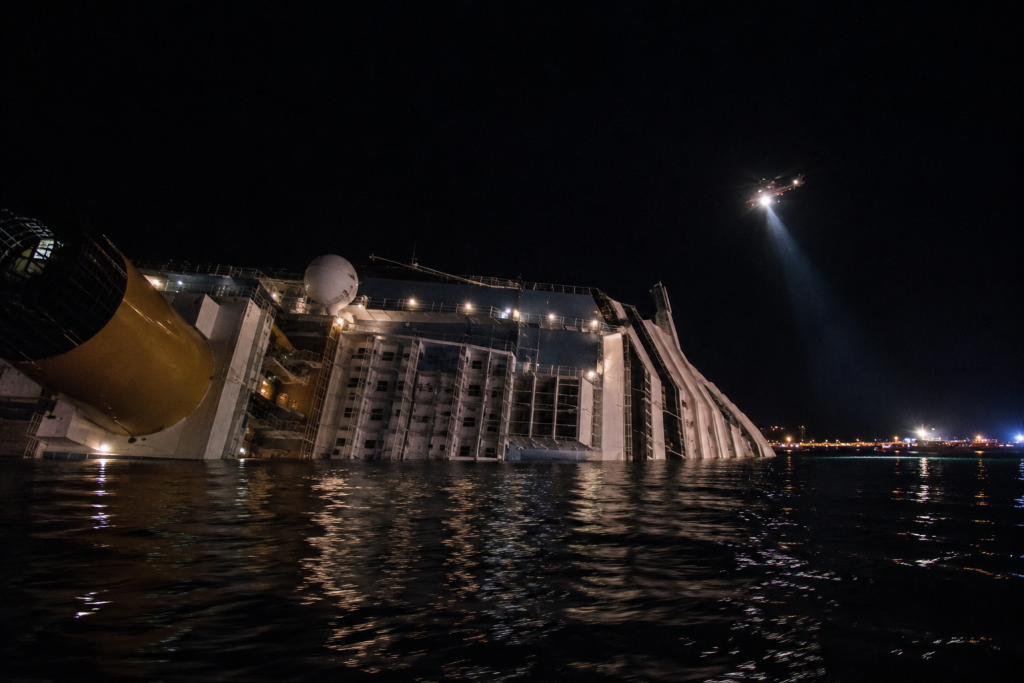
A Luxury Voyage That Turned Into a Nightmare
On January 13, 2012, the Costa Concordia departed the Italian port of Civitavecchia on what was supposed to be a routine Mediterranean cruise. Carrying more than 4,200 passengers and crew, the ship represented modern luxury at sea, complete with elegant restaurants, theaters, swimming pools, shops, and entertainment venues.
That evening, passengers were enjoying dinner, attending performances, or relaxing on deck as the ship sailed along Italy’s coastline.
Everything changed shortly before 10 p.m.
Captain Francesco Schettino steered the vessel unusually close to Giglio Island in an unofficial maneuver known as an inchino, or “salute,” intended to impress people on shore.
Instead, the ship struck an underwater reef.
The collision ripped a massive opening in the hull, allowing seawater to flood critical compartments within minutes. Electrical systems began failing, propulsion was lost, and one of the world’s largest cruise ships was suddenly fighting to stay afloat.
Confusion Made a Bad Situation Worse
The impact was severe, but many passengers were not immediately told what had happened.
Initial announcements suggested there had simply been an electrical failure, leading many people to remain calm instead of preparing to evacuate. Meanwhile, water continued pouring into the ship, and the vessel developed an increasingly dangerous list.
Later investigations concluded that the delay in ordering a full evacuation significantly reduced the time available to launch lifeboats safely and contributed to the chaos that followed.
As the ship leaned farther onto its side, every passing minute narrowed the options for both passengers and crew.
Why Rose Stayed Behind
Rose Metcalf wasn’t a passenger enjoying a vacation.
She was a performer working aboard the ship, and like many crew members, her responsibility was to assist passengers before thinking about her own escape.
While thousands of frightened people searched for lifeboats, crew members directed traffic, helped elderly travelers, reassured families, and guided guests through rapidly changing conditions.
As the vessel continued to tilt, walking became increasingly difficult. Staircases that had been perfectly normal only moments earlier turned into steep climbs. Furniture, luggage, and heavy objects slid across the decks, making movement even more dangerous.
Eventually, after many passengers had escaped, Rose and several fellow crew members found themselves stranded on the outside of the ship.
There was no safe route back inside.
There was no accessible lifeboat waiting below.
All they could do was wait for rescuers to notice them.
Why Seeing Survivors Isn’t Always Easy
It may seem surprising that rescue crews could overlook people on such an enormous ship.
In reality, nighttime search-and-rescue operations are far more challenging than most people realize.
From the air, individual people appear incredibly small against a dark background of steel, water, and shadows. Even a vessel as enormous as the Costa Concordia could conceal survivors if they weren’t creating movement or contrast.
Rescue crews are trained to look for anything that stands out—motion, reflections, or flashing lights.
That’s one reason why modern life jackets are often equipped with water-activated emergency lights. Their purpose isn’t to illuminate the surroundings but to make survivors easier to locate in darkness.
Without realizing it, Rose instinctively relied on the very same principle.
A Simple Idea That Worked
Later, Rose explained that she wasn’t trying to send a Morse code message.
She simply wanted the helicopter crew to realize people were still stranded aboard the wreck.
Using her flashlight, she began creating short bursts of light aimed toward the aircraft.
The flashes caught the rescuers’ attention.
Soon afterward, the helicopter crew located the group and began lifting them to safety using a rescue hoist.
For the pilots overhead, it may have appeared as nothing more than a blinking point of light.
For Rose and her colleagues, it meant they had finally been seen.
A Disaster That Changed the Cruise Industry
The Costa Concordia disaster claimed the lives of 32 people and became one of the most closely examined maritime accidents of the 21st century.
Investigators concluded that a combination of navigational errors, delayed emergency decisions, and poor crisis management contributed to the scale of the tragedy.
Captain Francesco Schettino was later convicted and sentenced to 16 years in prison for multiple offenses related to the disaster.
The ship itself remained off Giglio Island for years before engineers completed an unprecedented recovery operation known as parbuckling, which carefully rotated the wreck upright before it was removed for dismantling. The recovery effort cost more than $1.2 billion, making it the most expensive passenger ship salvage operation ever undertaken.
The disaster also prompted significant changes across the cruise industry, including stricter emergency procedures and mandatory safety drills shortly after passengers board.
A Reminder That Survival Depends on Being Found
The story of Rose Metcalf doesn’t change the causes of the Costa Concordia disaster, nor does it diminish the loss of the 32 people who never made it home.
Instead, it highlights an often-overlooked truth about emergencies.
Surviving the initial danger is only the first step.
Rescuers must also be able to locate you.
For Rose, that moment came when a simple flashlight cut through the darkness and caught the attention of a helicopter crew searching the wreck below.
In one of the deadliest cruise ship disasters of modern times, sophisticated technology certainly played its part. Yet for one stranded crew member, it was an ordinary flashlight—and the presence of mind to use it—that helped transform hope into rescue.