
A Voyage That Began Like Thousands Before It
For everyone stepping aboard the Costa Concordia on January 13, 2012, the evening promised exactly what a Mediterranean cruise was meant to deliver: elegant dining, live entertainment, breathtaking coastal scenery, and the comfort of one of Europe’s most impressive passenger ships.
The vessel itself symbolized the modern cruise industry. Stretching nearly 300 meters in length and carrying more than 4,200 passengers and crew, it was a floating resort complete with theaters, swimming pools, restaurants, shopping areas, spas, and hundreds of luxury cabins.
As darkness settled over the Tyrrhenian Sea, few people gave much thought to navigation or the decisions being made on the bridge. They trusted that those responsible for the ship knew exactly what they were doing.
Within hours, that confidence would disappear forever.
A Choice That Never Needed to Be Made
Commercial cruise routes are carefully planned long before a ship leaves port. Every course is designed to balance efficiency, passenger comfort, and above all, safety.
That evening, Captain Francesco Schettino decided to leave the planned route.
His intention was to perform what Italian sailors refer to as an inchino—a close coastal pass intended as a gesture of respect toward communities on shore. While the tradition had occasionally been practiced in the past, it was never without risk. Bringing a vessel the size of Costa Concordia closer to land dramatically reduced the margin for error.
Near the island of Giglio, that margin disappeared.
Hidden beneath calm waters lay rocky formations that had long been marked on nautical charts. A small navigational miscalculation proved to be all it took.
When a Luxury Ship Met Solid Rock
At approximately 9:45 p.m., passengers felt a violent jolt followed by the unmistakable sound of metal scraping against stone.
Dinner tables shook.
Glasses shattered.
The lights briefly flickered before sections of the ship lost power altogether.
To many guests, it felt like an unexpected mechanical problem rather than a life-threatening emergency.
The reality unfolding below the waterline was far more serious.
A section of the hull roughly 53 meters long had been torn open. Seawater rushed into critical compartments, damaging electrical systems and disabling propulsion. Although modern cruise ships are designed with watertight sections intended to contain flooding, the damage was too extensive for those safeguards to prevent the unfolding crisis.
The Most Dangerous Delay
Maritime emergencies are often determined not only by what happens first, but by how quickly people react afterward.
In the case of Costa Concordia, valuable time slipped away.
Rather than immediately ordering an evacuation, passengers were initially told that an electrical problem had occurred and that the situation remained under control. Many returned to their cabins. Others stayed in restaurants or lounges, assuming the interruption was temporary.
Meanwhile, engineers already understood that the ship had suffered catastrophic damage.
Every passing minute made evacuation more difficult.
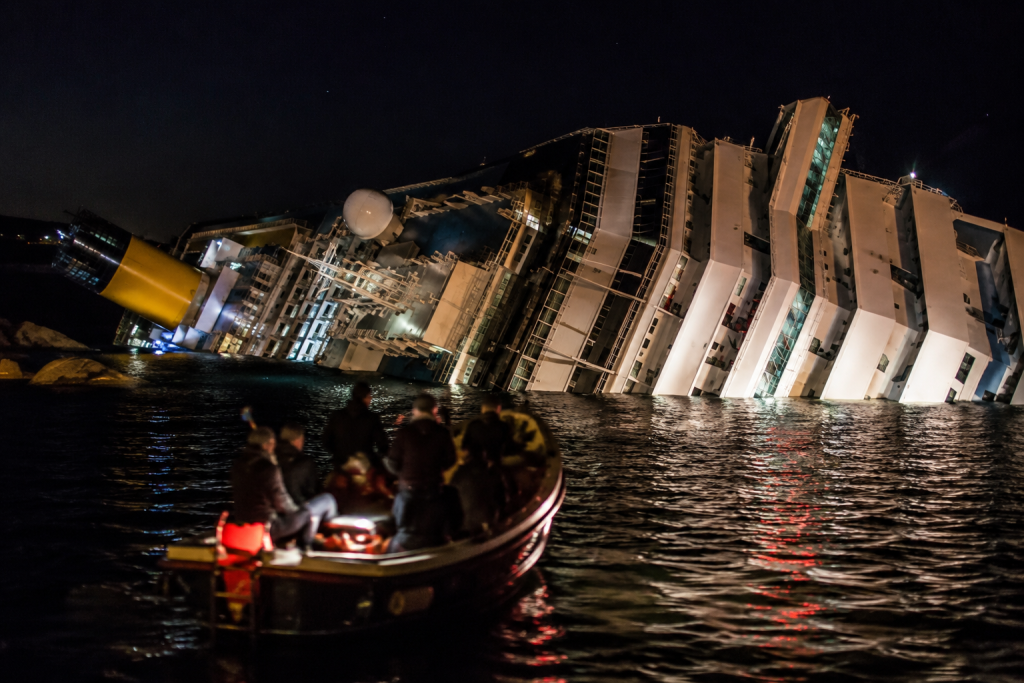
By the time the order to abandon ship was finally issued, Costa Concordia had developed a severe list, making it increasingly difficult—and in some cases impossible—to launch all of the lifeboats safely.
Panic Replaces Routine
What had been an ordinary evening quickly turned into confusion.
Hallways that had seemed perfectly level only minutes earlier became steep inclines. Furniture slid across floors. Staircases became difficult to climb. Families searching for one another struggled through crowded corridors while crew members attempted to guide thousands of frightened passengers toward emergency stations.
Many survivors later recalled that uncertainty proved just as frightening as the collision itself.
People did not know how serious the situation was.
They did not know whether to stay where they were or move.
Most importantly, they had not expected that a modern cruise ship could fail so quickly.
The Phone Call Heard Around the World
As rescue operations continued, Italian authorities made a discovery that would shape public opinion for years to come.
Captain Francesco Schettino was no longer aboard the ship.
A recorded conversation between Schettino and Coast Guard officer Gregorio De Falco soon became international news. During the exchange, De Falco repeatedly instructed the captain to return to the vessel and coordinate rescue efforts for passengers who remained trapped.
One sentence echoed around the world.
“Get back on board.”
The recording transformed the disaster from a maritime accident into a global debate about leadership, responsibility, and accountability under extreme pressure.
Schettino later insisted that he had not intentionally abandoned the vessel, claiming circumstances forced him off the ship. Italian courts ultimately rejected that explanation.
A Tragedy That Could Have Been Far Worse
When daylight arrived, images of Costa Concordia lying on its side just off the coast of Giglio shocked audiences worldwide.
Thirty-two people lost their lives.
More than 150 others were injured.
Despite the scale of the disaster, many maritime experts believe the final death toll could have been significantly higher. After the collision, the damaged vessel drifted toward shallow water before coming to rest against the rocky shoreline. Had it sunk in deep water instead, rescuing thousands of passengers during the night would have been vastly more difficult.
An Engineering Project Unlike Any Before
Removing the wreck presented another extraordinary challenge.
The ship contained thousands of tons of fuel and hazardous materials, making environmental protection a top priority.
Rather than dismantling the vessel where it rested, engineers designed one of the most ambitious salvage operations ever attempted.
Using an enormous system of underwater platforms, hydraulic equipment, steel cables, and giant flotation structures, specialists gradually rotated the ship back into an upright position through a technique known as parbuckling. The operation attracted worldwide attention and became one of the largest marine engineering projects in history.
Afterward, Costa Concordia was towed to the Italian port of Genoa, where it was dismantled and recycled over several years.
Justice and Lasting Consequences
Italian investigators concluded that the disaster resulted primarily from human error rather than mechanical failure.
Captain Francesco Schettino was convicted of multiple offenses, including manslaughter, causing the shipwreck, and abandoning passengers before the evacuation had been completed. His 16-year prison sentence became final in 2015.
The disaster also prompted sweeping changes throughout the cruise industry.
Mandatory emergency drills are now conducted much earlier during voyages. Communication procedures between bridge officers and passengers have been strengthened, and closer scrutiny has been placed on navigational decisions that bring large passenger ships unnecessarily close to shore.
A Legacy That Still Resonates
More than a decade later, Costa Concordia remains one of the defining maritime disasters of the 21st century.
It demonstrated that even the most technologically advanced ships depend on sound judgment, disciplined decision-making, and effective leadership. Sophisticated engineering can reduce risks, but it cannot eliminate the consequences of human error.
For millions who watched the events unfold, the tragedy became more than the story of a shipwreck. It became a reminder that, in moments of crisis, leadership is measured not by the decisions made when everything is going well, but by the choices made when everything begins to fall apart.