
Commercial aviation has earned its reputation as one of the safest forms of transportation ever developed. Every day, millions of passengers travel through the skies without giving much thought to the engineering that keeps an aircraft flying safely at cruising altitude. Behind every routine flight lies a carefully designed system built to withstand extreme temperatures, enormous pressure differences, and tremendous aerodynamic forces.
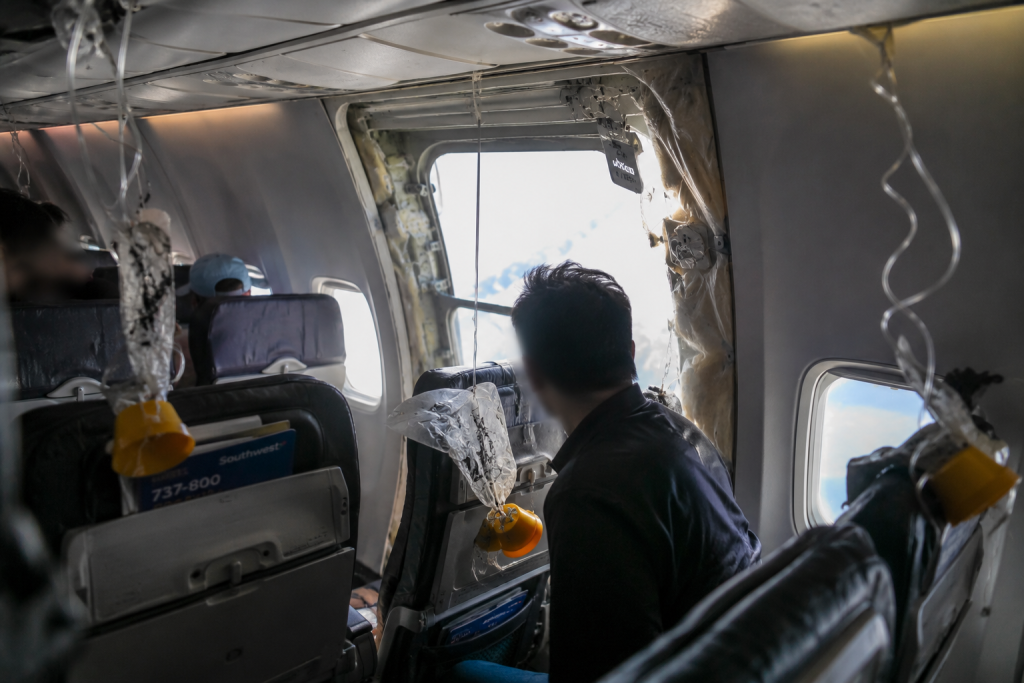
That is why the events aboard a Ryanair flight on July 10, 2026, attracted worldwide attention. What began as an ordinary journey from Thessaloniki, Greece, to Memmingen, Germany, turned into one of the most unusual aviation emergencies in recent years after a cabin window was damaged during flight. Within seconds, the aircraft experienced rapid depressurization, and a passenger seated beside the affected window was partially pulled outside the aircraft before fellow passengers and his seatbelt helped prevent an even greater tragedy.
Although the images and eyewitness accounts were dramatic, the incident also demonstrated why modern aviation safety procedures exist—and how multiple layers of protection can make the difference between disaster and survival.
An ordinary departure turned into an emergency
Passengers had barely settled into their seats after takeoff when the situation changed dramatically.
As the aircraft climbed away from Thessaloniki, a loud bang echoed through the cabin. Almost instantly, the cabin lost pressure, oxygen masks deployed automatically, and air rushed toward the damaged section of the fuselage with tremendous force.
People described the noise as overwhelming. Loose objects were blown through the cabin, conversations became impossible, and many passengers struggled to understand what had happened during the first few moments of the emergency.
For everyone on board, the flight had transformed from a routine trip into a life-threatening situation in a matter of seconds.
The passenger sitting beside the window faced the greatest danger
The person most directly exposed to the decompression was a 61-year-old Serbian passenger seated next to the damaged window.
According to eyewitness reports, the sudden pressure difference pulled his upper body toward the opening. His head, neck, and shoulders were forced outside the aircraft while the rest of his body remained restrained by his seatbelt.
Nearby passengers, including his wife, immediately reacted by holding onto him until the situation stabilized. Their quick response, combined with the restraint provided by the seatbelt, is widely believed to have played a crucial role in preventing a fatal outcome.
After the aircraft landed safely, the passenger was taken to a hospital with injuries to his neck and shoulders, along with trauma caused by exposure to the powerful airflow outside the aircraft. Fortunately, he survived.
Why the crew responded immediately
Rapid cabin depressurization is one of the emergency scenarios airline crews train for repeatedly throughout their careers.
When cabin pressure drops unexpectedly, aircraft systems automatically release oxygen masks for passengers. These masks are not designed to supply oxygen for the remainder of the flight. Instead, they provide enough oxygen—typically for around 12 to 20 minutes—to allow pilots to descend quickly to a lower altitude where the outside air becomes breathable.
The flight crew followed those procedures without delay. An emergency was declared, the aircraft began a controlled descent, and the pilots returned to Thessaloniki, where emergency services were already waiting.
The aircraft landed safely, allowing passengers to disembark without further injuries.
Why wasn’t everyone pulled toward the opening?
Movies often portray cabin decompression as an event in which every passenger is instantly sucked out of the aircraft. Real-world physics tells a different story.
When a cabin loses pressure, air rushes toward the area where the pressure is lower. The strongest forces are concentrated near the damaged section of the fuselage. Passengers seated farther away experience far less direct airflow, and as cabin pressure equalizes, the intensity of that airflow decreases rapidly.
Because the injured passenger was seated immediately beside the damaged window, he was uniquely exposed to the force created by the decompression.
A simple seatbelt may have saved a life
Many travelers loosen or remove their seatbelts shortly after the “fasten seatbelt” sign is switched off, assuming the greatest risks have already passed.
Safety experts continue to recommend keeping seatbelts fastened whenever passengers are seated, even during smooth flights. While unexpected turbulence is the most common reason, rare emergencies like rapid decompression provide another powerful reminder of why that advice matters.
In this case, the seatbelt likely prevented the passenger from being completely pulled through the damaged window, buying precious seconds for those around him to react.
What caused the window to fail?
Investigators are still working to determine the exact sequence of events.
Some early media reports suggested that debris originating from the engine area may have struck the cabin window, but that explanation has not been officially confirmed.
Ryanair acknowledged that the aircraft returned to Thessaloniki after a cabin window was damaged during flight, while aviation authorities opened a formal investigation to determine the precise cause.
Until the investigation is completed, any explanation regarding the origin of the damage remains preliminary.
Aircraft windows are built to withstand extreme conditions
Although passengers often think of them as ordinary windows, aircraft cabin windows are sophisticated structural components engineered to perform under extraordinary conditions.
They consist of multiple layers of high-strength acrylic materials, each serving a specific purpose. Together, these layers are designed to tolerate large pressure differences, freezing temperatures at high altitude, ultraviolet radiation, repeated pressurization cycles, and impacts from small airborne debris.
Before entering service, these windows undergo rigorous certification testing that exceeds the stresses encountered during normal airline operations.
For that reason, structural failures involving passenger windows are exceptionally rare in modern commercial aviation.
Similar accidents have shaped aviation safety
Incidents involving cabin depressurization are uncommon, but they have significantly influenced aviation safety standards over the years.
One of the best-known examples occurred in 1990 aboard British Airways Flight 5390, when the cockpit windscreen detached shortly after takeoff. The captain was partially pulled outside the aircraft, while crew members held onto him until the aircraft landed safely. The investigation ultimately led to important changes in maintenance and inspection procedures.
Another widely known case happened in 2018 on Southwest Airlines Flight 1380, when an engine failure sent debris through a passenger window. A woman seated beside the damaged window was partially pulled outside the aircraft and later died from her injuries despite efforts to save her.
Every major aviation accident is thoroughly analyzed, and the lessons learned frequently lead to design improvements, maintenance updates, or revised operating procedures intended to reduce future risks.
A rare reminder of why aviation remains so safe
The Ryanair incident was undoubtedly frightening for everyone on board, yet it also highlighted the remarkable resilience of modern commercial aviation.
The aircraft remained controllable. Emergency systems activated exactly as designed. The pilots followed established procedures, emergency responders were prepared upon landing, and a passenger survived an event that only a handful of people have ever experienced.
The ongoing investigation will determine exactly why the window failed. Regardless of its conclusions, the incident serves as a reminder that aviation safety is built upon thousands of engineering decisions, strict maintenance standards, and highly trained professionals prepared to respond when the unexpected happens.
For most passengers, fastening a seatbelt is little more than a routine habit. For one man aboard that July 2026 flight, it may well have been the single most important decision that allowed him to walk away from one of the rarest emergencies in commercial aviation.