
The candles are lit, everyone gathers around to sing, and phones are already recording the big moment. Just as the birthday celebrant leans in to blow out the candles, someone suddenly shoves their face straight into the cake. The room erupts in laughter, and within minutes the video is uploaded to TikTok, Instagram, or Facebook.
For many people, it’s simply a funny birthday prank. What most don’t realize, however, is that elaborate celebration cakes often contain hidden structural supports that can turn a split-second joke into a painful accident.
While serious injuries are uncommon, bakers and medical professionals alike have warned that this viral tradition carries risks that many party guests never consider.
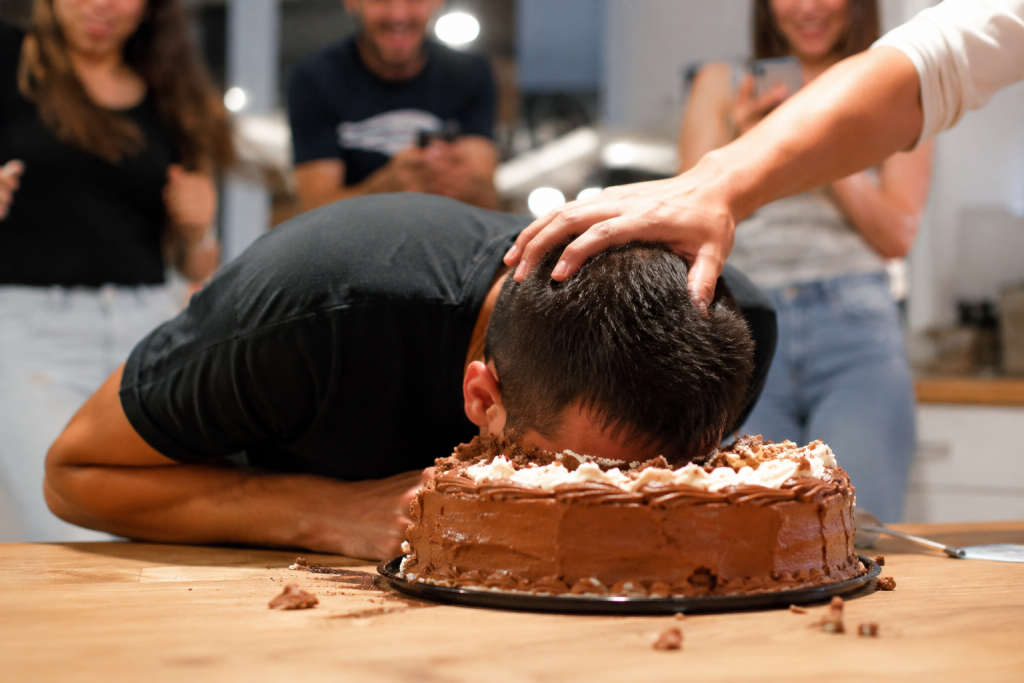
A Viral Trend That Spread Far Beyond Its Origins
Although social media has made the prank famous worldwide, the tradition itself existed long before TikTok. Variations of pushing the birthday person into the cake have been part of celebrations in parts of Latin America for decades before becoming a global internet trend.
Today, countless videos show the same sequence: laughter, surprise, frosting everywhere, and thousands—sometimes millions—of views. Because most clips end with everyone smiling, it’s easy to assume the prank is completely harmless.
The reality is more complicated.
Celebration Cakes Are Often Carefully Engineered
Modern custom cakes are far more than layers of sponge and frosting.
Wedding cakes, milestone birthday cakes, and other multi-tiered creations are designed to support significant weight. Some large cakes can weigh dozens of pounds, and without internal reinforcement, the lower layers would collapse under the pressure.
Professional cake decorators therefore build internal support systems that keep every tier stable during transportation and display. These supports are a normal part of cake construction and are used by bakeries around the world.
What You Can’t See Inside the Cake
Many multi-tier cakes contain vertical support rods—commonly called dowels—made from food-safe wood, plastic, or other approved materials.
Their purpose is simple: distribute weight evenly so each tier can safely support the ones above it.
Larger cakes may also include a central support rod running through several layers to prevent the structure from shifting while being transported.
These components are completely hidden beneath the icing. Guests usually have no idea they’re there because they’re only removed as the cake is sliced and served.
From the outside, two cakes may appear nearly identical, yet one could contain several internal supports while the other has none.
Why the Prank Can Become Dangerous
The problem isn’t the cake itself—it’s the sudden impact.
When someone is unexpectedly pushed forward, they have little or no time to protect their face. If the cake contains hidden supports, those rigid components could contribute to injuries depending on the direction and force of the impact.
Even when a cake has no internal rods, other hazards remain. A person may strike the edge of the table, a cake stand, nearby decorations, or lose their balance entirely.
What begins as a joke can quickly become something nobody intended.
Real Injuries Have Been Reported
Although most cake-smashing pranks end with laughter, there have been documented cases of people suffering facial injuries, damaged teeth, cuts to the lips, and eye-area trauma after being shoved into cakes.
In some incidents, hidden support structures played a role. In others, the injuries resulted from hitting tables, decorative stands, or surrounding objects during the fall.
These accidents are relatively rare compared with the number of birthday parties held every year, but they demonstrate that the risk is genuine rather than purely hypothetical.
Children Deserve Extra Protection
The trend has also appeared at children’s birthday parties, where the risks deserve even greater attention.
Young children cannot anticipate a sudden shove, have slower protective reflexes, and are more likely to lose their balance. Beyond the possibility of physical injury, the experience itself can be frightening and overwhelming.
Many child safety experts recommend avoiding these types of pranks altogether, especially during celebrations that are meant to create happy memories.
Not Every Cake Contains Internal Supports
It’s important to keep the discussion in perspective.
A small, single-layer birthday cake may not contain any internal reinforcement at all.
However, taller cakes, stacked designs, wedding cakes, and elaborate custom creations frequently rely on support rods to remain stable. Since guests rarely know how a cake has been constructed, there’s no reliable way to tell simply by looking.
That’s one reason why many professionals discourage turning a decorated cake into the centerpiece of a physical prank.
Is a Viral Moment Worth the Risk?
Social media rewards surprise. The more unexpected the reaction, the more likely a video is to be shared.
What viewers rarely see are the moments after the recording stops: a visit to the emergency room, a broken tooth, stitches, or an injured child whose birthday ended very differently than planned.
Most cake-smashing pranks don’t lead to serious injuries. But when a few seconds of entertainment carries a risk that can be avoided entirely, it’s worth asking whether the tradition is really worth continuing.
Final Thoughts
Beautiful celebration cakes are designed to be admired, shared, and enjoyed—not to absorb the force of someone’s face being pushed into them.
The hidden support structures inside many custom cakes are essential for keeping them stable, but they also serve as a reminder that appearances can be deceiving.
Before recreating the next viral birthday prank, it may be worth remembering that the funniest moments are the ones everyone walks away from safely. Sometimes, choosing not to push someone into the cake is the best way to ensure the celebration remains exactly what it was meant to be: a happy memory.